



Question: Question 2 (24 marks) Asset A offers an expected rate of return of 10% with a standard deviation of 25%. Asset B offers an expected
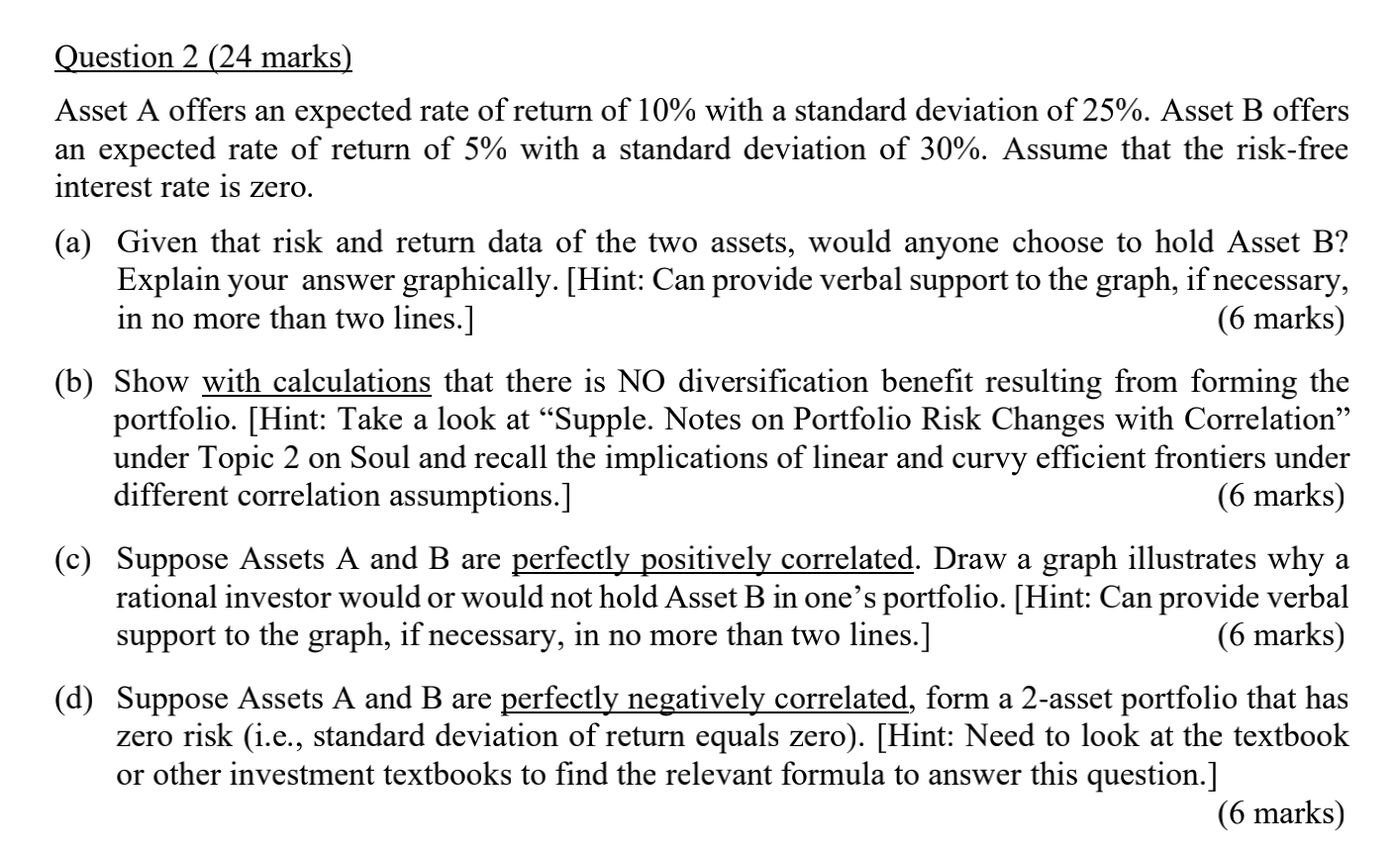
Question 2 (24 marks) Asset A offers an expected rate of return of 10% with a standard deviation of 25%. Asset B offers an expected rate of return of 5% with a standard deviation of 30%. Assume that the risk-free interest rate is zero. (a) Given that risk and return data of the two assets, would anyone choose to hold Asset B? Explain your answer graphically. [Hint: Can provide verbal support to the graph, if necessary, in no more than two lines.] (6 marks) (b) Show with calculations that there is NO diversification benefit resulting from forming the portfolio. [Hint: Take a look at Supple. Notes on Portfolio Risk Changes with Correlation under Topic 2 on Soul and recall the implications of linear and curvy efficient frontiers under different correlation assumptions.] (6 marks) (c) Suppose Assets A and B are perfectly positively correlated. Draw a graph illustrates why a rational investor would or would not hold Asset B in one's portfolio. [Hint: Can provide verbal support to the graph, if necessary, in no more than two lines.] (6 marks) (d) Suppose Assets A and B are perfectly negatively correlated, form a 2-asset portfolio that has zero risk (i.e., standard deviation of return equals zero). [Hint: Need to look at the textbook or other investment textbooks to find the relevant formula to answer this question.] (6 marks) Question 2 (24 marks) Asset A offers an expected rate of return of 10% with a standard deviation of 25%. Asset B offers an expected rate of return of 5% with a standard deviation of 30%. Assume that the risk-free interest rate is zero. (a) Given that risk and return data of the two assets, would anyone choose to hold Asset B? Explain your answer graphically. [Hint: Can provide verbal support to the graph, if necessary, in no more than two lines.] (6 marks) (b) Show with calculations that there is NO diversification benefit resulting from forming the portfolio. [Hint: Take a look at Supple. Notes on Portfolio Risk Changes with Correlation under Topic 2 on Soul and recall the implications of linear and curvy efficient frontiers under different correlation assumptions.] (6 marks) (c) Suppose Assets A and B are perfectly positively correlated. Draw a graph illustrates why a rational investor would or would not hold Asset B in one's portfolio. [Hint: Can provide verbal support to the graph, if necessary, in no more than two lines.] (6 marks) (d) Suppose Assets A and B are perfectly negatively correlated, form a 2-asset portfolio that has zero risk (i.e., standard deviation of return equals zero). [Hint: Need to look at the textbook or other investment textbooks to find the relevant formula to answer this question.] (6 marks)
Step by Step Solution
There are 3 Steps involved in it

Get step-by-step solutions from verified subject matter experts