







Question: Question 2 (25 points): An Industrial and Systems Engineering student has developed an algorithm to solve a mixed integer nonlinear optimization problem. The algorithm reduced
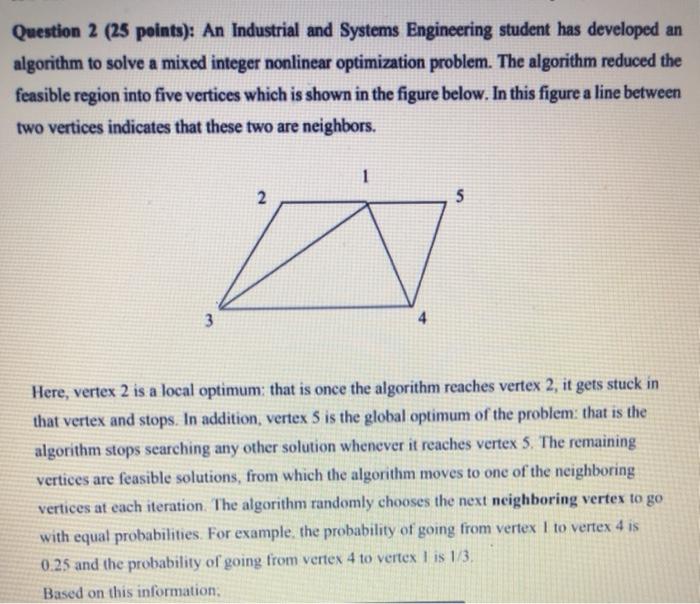
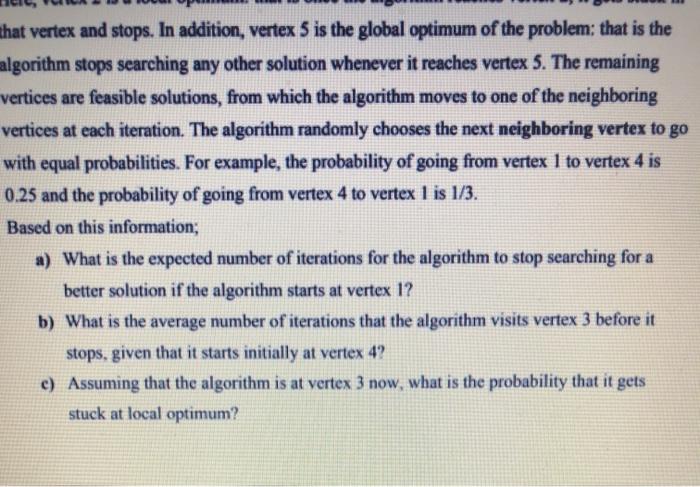
Question 2 (25 points): An Industrial and Systems Engineering student has developed an algorithm to solve a mixed integer nonlinear optimization problem. The algorithm reduced the feasible region into five vertices which is shown in the figure below. In this figure a line between two vertices indicates that these two are neighbors. 1 2 5 / 3 4 Here, vertex 2 is a local optimum: that is once the algorithm reaches vertex 2, it gets stuck in that vertex and stops. In addition, vertex 5 is the global optimum of the problem: that is the algorithm stops searching any other solution whenever it reaches vertex 5. The remaining vertices are feasible solutions, from which the algorithm moves to one of the neighboring vertices at each iteration. The algorithm randomly chooses the next neighboring vertex to go with equal probabilities. For example, the probability of going from vertex I to vertex 4 is 0.25 and the probability of going from vertex 4 to vertex I is 1/3 Based on this information, that vertex and stops. In addition, vertex 5 is the global optimum of the problem that is the algorithm stops searching any other solution whenever it reaches vertex 5. The remaining vertices are feasible solutions, from which the algorithm moves to one of the neighboring vertices at each iteration. The algorithm randomly chooses the next neighboring vertex to go with equal probabilities. For example, the probability of going from vertex 1 to vertex 4 is 0.25 and the probability of going from vertex 4 to vertex 1 is 1/3. Based on this information; a) What is the expected number of iterations for the algorithm to stop searching for a better solution if the algorithm starts at vertex 1? b) What is the average number of iterations that the algorithm visits vertex 3 before it stops, given that it starts initially at vertex 4? e) Assuming that the algorithm is at vertex 3 now, what is the probability that it gets stuck at local optimum? Question 2 (25 points): An Industrial and Systems Engineering student has developed an algorithm to solve a mixed integer nonlinear optimization problem. The algorithm reduced the feasible region into five vertices which is shown in the figure below. In this figure a line between two vertices indicates that these two are neighbors. 1 2 5 / 3 4 Here, vertex 2 is a local optimum: that is once the algorithm reaches vertex 2, it gets stuck in that vertex and stops. In addition, vertex 5 is the global optimum of the problem: that is the algorithm stops searching any other solution whenever it reaches vertex 5. The remaining vertices are feasible solutions, from which the algorithm moves to one of the neighboring vertices at each iteration. The algorithm randomly chooses the next neighboring vertex to go with equal probabilities. For example, the probability of going from vertex I to vertex 4 is 0.25 and the probability of going from vertex 4 to vertex I is 1/3 Based on this information, that vertex and stops. In addition, vertex 5 is the global optimum of the problem that is the algorithm stops searching any other solution whenever it reaches vertex 5. The remaining vertices are feasible solutions, from which the algorithm moves to one of the neighboring vertices at each iteration. The algorithm randomly chooses the next neighboring vertex to go with equal probabilities. For example, the probability of going from vertex 1 to vertex 4 is 0.25 and the probability of going from vertex 4 to vertex 1 is 1/3. Based on this information; a) What is the expected number of iterations for the algorithm to stop searching for a better solution if the algorithm starts at vertex 1? b) What is the average number of iterations that the algorithm visits vertex 3 before it stops, given that it starts initially at vertex 4? e) Assuming that the algorithm is at vertex 3 now, what is the probability that it gets stuck at local optimum
Step by Step Solution
There are 3 Steps involved in it

Get step-by-step solutions from verified subject matter experts
 Study Help