







Question: Question 2 . . . . . . . . . . . . . . . . . . . . . . .
Question marks
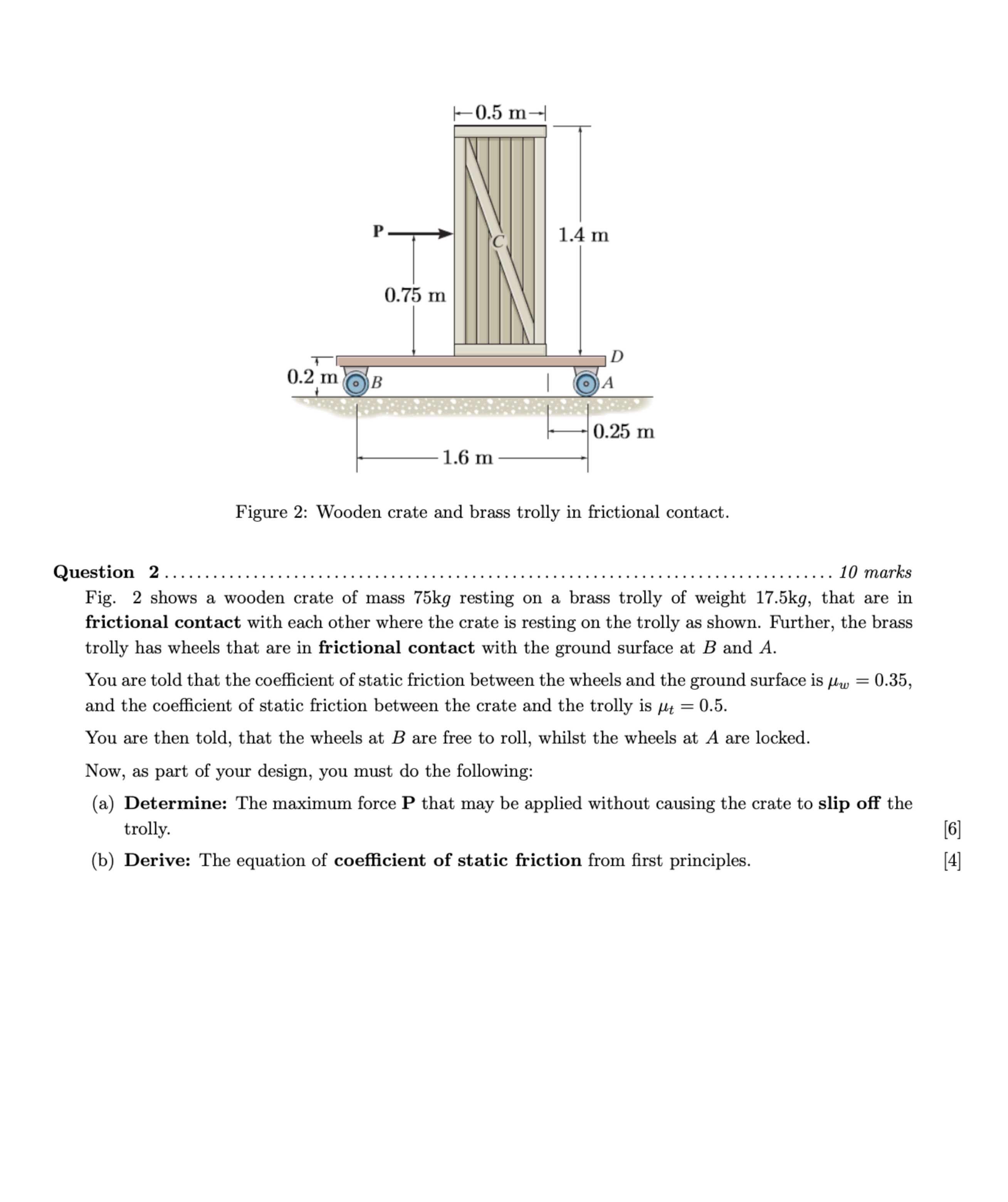
Fig. shows a wooden crate of mass mathrmk g resting on a brass trolly of weight mathrmk g that are in frictional contact with each other where the crate is resting on the trolly as shown. Further, the brass trolly has wheels that are in frictional contact with the ground surface at B and A
You are told that the coefficient of static friction between the wheels and the ground surface is muw and the coefficient of static friction between the crate and the trolly is mut
You are then told, that the wheels at B are free to roll, whilst the wheels at A are locked.
Now, as part of your design, you must do the following:
a Determine: The maximum force mathbfP that may be applied without causing the crate to slip off the trolly.
b Derive: The equation of coefficient of static friction from first principles.
Step by Step Solution
There are 3 Steps involved in it
1 Expert Approved Answer
Step: 1 Unlock

Question Has Been Solved by an Expert!
Get step-by-step solutions from verified subject matter experts
Step: 2 Unlock
Step: 3 Unlock
 Study Help