



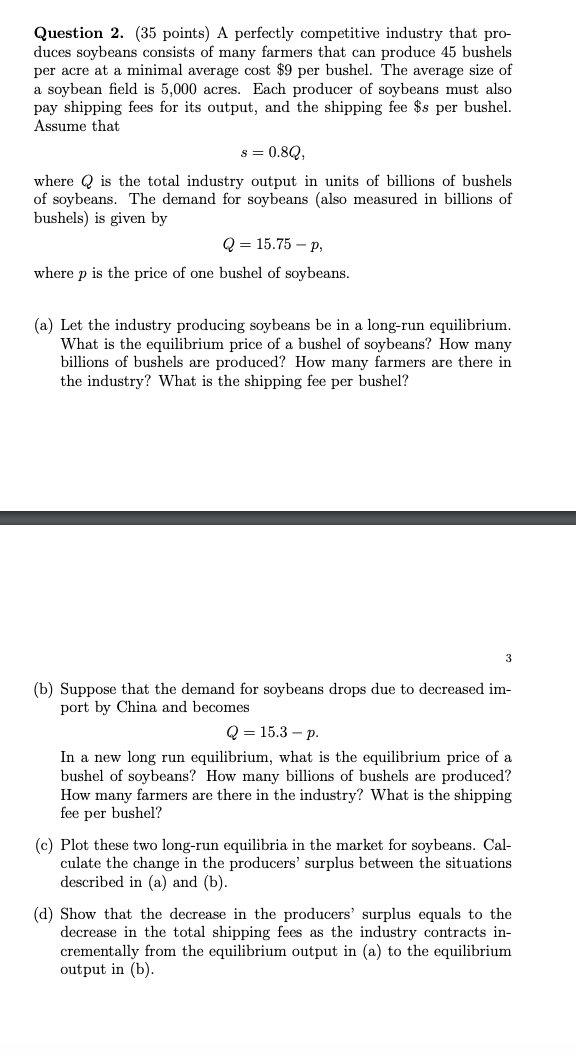
Question: Question 2 . ( 3 5 points ) A perfectly competitive industry that produces soybeans consists of many farmers that can produce 4 5 bushels
Question points A perfectly competitive industry that produces soybeans consists of many farmers that can produce bushels per acre at a minimal average cost $ per bushel. The average size of a soybean field is acres. Each producer of soybeans must also pay shipping fees for its output, and the shipping fee $ s per bushel. Assume that
s Q
where Q is the total industry output in units of billions of bushels of soybeans. The demand for soybeans also measured in billions of bushels is given by
Qp
where p is the price of one bushel of soybeans.
a Let the industry producing soybeans be in a longrun equilibrium. What is the equilibrium price of a bushel of soybeans? How many billions of bushels are produced? How many farmers are there in the industry? What is the shipping fee per bushel?
b Suppose that the demand for soybeans drops due to decreased import by China and becomes
Qp
In a new long run equilibrium, what is the equilibrium price of a bushel of soybeans? How many billions of bushels are produced? How many farmers are there in the industry? What is the shipping fee per bushel?
c Plot these two longrun equilibria in the market for soybeans. Calculate the change in the producers' surplus between the situations described in a and b
d Show that the decrease in the producers' surplus equals to the decrease in the total shipping fees as the industry contracts incrementally from the equilibrium output in a to the equilibrium output in b
Step by Step Solution
There are 3 Steps involved in it
1 Expert Approved Answer
Step: 1 Unlock

Question Has Been Solved by an Expert!
Get step-by-step solutions from verified subject matter experts
Step: 2 Unlock
Step: 3 Unlock