







Question: Question 2 & 3 . public boolean HasChildren (T Value): Indicates if the node/Object Value has children in the tree. You should verify that the
Question 2 & 3
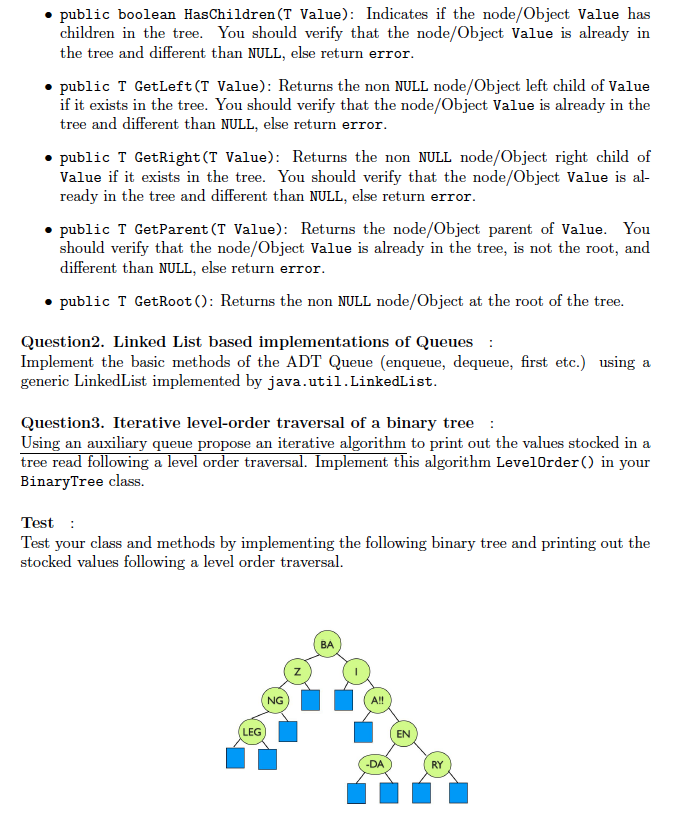
. public boolean HasChildren (T Value): Indicates if the node/Object Value has children in the tree. You should verify that the node/Object Value is already in the tree and different than NULL, else return error public T GetLeft (T Value): Returns the non NULL node/Object left child of Value if it exists in the tree. You should verify that the node/Object Value is already in the tree and different than NULL, else return error public T GetRight (T Value): Returns the non NULL node/Object right child of Value if it exists in the tree. You should verify that the node/Object Value is al- ready in the tree and different than NULL, else return error public T GetParent (T Value): Returns the node/Object parent of Value. You should verify that the node/Object Value is already in the tree, is not the root, and different than NULL, else return error . public T GetRoot (): Returns the non NULL node/Object at the root of the tree Question2. Linked List based implementations of Queues: generic LinkedList implemented by java.util.LinkedList Question3. Iterative level-order traversal of a binary tree: Implement the basic methods of the ADT Queue (enqueue, dequeue, first etc.) using a Using an auxiliary queue propose an iterative algorithm to print out the values stocked in a tree read following a level order traversal. Implement this algorithm Leve1Order ) in your BinaryTree class. Test : stocked values following a level order traversal. Test your class and methods by implementing the following binary tree and printing out the BA NG LEG EN -DA RY
Step by Step Solution
There are 3 Steps involved in it

Get step-by-step solutions from verified subject matter experts
 Study Help