







Question: Question 2 : ( 5 0 pts ) Consider the Vertex Coloring Problem in which we assign different colors to the adjacent vertices on a
Question : pts Consider the Vertex Coloring Problem in which we assign different colors to the adjacent vertices on a given graph The objective is to color the vertices of the graph using minimum number of colors.
Input: A graph where is the set of vertices and is the set of edges of the graph
Output: Color assignments of the vertices using minimum number of colors.
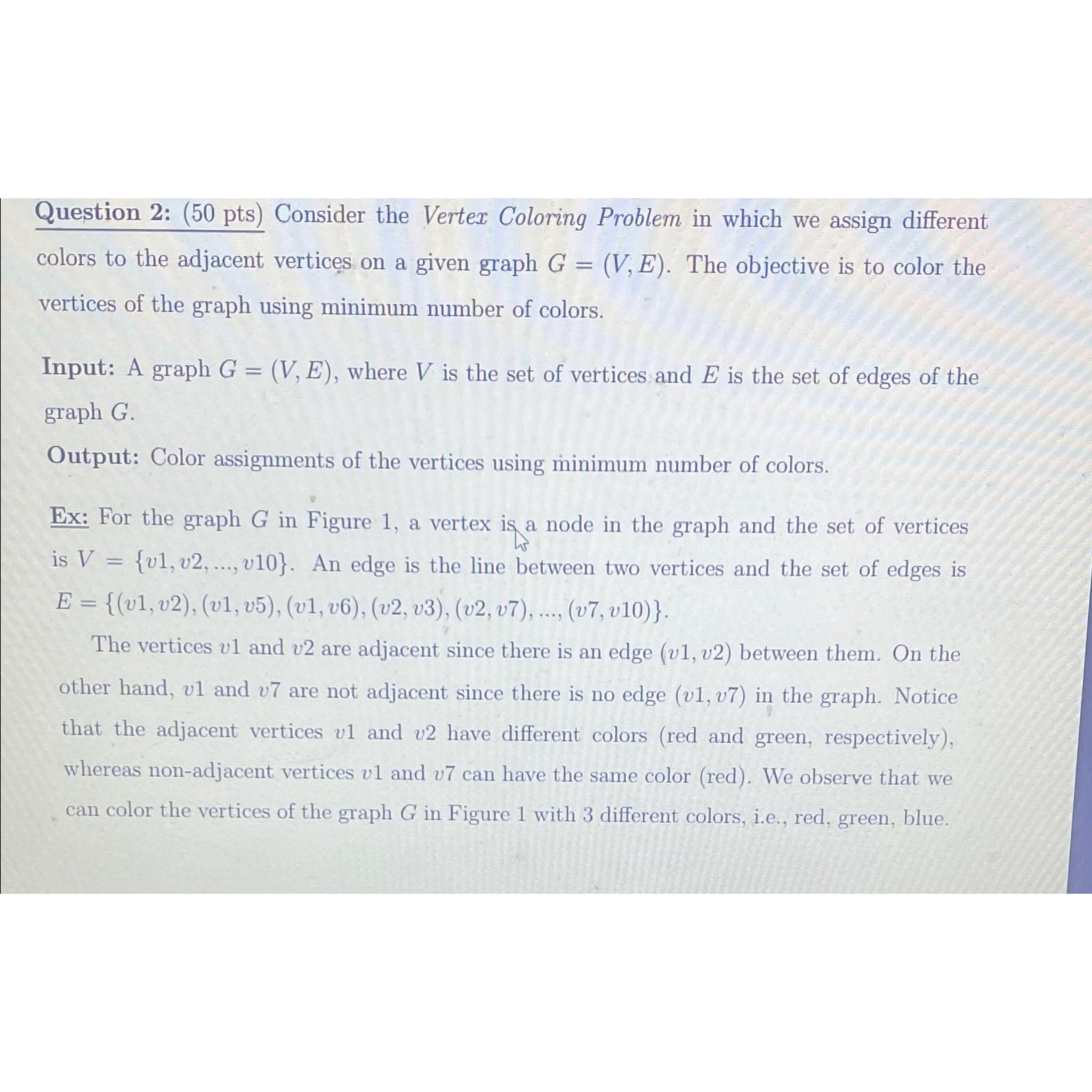
Ex: For the graph in Figure a vertex is a node in the graph and the set of vertices is dots, An edge is the line between two vertices and the set of edges is dots,
The vertices and are adjacent since there is an edge between them. On the other hand, and are not adjacent since there is no edge in the graph. Notice that the adjacent vertices and have different colors red and green, respectively whereas nonadjacent vertices and can have the same color red We observe that we can color the vertices of the graph in Figure with different colors, ie red, green, blue.
Step by Step Solution
There are 3 Steps involved in it
1 Expert Approved Answer
Step: 1 Unlock

Question Has Been Solved by an Expert!
Get step-by-step solutions from verified subject matter experts
Step: 2 Unlock
Step: 3 Unlock
 Study Help