







Question: Question 2 (5 points): Let's define a super number n to be a positive integer (strictly greater than zero) such that either n = 7
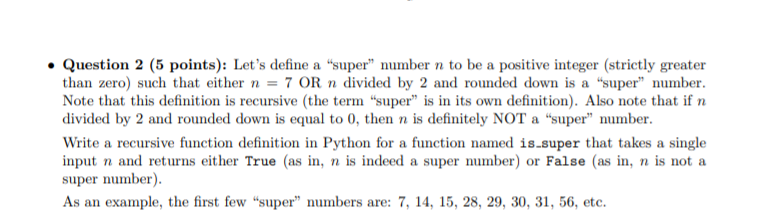
Question 2 (5 points): Let's define a "super" number n to be a positive integer (strictly greater than zero) such that either n = 7 OR n divided by 2 and rounded down is a "super" number. Note that this definition is recursive (the term "super" is in its own definition). Also note that if n divided by 2 and rounded down is equal to 0, then n is definitely NOT a "super" number. Write a recursive function definition in Python for a function named is super that takes a single input n and returns either True (as in, n is indeed a super number) or False (as in, n is not a super number). As an example, the first few "super" numbers are: 7, 14, 15, 28, 29, 30, 31, 56, etc
Step by Step Solution
There are 3 Steps involved in it

Get step-by-step solutions from verified subject matter experts
 Study Help