







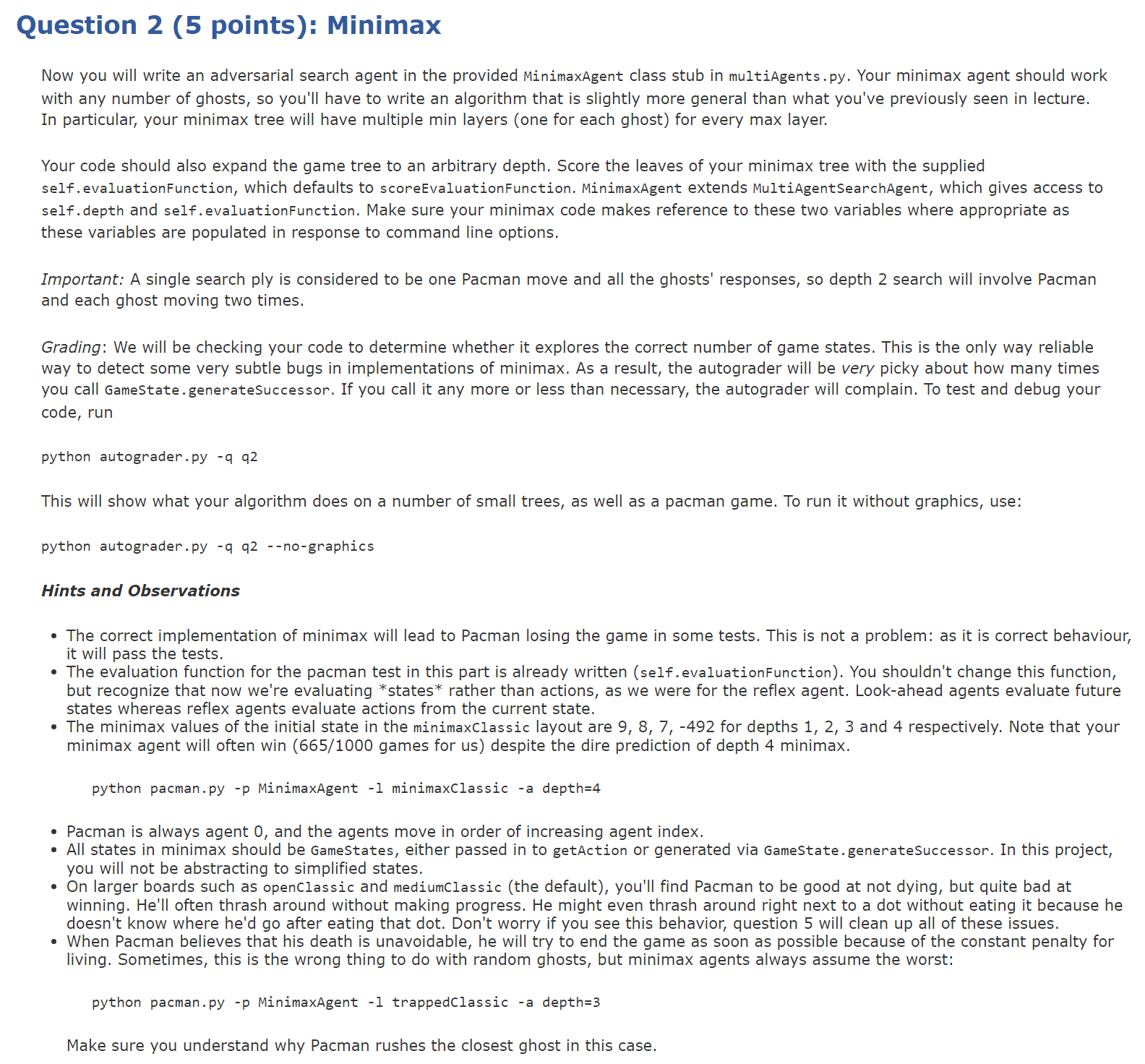
Question: Question 2 ( 5 points ) : Minimax Now you will write an adversarial search agent in the provided MinimaxAgent class stub in multiAgents.py .
Question points: Minimax
Now you will write an adversarial search agent in the provided MinimaxAgent class stub in multiAgents.py Your minimax agent should work with any number of ghosts, so you'll have to write an algorithm that is slightly more general than what you've previously seen in lecture. In particular, your minimax tree will have multiple min layers one for each ghost for every max layer.
Your code should also expand the game tree to an arbitrary depth. Score the leaves of your minimax tree with the supplied self.evaluationFunction, which defaults to scoreEvaluationFunction. MinimaxAgent extends MultiAgentSearchAgent, which gives access to self.depth and self.evaluationFunction. Make sure your minimax code makes reference to these two variables where appropriate as these variables are populated in response to command line options.
Important: A single search ply is considered to be one Pacman move and all the ghosts' responses, so depth search will involve Pacman and each ghost moving two times.
Grading: We will be checking your code to determine whether it explores the correct number of game states. This is the only way reliable way to detect some very subtle bugs in implementations of minimax. As a result, the autograder will be very picky about how many times you call GameState.generateSuccessor. If you call it any more or less than necessary, the autograder will complain. To test and debug your code, run
python autograder.py q q
This will show what your algorithm does on a number of small trees, as well as a pacman game. To run it without graphics, use:
python autograder.py q qnographics
Hints and Observations
The correct implementation of minimax will lead to Pacman losing the game in some tests. This is not a problem: as it is correct behaviour, it will pass the tests.
The evaluation function for the pacman test in this part is already written selfevaluationfunction You shouldn't change this function, but recognize that now we're evaluating states rather than actions, as we were for the reflex agent. Lookahead agents evaluate future states whereas reflex agents evaluate actions from the current state.
The minimax values of the initial state in the minimaxClassic layout are for depths and respectively. Note that your minimax agent will often win games for us despite the dire prediction of depth minimax.
python pacman.py p MinimaxAgent minimaxClassic a depth
Pacman is always agent and the agents move in order of increasing agent index.
All states in minimax should be GameStates, either passed in to getAction or generated via GameState.generateSuccessor. In this project, you will not be abstracting to simplified states.
On larger boards such as openClassic and mediumClassic the default you'll find Pacman to be good at not dying, but quite bad at winning. He'll often thrash around without making progress. He might even thrash around right next to a dot without eating it because he doesn't know where he'd go after eating that dot. Don't worry if you see this behavior, question will clean up all of these issues.
When Pacman believes that his death is unavoidable, he will try to end the game as soon as possible because of the constant penalty for living. Sometimes, this is the wrong thing to do with random ghosts, but minimax agents always assume the worst:
python pacman.py p MinimaxAgent trappedClassic a depth
Make sure you understand why Pacman rushes the closest ghost in this case.
Step by Step Solution
There are 3 Steps involved in it
1 Expert Approved Answer
Step: 1 Unlock

Question Has Been Solved by an Expert!
Get step-by-step solutions from verified subject matter experts
Step: 2 Unlock
Step: 3 Unlock
 Study Help