







Question: Question 2. (5 points): This question is based on Heckscher-Ohlin (HO) Model Suppose two countries, Grainland and Carsland, use only capital and labor to produce
Question 2. (5 points): This question is based on Heckscher-Ohlin (HO) Model
Suppose two countries, Grainland and Carsland, use only capital and labor to produce two goods, Grain (G) and Cars (C). Grainland has 2,050 units of capital and 916 units of labor, and Carland has 816 units of capital and 270 units of labor. In Carsland, there are 366 units of capital and 135 units of labor employed in the Grain industry. In Grainland, there are 926 units of capital and 618 units of labor employed in the Grain industry.
A. Which country is labor-abundant? Which country is capital-abundant? In Carsland which industry is labor-intensive and why?
B. Suppose that Grainland and Carsland do not engage in international trade. Assuming the countries have identical preferences, which country would have the cheaper relative price of Grain?
C. Now suppose the two countries trade with one another. What will happen to the relative price of Grain in Grainland? What is the effect of free trade on labor and capital owners in Grainland?
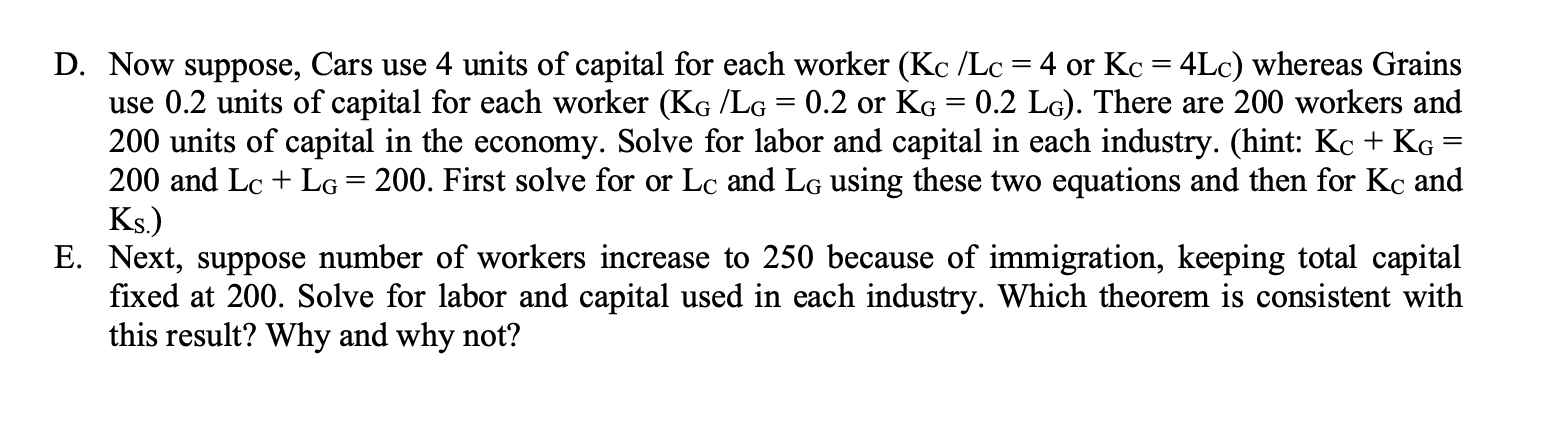
D. Now suppose, Cars use 4 units of capital for each worker (Kc /Lc = 4 or Kc = 4Lc) whereas Grains E. use 0.2 units of capital for each worker (KG /LG = 0.2 or KG = 0.2 La). There are 200 workers and 200 units of capital in the economy. Solve for labor and capital in each industry. (hint: Kc + KG = 200 and LC + LG = 200. First solve for or La and LG using these two equations and then for Kc and K5) Next, suppose number of workers increase to 250 because of immigration, keeping total capital xed at 200. Solve for labor and capital used in each industry. Which theorem is consistent with this result? Why and why not
Step by Step Solution
There are 3 Steps involved in it

Get step-by-step solutions from verified subject matter experts
 Study Help