







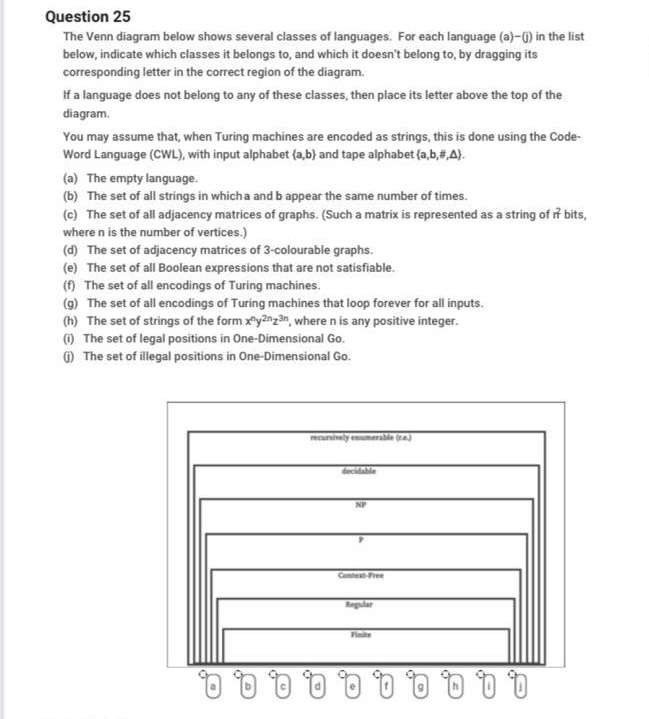
Question: Question 2 5 The Venn diagram below shows several classes of languages. For each language ( a ) - ( j ) in the list
Question
The Venn diagram below shows several classes of languages. For each language aj in the list
below, indicate which classes it belongs to and which it doesn't belong to by dragging its
corresponding letter in the correct region of the diagram.
If a language does not belong to any of these classes, then place its letter above the top of the
diagram.
You may assume that, when Turing machines are encoded as strings, this is done using the Code
Word Language CWL with input alphabet and tape alphabet #
a The empty language.
b The set of all strings in which a and b appear the same number of times.
c The set of all adjacency matrices of graphs. Such a matrix is represented as a string of in bits,
where is the number of vertices.
d The set of adjacency matrices of colourable graphs.
e The set of all Boolean expressions that are not satisfiable.
f The set of all encodings of Turing machines.
g The set of all encodings of Turing machines that loop forever for all inputs.
h The set of strings of the form where is any positive integer.
i The set of legal positions in OneDimensional Go
j The set of illegal positions in OneDimensional Go
Step by Step Solution
There are 3 Steps involved in it
1 Expert Approved Answer
Step: 1 Unlock

Question Has Been Solved by an Expert!
Get step-by-step solutions from verified subject matter experts
Step: 2 Unlock
Step: 3 Unlock
 Study Help