





Question: Question 2. A bank has two identical tellers, each with a separate queue. Customers arriving to the bank join the shortest queue (queue 1 if
Question 2. A bank has two identical tellers,

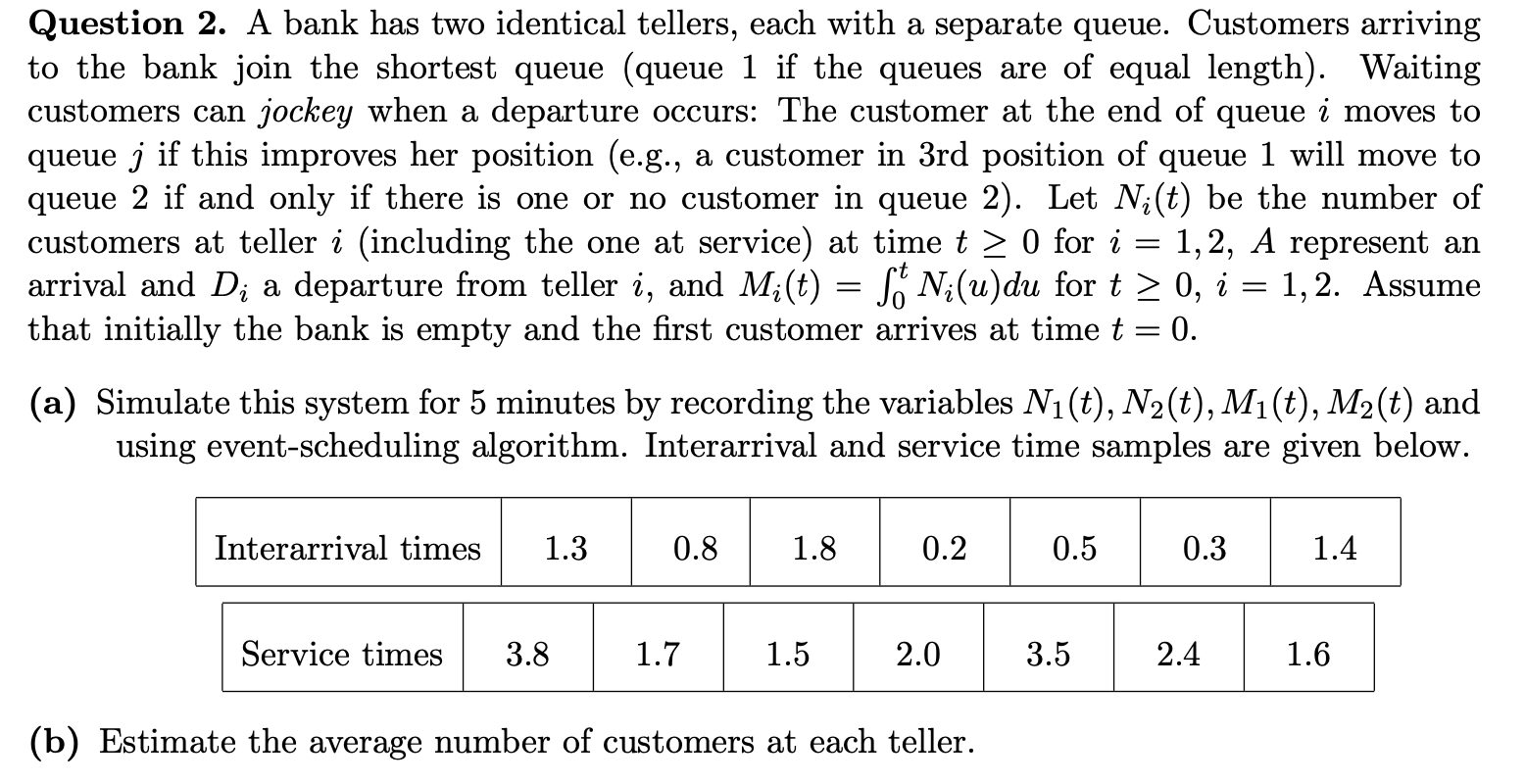
Question 2. A bank has two identical tellers, each with a separate queue. Customers arriving to the bank join the shortest queue (queue 1 if the queues are of equal length). Waiting customers can jockey when a departure occurs: The customer at the end of queue i moves to queue j if this improves her position (e.g., a customer in 3rd position of queue 1 will move to queue 2 if and only if there is one or no customer in queue 2). Let Ni(t) be the number of customers at teller i (including the one at service) at time t > 0 for i 1,2, A represent an arrival and Di a departure from teller i, and M;(t) = S N;(u)du for t > 0, i = 1,2. Assume that initially the bank is empty and the first customer arrives at time t 0. (a) Simulate this system for 5 minutes by recording the variables Ni(t), N2(t), Mi(t), M2(t) and using event-scheduling algorithm. Interarrival and service time samples are given below. Interarrival times 1.3 0.8 1.8 0.2 0.5 0.3 1.4 Service times 3.8 1.7 1.5 2.0 3.5 2.4 1.6 (b) Estimate the average number of customers at each teller

Step by Step Solution

There are 3 Steps involved in it

1 Expert Approved Answer
Step: 1 Unlock blur-text-image

Question Has Been Solved by an Expert!

Get step-by-step solutions from verified subject matter experts

Step: 2 Unlock
Step: 3 Unlock

Students Have Also Explored These Related General Management Questions!