







Question: Question 2: a) Design and draw a HLSM that controls the state of your space agency's new Uranus rover. It should have the following behavior:
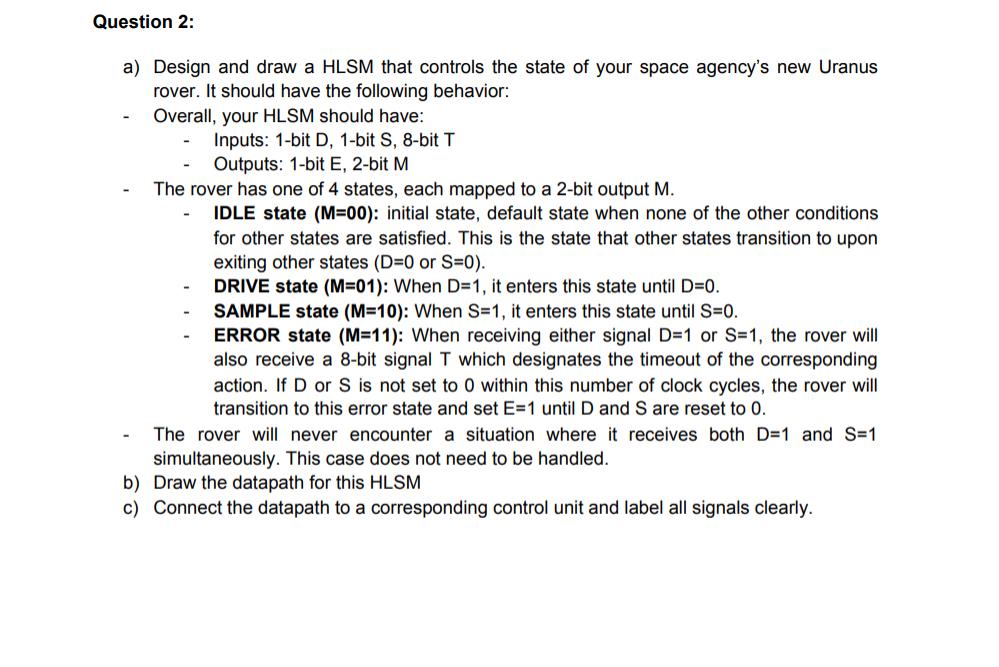
Question 2: a) Design and draw a HLSM that controls the state of your space agency's new Uranus rover. It should have the following behavior: Overall, your HLSM should have: Inputs: 1-bit D, 1-bit S, 8-bit T Outputs: 1-bit E, 2-bit M The rover has one of 4 states, each mapped to a 2-bit output M. IDLE state (M=00): initial state, default state when none of the other conditions for other states are satisfied. This is the state that other states transition to upon exiting other states (D=0 or S=0). DRIVE state (M=01): When D=1, it enters this state until D=0. SAMPLE state (M=10): When S=1, it enters this state until S=0. ERROR state (M=11): When receiving either signal D=1 or S=1, the rover will also receive a 8-bit signal T which designates the timeout of the corresponding action. If D or S is not set to O within this number of clock cycles, the rover will transition to this error state and set E=1 until D and S are reset to 0. The rover will never encounter a situation where it receives both D=1 and S=1 simultaneously. This case does not need to be handled. b) Draw the datapath for this HLSM c) Connect the datapath to a corresponding control unit and label all signals clearly. Question 2: a) Design and draw a HLSM that controls the state of your space agency's new Uranus rover. It should have the following behavior: Overall, your HLSM should have: Inputs: 1-bit D, 1-bit S, 8-bit T Outputs: 1-bit E, 2-bit M The rover has one of 4 states, each mapped to a 2-bit output M. IDLE state (M=00): initial state, default state when none of the other conditions for other states are satisfied. This is the state that other states transition to upon exiting other states (D=0 or S=0). DRIVE state (M=01): When D=1, it enters this state until D=0. SAMPLE state (M=10): When S=1, it enters this state until S=0. ERROR state (M=11): When receiving either signal D=1 or S=1, the rover will also receive a 8-bit signal T which designates the timeout of the corresponding action. If D or S is not set to O within this number of clock cycles, the rover will transition to this error state and set E=1 until D and S are reset to 0. The rover will never encounter a situation where it receives both D=1 and S=1 simultaneously. This case does not need to be handled. b) Draw the datapath for this HLSM c) Connect the datapath to a corresponding control unit and label all signals clearly
Step by Step Solution
There are 3 Steps involved in it

Get step-by-step solutions from verified subject matter experts
 Study Help