







Question: Question 2 A kitchen rolling pin consists of a solid cylinder of mass 1.9 kg and radius 0.025 m, with one solid cylindrical handle Not
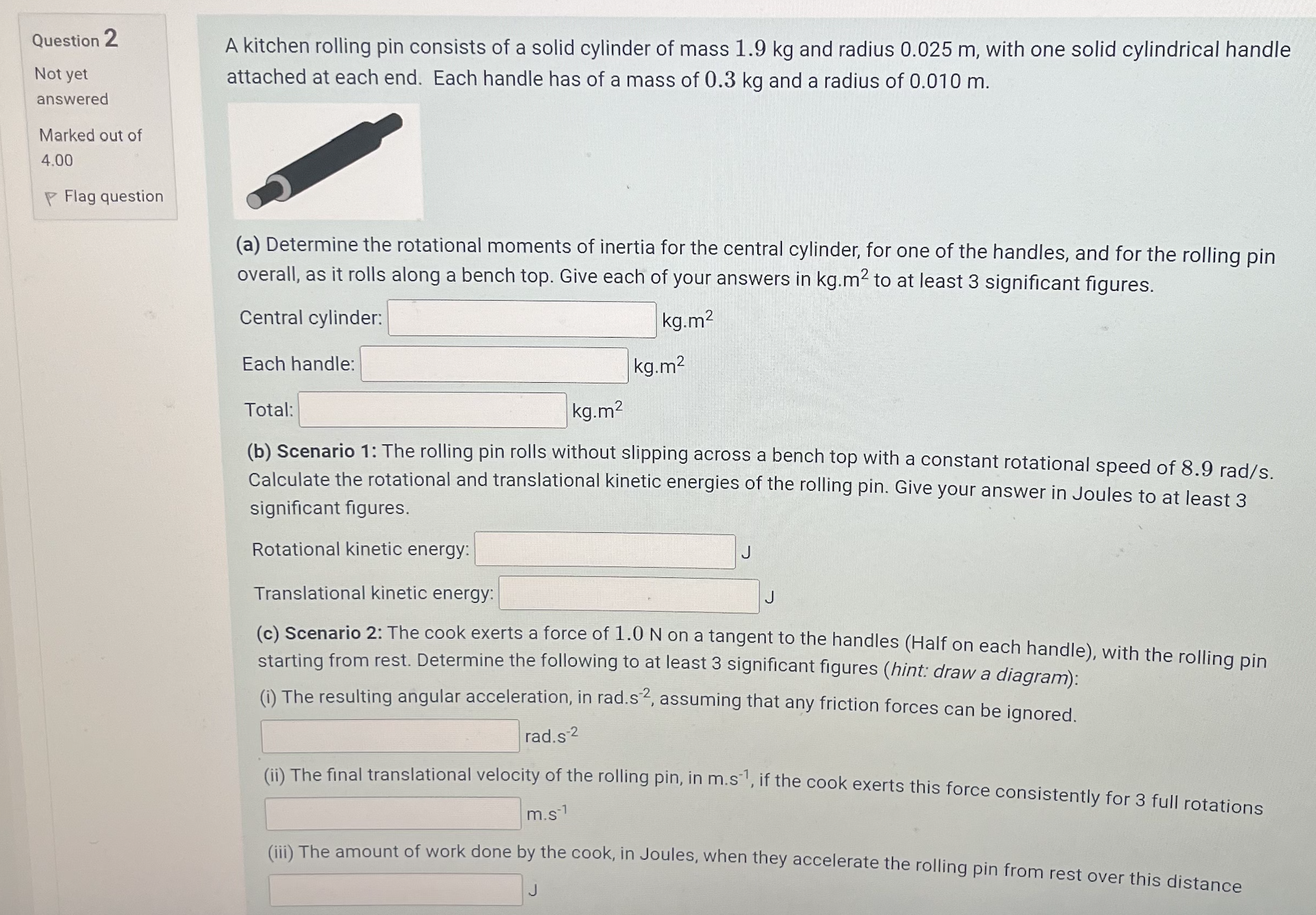
Question 2 A kitchen rolling pin consists of a solid cylinder of mass 1.9 kg and radius 0.025 m, with one solid cylindrical handle Not yet attached at each end. Each handle has of a mass of 0.3 kg and a radius of 0.010 m. answered Marked out of 4.00 P Flag question (a) Determine the rotational moments of inertia for the central cylinder, for one of the handles, and for the rolling pin overall, as it rolls along a bench top. Give each of your answers in kg.m2 to at least 3 significant figures. Central cylinder: kg.m 2 Each handle: kg.m 2 Total: kg.m 2 (b) Scenario 1: The rolling pin rolls without slipping across a bench top with a constant rotational speed of 8.9 rad/s. Calculate the rotational and translational kinetic energies of the rolling pin. Give your answer in Joules to at least 3 significant figures. Rotational kinetic energy: Translational kinetic energy: (c) Scenario 2: The cook exerts a force of 1.0 N on a tangent to the handles (Half on each handle), with the rolling pin starting from rest. Determine the following to at least 3 significant figures (hint: draw a diagram): (i) The resulting angular acceleration, in rad.s", assuming that any friction forces can be ignored. rad.s-2 (ii) The final translational velocity of the rolling pin, in m.s", if the cook exerts this force consistently for 3 full rotations m.S - 1 (iii) The amount of work done by the cook, in Joules, when they accelerate the rolling pin from rest over this distanceQuestion 3 A mass of weight 15.2 kg is held directly above a linear spring that has a spring constant of 2 kN/m. The spring is 50 cm Not yet answered long and attached to the ground at its bottom. The spring is initially in its relaxed position (x=0). The mass is then released, and the system begins to oscillate. What is the furthest vertical distance down that the mass will travel? Marked out of 1.00 You may assume that no energy is lost during the compression of the spring. Give your answer in cm to at least 3 significant figures. Flag
Step by Step Solution
There are 3 Steps involved in it

Get step-by-step solutions from verified subject matter experts
 Study Help