







Question: Question 2 : A Model with a Different Monetary Policy Rule (60 points) In this Exercise, we start directly with the approximated model from the
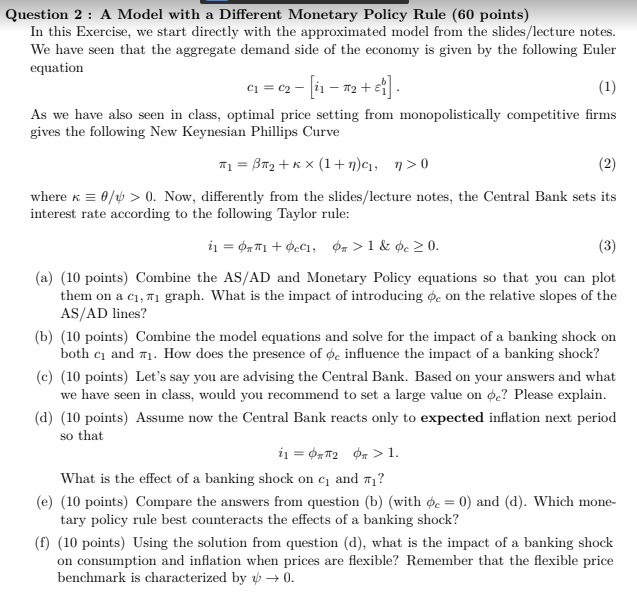
Question 2 : A Model with a Different Monetary Policy Rule (60 points) In this Exercise, we start directly with the approximated model from the slides/lecture notes. We have seen that the aggregate demand side of the economy is given by the following Euler equation C1 = 02 - 1 1 - #2 + =4]. (1) As we have also seen in class, optimal price setting from monopolistically competitive firms gives the following New Keynesian Phillips Curve 71 = Bn2 + x x (1+n)q, n>0 (2) where k = 0/1 > 0. Now, differently from the slides/lecture notes, the Central Bank sets its interest rate according to the following Taylor rule: i1 = damit decl, or >1 & 6- 20. (3) (a) (10 points) Combine the AS/AD and Monetary Policy equations so that you can plot them on a ci, m graph. What is the impact of introducing de on the relative slopes of the AS/AD lines? (b) (10 points) Combine the model equations and solve for the impact of a banking shock on both c and m. How does the presence of de influence the impact of a banking shock? (c) (10 points) Let's say you are advising the Central Bank. Based on your answers and what we have seen in class, would you recommend to set a large value on de? Please explain. (d) (10 points) Assume now the Central Bank reacts only to expected inflation next period so that i1 = 0x72 0x > 1. What is the effect of a banking shock on c, and m? (e) (10 points) Compare the answers from question (b) (with de = 0) and (d). Which mone- tary policy rule best counteracts the effects of a banking shock? (f) (10 points) Using the solution from question (d), what is the impact of a banking shock on consumption and inflation when prices are flexible? Remember that the flexible price benchmark is characterized by v -+ 0
Step by Step Solution
There are 3 Steps involved in it

Get step-by-step solutions from verified subject matter experts
 Study Help