





Question: Question 2 - A Retail Store Customers enter a store according to a Poisson process of rate 10 per hour (i.e, customers arrive with interarrival
Question 2 - A Retail Store Customers enter a
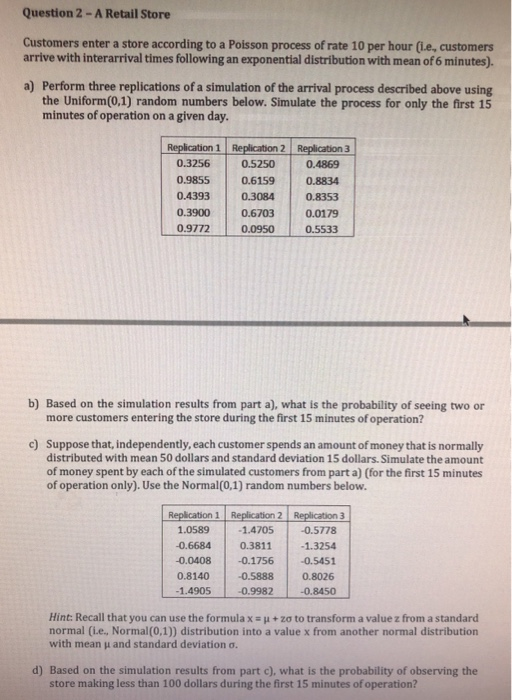
Question 2 - A Retail Store Customers enter a store according to a Poisson process of rate 10 per hour (i.e, customers arrive with interarrival times following an exponential distribution with mean of 6 minutes). a) Perform three replications of a simulation of the arrival process described above using the Uniform(0.1) random numbers below. Simulate the process for only the first 15 minutes of operation on a given day. Replication 1 Replication 2 Replication 3 0.3256 0.5250 0.4869 0.9855 0.6159 0.8834 0.4393 0.3084 0.8353 0.3900 0.6703 0.0179 0.9772 0.0950 0.5533 b) Based on the simulation results from part a), what is the probability of seeing two or more customers entering the store during the first 15 minutes of operation? c) Suppose that, independently, each customer spends an amount of money that is normally distributed with mean 50 dollars and standard deviation 15 dollars. Simulate the amount of money spent by each of the simulated customers from part a) (for the first 15 minutes of operation only). Use the Normal(0,1) random numbers below. Replication 1 Replication 2 Replication 3 1.0589 -1.4705 -0.5778 -0.6684 0.3811 -1.3254 -0.0408 -0.1756 0.8140 -0.5888 0.8026 -1.4905 -0.9982 -0.8450 -0.5451 Hint: Recall that you can use the formula x =p+zo to transform a value z from a standard normal (i.e., Normal(0,1)) distribution into a value x from another normal distribution with mean and standard deviation o. d) Based on the simulation results from part c), what is the probability of observing the store making less than 100 dollars during the first 15 minutes of operation? Question 2 - A Retail Store Customers enter a store according to a Poisson process of rate 10 per hour (i.e, customers arrive with interarrival times following an exponential distribution with mean of 6 minutes). a) Perform three replications of a simulation of the arrival process described above using the Uniform(0.1) random numbers below. Simulate the process for only the first 15 minutes of operation on a given day. Replication 1 Replication 2 Replication 3 0.3256 0.5250 0.4869 0.9855 0.6159 0.8834 0.4393 0.3084 0.8353 0.3900 0.6703 0.0179 0.9772 0.0950 0.5533 b) Based on the simulation results from part a), what is the probability of seeing two or more customers entering the store during the first 15 minutes of operation? c) Suppose that, independently, each customer spends an amount of money that is normally distributed with mean 50 dollars and standard deviation 15 dollars. Simulate the amount of money spent by each of the simulated customers from part a) (for the first 15 minutes of operation only). Use the Normal(0,1) random numbers below. Replication 1 Replication 2 Replication 3 1.0589 -1.4705 -0.5778 -0.6684 0.3811 -1.3254 -0.0408 -0.1756 0.8140 -0.5888 0.8026 -1.4905 -0.9982 -0.8450 -0.5451 Hint: Recall that you can use the formula x =p+zo to transform a value z from a standard normal (i.e., Normal(0,1)) distribution into a value x from another normal distribution with mean and standard deviation o. d) Based on the simulation results from part c), what is the probability of observing the store making less than 100 dollars during the first 15 minutes of operation

Step by Step Solution

There are 3 Steps involved in it

1 Expert Approved Answer
Step: 1 Unlock blur-text-image

Question Has Been Solved by an Expert!

Get step-by-step solutions from verified subject matter experts

Step: 2 Unlock
Step: 3 Unlock

Students Have Also Explored These Related General Management Questions!