







Question: Question 2: a- Use Indirect addressing to write a PIC 24 assembly code that stores 100 data bytes in the memory starting from address 0X
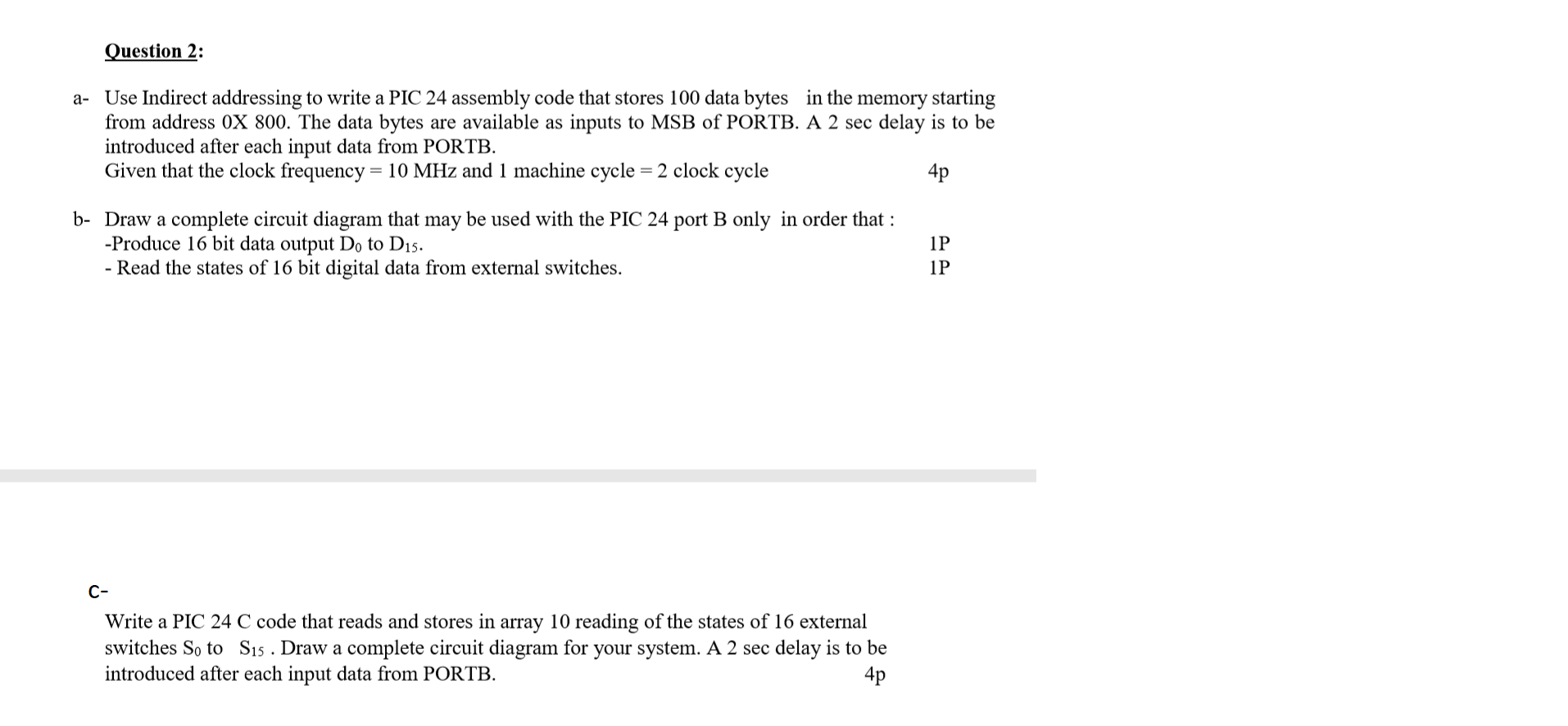
Question 2: a- Use Indirect addressing to write a PIC 24 assembly code that stores 100 data bytes in the memory starting from address 0X 800. The data bytes are available as inputs to MSB of PORTB. A 2 sec delay is to be introduced after each input data from PORTB. Given that the clock frequency = 10 MHz and 1 machine cycle = 2 clock cycle 4p b- Draw a complete circuit diagram that may be used with the PIC 24 port B only in order that : -Produce 16 bit data output Do to D15. - Read the states of 16 bit digital data from external switches. 1P 1P C- Write a PIC 24 C code that reads and stores in array 10 reading of the states of 16 external switches So to Sis. Draw a complete circuit diagram for your system. A 2 sec delay is to be introduced after each input data from PORTB. 4p Question 2: a- Use Indirect addressing to write a PIC 24 assembly code that stores 100 data bytes in the memory starting from address 0X 800. The data bytes are available as inputs to MSB of PORTB. A 2 sec delay is to be introduced after each input data from PORTB. Given that the clock frequency = 10 MHz and 1 machine cycle = 2 clock cycle 4p b- Draw a complete circuit diagram that may be used with the PIC 24 port B only in order that : -Produce 16 bit data output Do to D15. - Read the states of 16 bit digital data from external switches. 1P 1P C- Write a PIC 24 C code that reads and stores in array 10 reading of the states of 16 external switches So to Sis. Draw a complete circuit diagram for your system. A 2 sec delay is to be introduced after each input data from PORTB. 4p
Step by Step Solution
There are 3 Steps involved in it

Get step-by-step solutions from verified subject matter experts
 Study Help