







Question: Question 2. Although this was not stated as the main result on Lagrange multipliers (which only mentioned absolute extrema), recall that if p0 is a
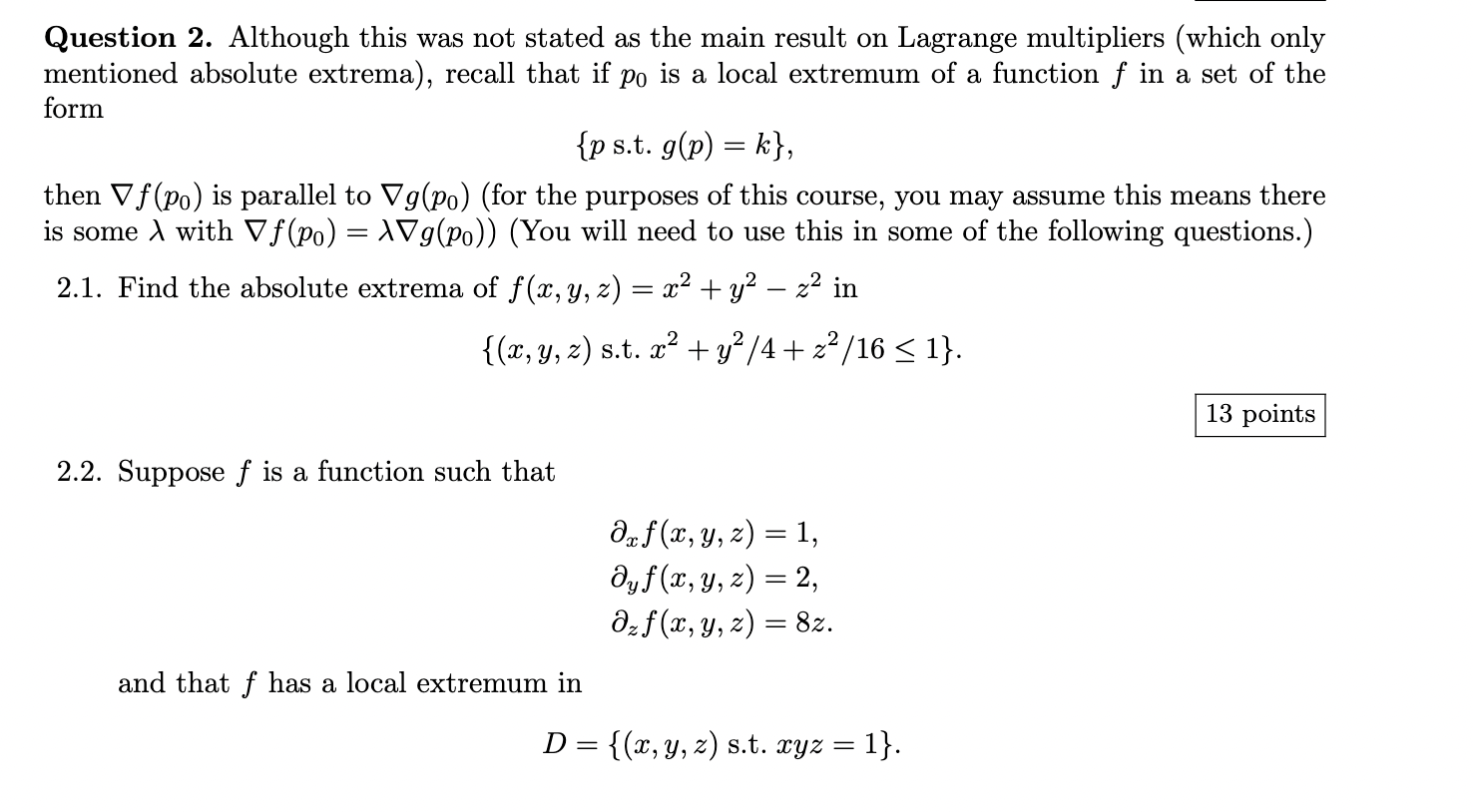

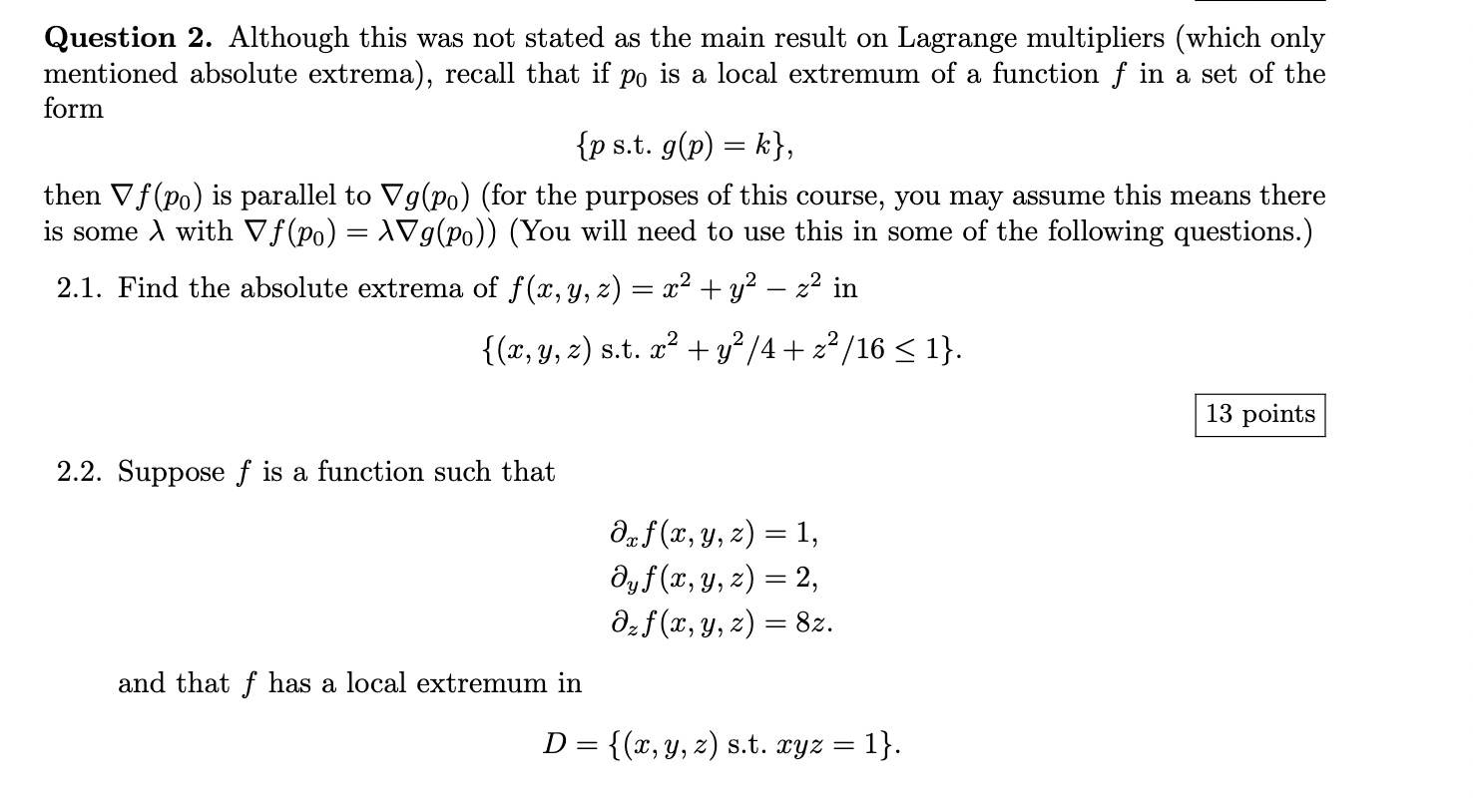

Question 2. Although this was not stated as the main result on Lagrange multipliers (which only mentioned absolute extrema), recall that if p0 is a local extremurn of a function f in a set of the form {13 813.9(1)) = k}, then V f 030) is parallel to Vg(p0) (for the purposes of this course, you may assume this means there is some A with V f 090) = AVg(p0)) (You will need to use this in some of the following questions.) 2.1. Find the absolute extrema of f (27, y, z) = 3:2 + y2 22 in {(miy,z) s.t. m2 + y2/4 + 22/16 g 1}. 2.2. Suppose f is a function such that 8$f(:t:,y,z) = 1: 3yf(m,y,2) = 2, 62f(:c,y, z) = 82. and that f has a local extremum in D = {(x, y,z) s.t. xyz = 1}. At what point must this local extremum of f in D occur? Remark: if xyz = 1, then :3, y, 2 must all be nonzero
Step by Step Solution
There are 3 Steps involved in it

Get step-by-step solutions from verified subject matter experts
 Study Help