







Question: Question 2 An Fe - 0 . 1 C ( in wt . % ) binary alloy undergoes a tensile test with repeated loading and
Question
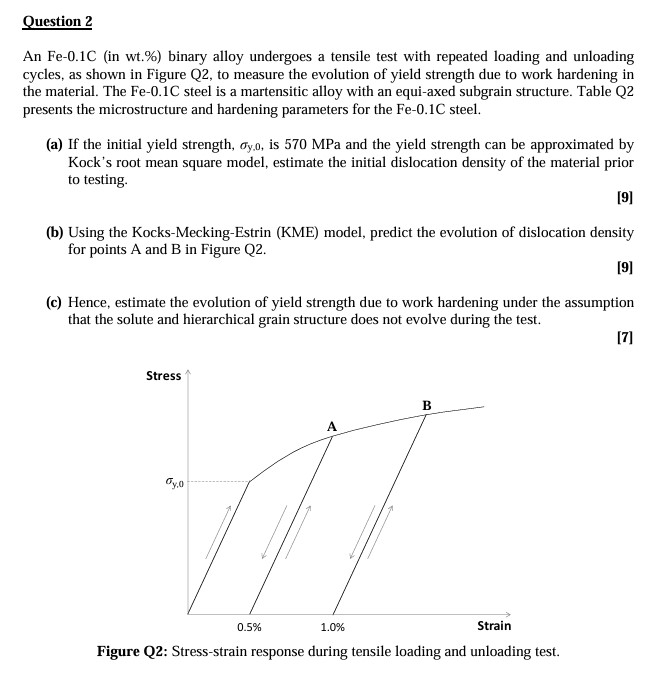
An FeC in wt binary alloy undergoes a tensile test with repeated loading and unloading cycles, as shown in Figure Q to measure the evolution of yield strength due to work hardening in the material. The FeC steel is a martensitic alloy with an equiaxed subgrain structure. Table Q presents the microstructure and hardening parameters for the FeC steel.
a If the initial yield strength, sigma y is MPa and the yield strength can be approximated by Kock's root mean square model, estimate the initial dislocation density of the material prior to testing.
b Using the KocksMeckingEstrin KME model, predict the evolution of dislocation density for points A and B in Figure Q
c Hence, estimate the evolution of yield strength due to work hardening under the assumption that the solute and hierarchical grain structure does not evolve during the test.
Figur
test.
Table Q: Model parameters for FeC
Step by Step Solution
There are 3 Steps involved in it
1 Expert Approved Answer
Step: 1 Unlock

Question Has Been Solved by an Expert!
Get step-by-step solutions from verified subject matter experts
Step: 2 Unlock
Step: 3 Unlock
 Study Help