







Question: Question 2 Arithmetic Average Monthly Stock Return Geometric Average Return Starbucks 1.71% 1.57% Shake Shack 1.59% 0.75% Question 3 Total Variance Standard Deviation Starbucks 0.28%
| Question 2 | ||
| Arithmetic Average Monthly Stock Return | Geometric Average Return | |
| Starbucks | 1.71% | 1.57% |
| Shake Shack | 1.59% | 0.75% |
| Question 3 | ||
| Total Variance | Standard Deviation | |
| Starbucks | 0.28% | 5.31% |
| Shake Shack | 1.74% | 13.17% |

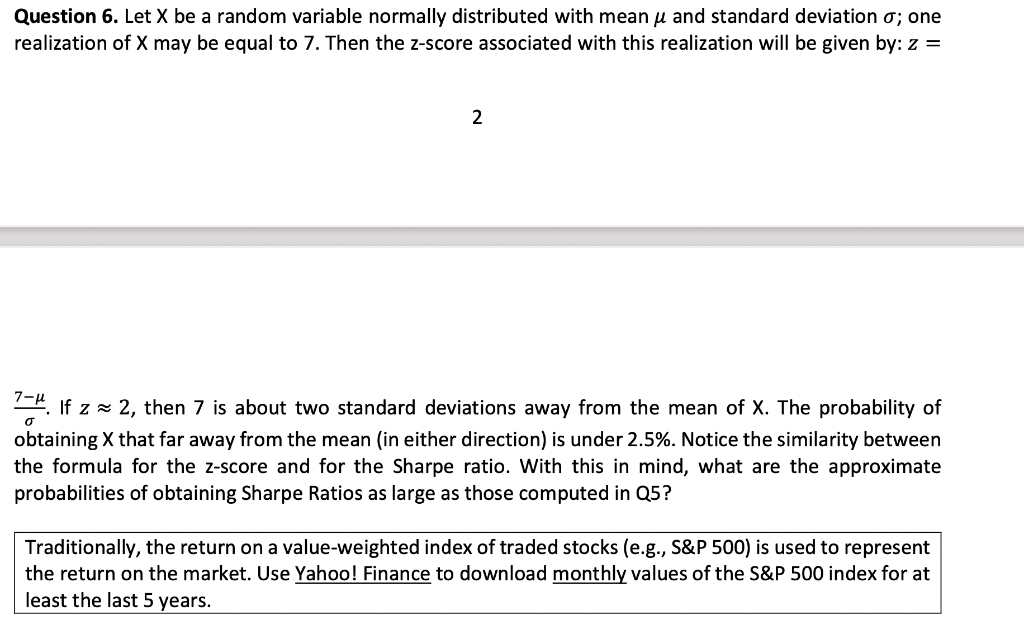
Question 5. For each stock, divide the arithmetic average monthly return (from Q2) by the standard deviation of monthly returns (from Q3). (In other words, at this point we are not calculating the excess return by subtracting the risk-free rate.) This is the (simplified) Sharpe Ratio. Which stock has been a better investment based on the (simplified) Sharpe Ratio comparison? Question 6. Let X be a random variable normally distributed with mean u and standard deviation o; one realization of X may be equal to 7. Then the Z-score associated with this realization will be given by: z = 2 74. If z = 2, then 7 is about two standard deviations away from the mean of X. The probability of obtaining X that far away from the mean (in either direction) is under 2.5%. Notice the similarity between the formula for the z-score and for the Sharpe ratio. With this in mind, what are the approximate probabilities of obtaining Sharpe Ratios as large as those computed in Q5? Traditionally, the return on a value-weighted index of traded stocks (e.g., S&P 500) is used to represent the return on the market. Use Yahoo! Finance to download monthly values of the S&P 500 index for at least the last 5 years. Question 5. For each stock, divide the arithmetic average monthly return (from Q2) by the standard deviation of monthly returns (from Q3). (In other words, at this point we are not calculating the excess return by subtracting the risk-free rate.) This is the (simplified) Sharpe Ratio. Which stock has been a better investment based on the (simplified) Sharpe Ratio comparison? Question 6. Let X be a random variable normally distributed with mean u and standard deviation o; one realization of X may be equal to 7. Then the Z-score associated with this realization will be given by: z = 2 74. If z = 2, then 7 is about two standard deviations away from the mean of X. The probability of obtaining X that far away from the mean (in either direction) is under 2.5%. Notice the similarity between the formula for the z-score and for the Sharpe ratio. With this in mind, what are the approximate probabilities of obtaining Sharpe Ratios as large as those computed in Q5? Traditionally, the return on a value-weighted index of traded stocks (e.g., S&P 500) is used to represent the return on the market. Use Yahoo! Finance to download monthly values of the S&P 500 index for at least the last 5 years
Step by Step Solution
There are 3 Steps involved in it

Get step-by-step solutions from verified subject matter experts
 Study Help