







Question: QUESTION 2 Case Study The case below relates to an MBA Accounting & Finance student, Eli, at UPSA, who was interested in the applicability of
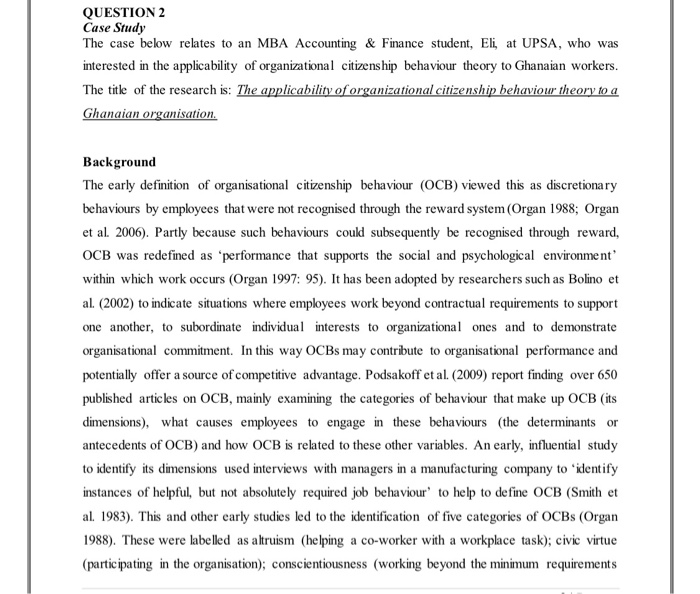
QUESTION 2 Case Study The case below relates to an MBA Accounting & Finance student, Eli, at UPSA, who was interested in the applicability of organizational citizenship behaviour theory to Ghanaian workers. The title of the research is: The applicability of organizational citizenship behaviour theory to a Ghanaian organisation Background The early definition of organisational citizenship behaviour (OCB) viewed this as discretionary behaviours by employees that were not recognised through the reward system (Organ 1988; Organ et al. 2006). Partly because such behaviours could subsequently be recognised through reward, OCB was redefined as 'performance that supports the social and psychological environment within which work occurs (Organ 1997: 95). It has been adopted by researchers such as Bolino et al. (2002) to indicate situations where employees work beyond contractual requirements to support one another, to subordinate individual interests to organizational ones and to demonstrate organisational commitment. In this way OCBs may contribute to organisational performance and potentially offer a source of competitive advantage. Podsakoff et al. (2009) report finding over 650 published articles on OCB, mainly examining the categories of behaviour that make up OCB (its dimensions), what causes employees to engage in these behaviours (the determinants or antecedents of OCB) and how OCB is related to these other variables. An early, influential study to identify its dimensions used interviews with managers in a manufacturing company to identify instances of helpful, but not absolutely required job behaviour' to help to define OCB (Smith et al. 1983). This and other early studies led to the identification of five categories of OCBs (Organ 1988). These were labelled as altruism (helping a co-worker with a workplace task); civic virtue (participating in the organisation); conscientiousness (working beyond the minimum requirements QUESTION 2 Case Study The case below relates to an MBA Accounting & Finance student, Eli, at UPSA, who was interested in the applicability of organizational citizenship behaviour theory to Ghanaian workers. The title of the research is: The applicability of organizational citizenship behaviour theory to a Ghanaian organisation Background The early definition of organisational citizenship behaviour (OCB) viewed this as discretionary behaviours by employees that were not recognised through the reward system (Organ 1988; Organ et al. 2006). Partly because such behaviours could subsequently be recognised through reward, OCB was redefined as 'performance that supports the social and psychological environment within which work occurs (Organ 1997: 95). It has been adopted by researchers such as Bolino et al. (2002) to indicate situations where employees work beyond contractual requirements to support one another, to subordinate individual interests to organizational ones and to demonstrate organisational commitment. In this way OCBs may contribute to organisational performance and potentially offer a source of competitive advantage. Podsakoff et al. (2009) report finding over 650 published articles on OCB, mainly examining the categories of behaviour that make up OCB (its dimensions), what causes employees to engage in these behaviours (the determinants or antecedents of OCB) and how OCB is related to these other variables. An early, influential study to identify its dimensions used interviews with managers in a manufacturing company to identify instances of helpful, but not absolutely required job behaviour' to help to define OCB (Smith et al. 1983). This and other early studies led to the identification of five categories of OCBs (Organ 1988). These were labelled as altruism (helping a co-worker with a workplace task); civic virtue (participating in the organisation); conscientiousness (working beyond the minimum requirements
Step by Step Solution
There are 3 Steps involved in it

Get step-by-step solutions from verified subject matter experts
 Study Help