







Question: Question 2 : Coloring a Graph . . . . . . . . . . . . . . . . . . .
Question : Coloring a Graph
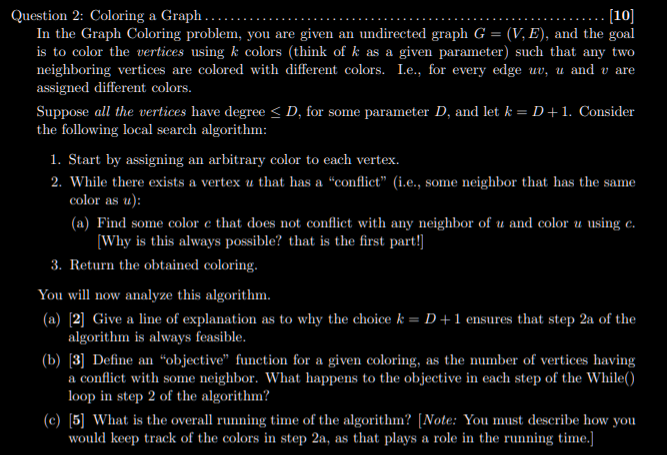
In the Graph Coloring problem, you are given an undirected graph GV E and the goal is to color the vertices using k colors think of k as a given parameter such that any two neighboring vertices are colored with different colors. I.e for every edge u v u and v are assigned different colors.
Suppose all the vertices have degree leq D for some parameter D and let kD Consider the following local search algorithm:
Start by assigning an arbitrary color to each vertex.
While there exists a vertex u that has a "conflict" ie some neighbor that has the same color as u :
a Find some color c that does not conflict with any neighbor of u and color u using c Why is this always possible? that is the first part!
Return the obtained coloring.
You will now analyze this algorithm.
a Give a line of explanation as to why the choice kD ensures that step a of the algorithm is always feasible.
b Define an "objective" function for a given coloring, as the number of vertices having a conflict with some neighbor. What happens to the objective in each step of the While loop in step of the algorithm?
c What is the overall running time of the algorithm? Note: You must describe how you would keep track of the colors in step a as that plays a role in the running time.
Step by Step Solution
There are 3 Steps involved in it
1 Expert Approved Answer
Step: 1 Unlock

Question Has Been Solved by an Expert!
Get step-by-step solutions from verified subject matter experts
Step: 2 Unlock
Step: 3 Unlock
 Study Help