







Question: Question 2: Computing Dice Probabilities from a Computer Simulation The data set labeled Dice Simulation reports the outcome of a computer simulation in which two
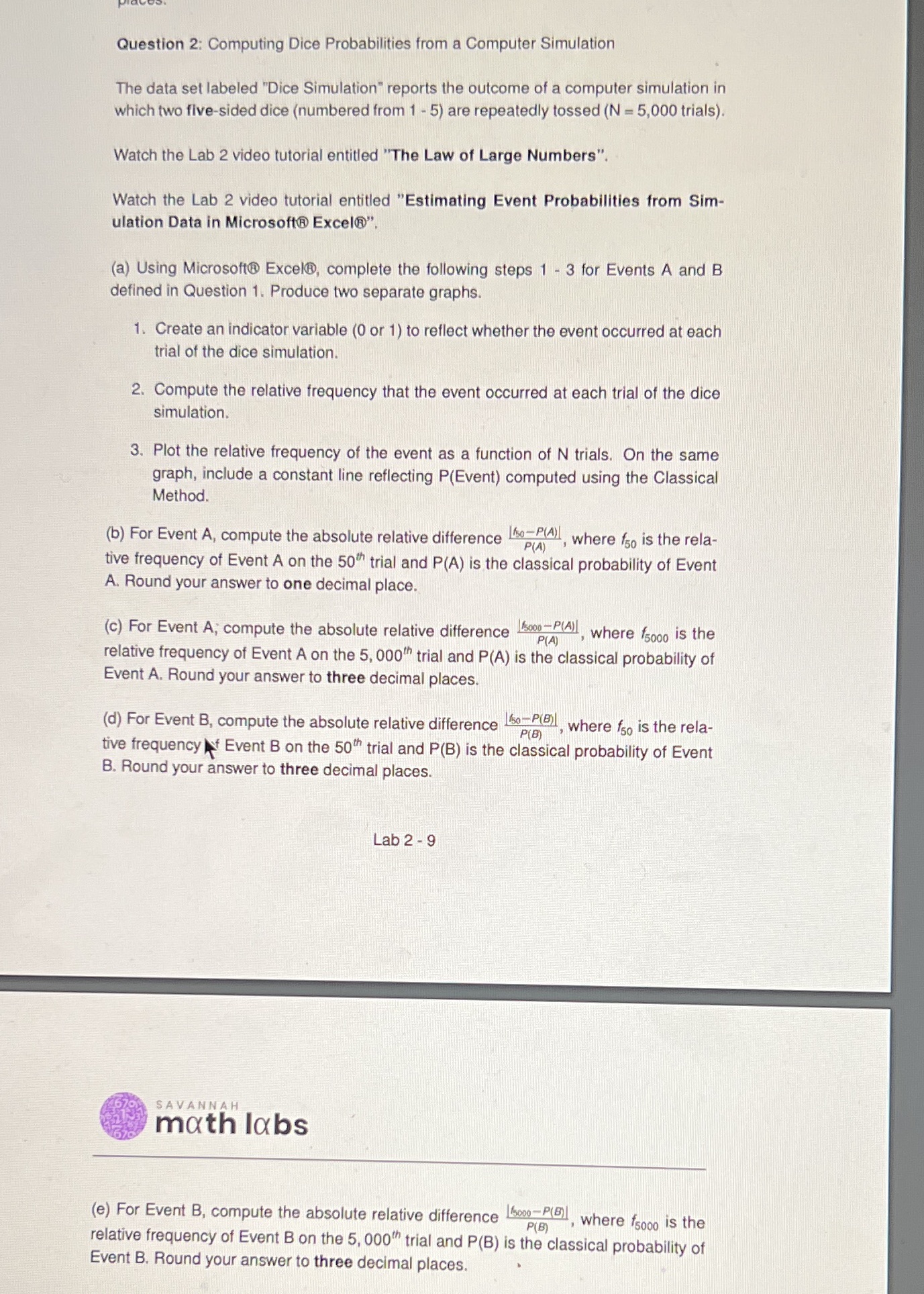
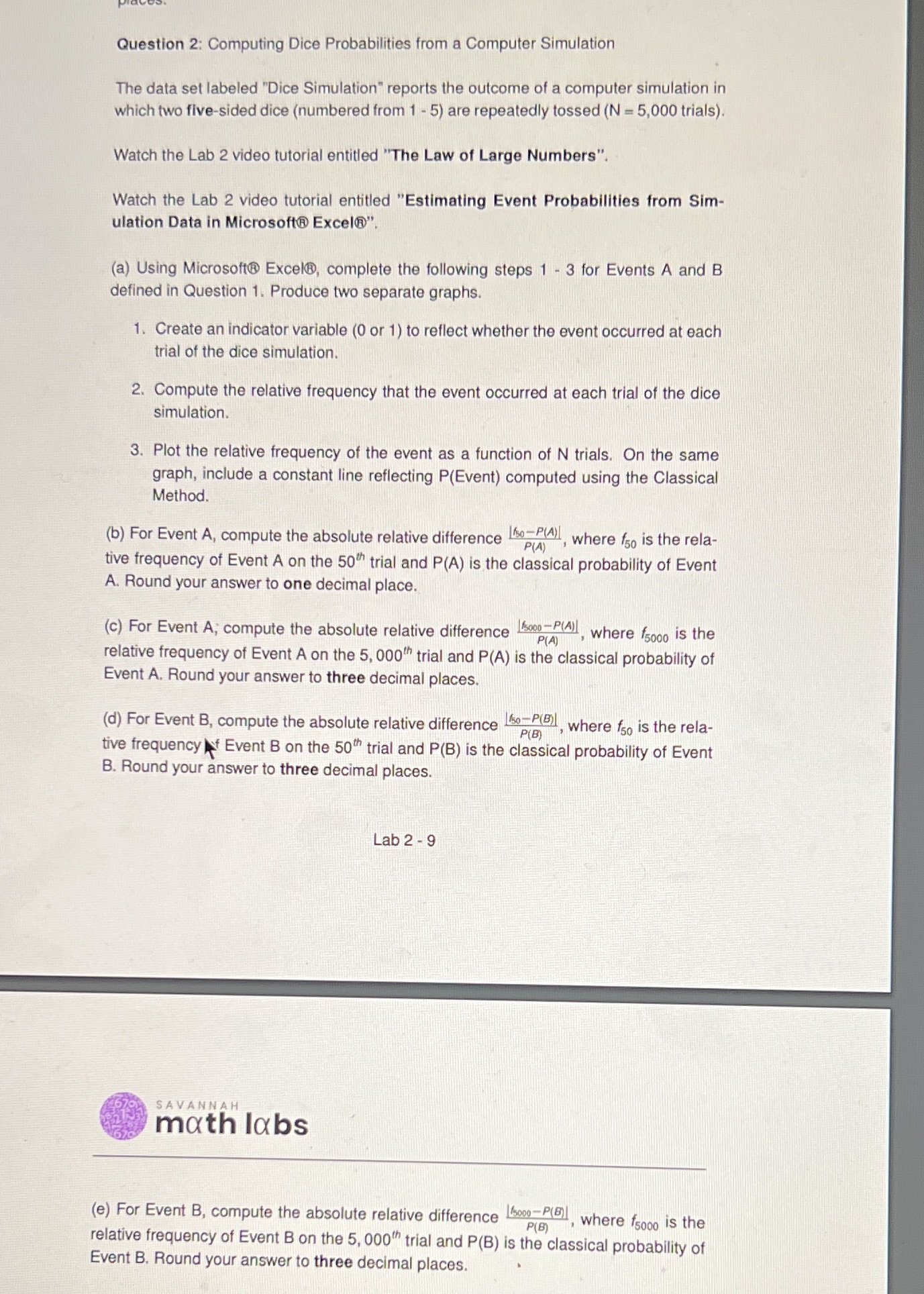
Question 2: Computing Dice Probabilities from a Computer Simulation The data set labeled "Dice Simulation" reports the outcome of a computer simulation in which two five-sided dice (numbered from 1 - 5) are repeatedly tossed (N = 5,000 trials). Watch the Lab 2 video tutorial entitled "The Law of Large Numbers". Watch the Lab 2 video tutorial entitled "Estimating Event Probabilities from Sim- ulation Data in Microsoft@ Excel@". (a) Using Microsoft@ Excel@, complete the following steps 1 - 3 for Events A and B defined in Question 1. Produce two separate graphs. 1. Create an indicator variable (0 or 1) to reflect whether the event occurred at each trial of the dice simulation. 2. Compute the relative frequency that the event occurred at each trial of the dice simulation. 3. Plot the relative frequency of the event as a function of N trials. On the same graph, include a constant line reflecting P(Event) computed using the Classical Method. (b) For Event A, compute the absolute relative difference so -P(A) P(4) . where fo is the rela- tive frequency of Event A on the 50" trial and P(A) is the classical probability of Event A. Round your answer to one decimal place. (c) For Event A, compute the absolute relative difference , where food is the relative frequency of Event A on the 5, 000" trial and P(A) is the classical probability of Event A. Round your answer to three decimal places. (d) For Event B, compute the absolute relative difference , where fo is the rela- tive frequency of Event B on the 50" trial and P(B) is the classical probability of Event B. Round your answer to three decimal places. Lab 2 - 9 SAVANNAH math labs (e) For Event B, compute the absolute relative difference , where f50%% is the relative frequency of Event B on the 5, 000" trial and P(B) is the classical probability of Event B. Round your answer to three decimal places
Step by Step Solution
There are 3 Steps involved in it

Get step-by-step solutions from verified subject matter experts
 Study Help