







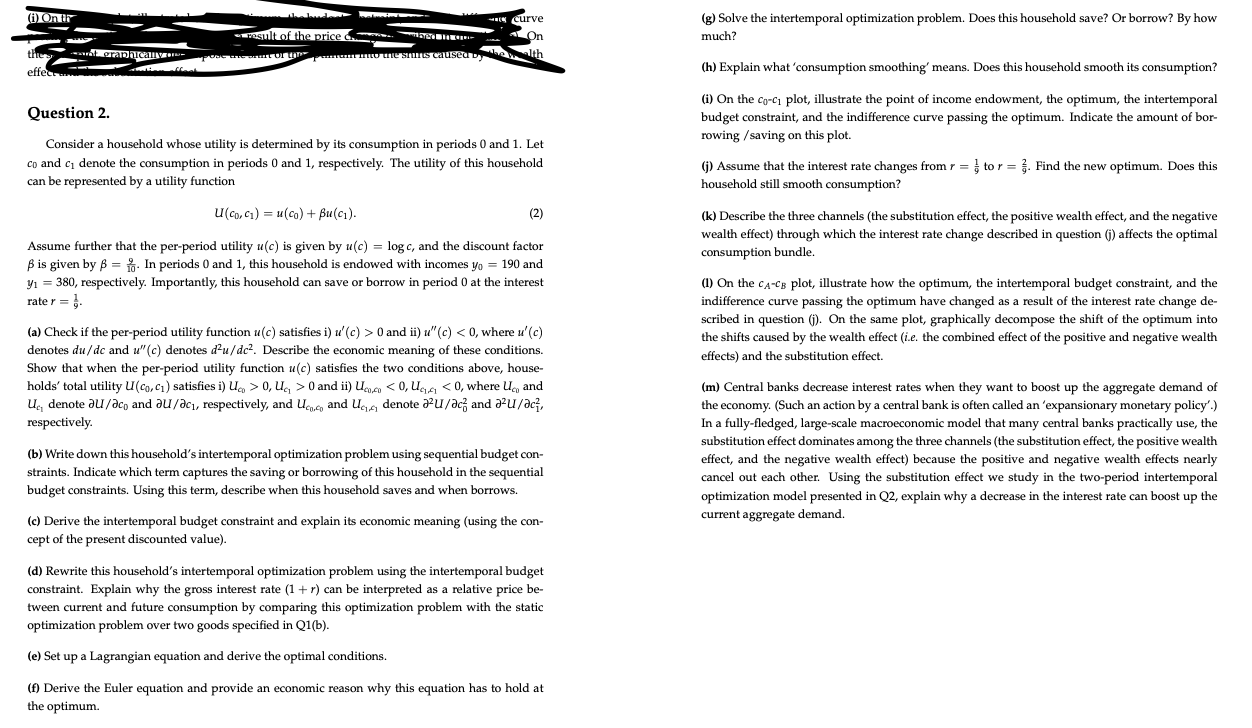
Question: Question 2 . Consider a household whose utility is determined by its consumption in periods 0 and 1 . Let c 0 and c 1
Question
Consider a household whose utility is determined by its consumption in periods and Let
and denote the consumption in periods and respectively. The utility of this household
can be represented by a utility function
Assume further that the perperiod utility is given by and the discount factor
is given by In periods and this household is endowed with incomes and
respectively. Importantly, this household can save or borrow in period at the interest
rate
a Check if the perperiod utility function satisfies i and ii where
denotes and denotes Describe the economic meaning of these conditions.
Show that when the perperiod utility function satisfies the two conditions above, house
holds' total utility satisfies i and ii where and
denote del and del respectively, and and denote and
respectively.
b Write down this household's intertemporal optimization problem using sequential budget con
straints. Indicate which term captures the saving or borrowing of this household in the sequential
budget constraints. Using this term, describe when this household saves and when borrows.
c Derive the intertemporal budget constraint and explain its economic meaning using the con
cept of the present discounted value
d Rewrite this household's intertemporal optimization problem using the intertemporal budget
constraint. Explain why the gross interest rate can be interpreted as a relative price be
tween current and future consumption by comparing this optimization problem with the static
optimization problem over two goods specified in Qb
e Set up a Lagrangian equation and derive the optimal conditions.
f Derive the Euler equation and provide an economic reason why this equation has to hold at
the optimum.
g Solve the intertemporal optimization problem. Does this household save? Or borrow? By how
much?
h Explain what 'consumption smoothing' means. Does this household smooth its consumption?
i On the plot, illustrate the point of income endowment, the optimum, the intertemporal
budget constraint, and the indifference curve passing the optimum. Indicate the amount of bor
rowing saving on this plot.
j Assume that the interest rate changes from to Find the new optimum. Does this
household still smooth consumption?
k Describe the three channels the substitution effect, the positive wealth effect, and the negative
wealth effect through which the interest rate change described in question j affects the optimal
consumption bundle.
On the plot, illustrate how the optimum, the intertemporal budget constraint, and the
indifference curve passing the optimum have changed as a result of the interest rate change de
scribed in question j On the same plot, graphically decompose the shift of the optimum into
the shifts caused by the wealth effect ie the combined effect of the positive and negative wealth
effects and the substitution effect.
m Central banks decrease interest rates when they want to boost up the aggregate demand of
the economy. Such an action by a central bank is often called an 'expansionary monetary policy'.
In a fullyfledged, largescale macroeconomic model that many central banks practically use, the
substitution effect dominates among the three channels the substitution effect, the positive wealth
effect, and the negative wealth effect because the positive and negative wealth effects nearly
cancel out each other. Using the substitution effect we study in the twoperi
Step by Step Solution
There are 3 Steps involved in it
1 Expert Approved Answer
Step: 1 Unlock

Question Has Been Solved by an Expert!
Get step-by-step solutions from verified subject matter experts
Step: 2 Unlock
Step: 3 Unlock
 Study Help