



Question: Question 2. Consider the five types of power we discussed in class. Select two of the five to explain why William is experiencing challenges in
Question 2. Consider the five types of power we discussed in class. Select two of the five to explain why William is experiencing challenges in being the volunteer leader of the leaderless team (Hint: define the type of power and explain whether William derives power from that source). (4 points)
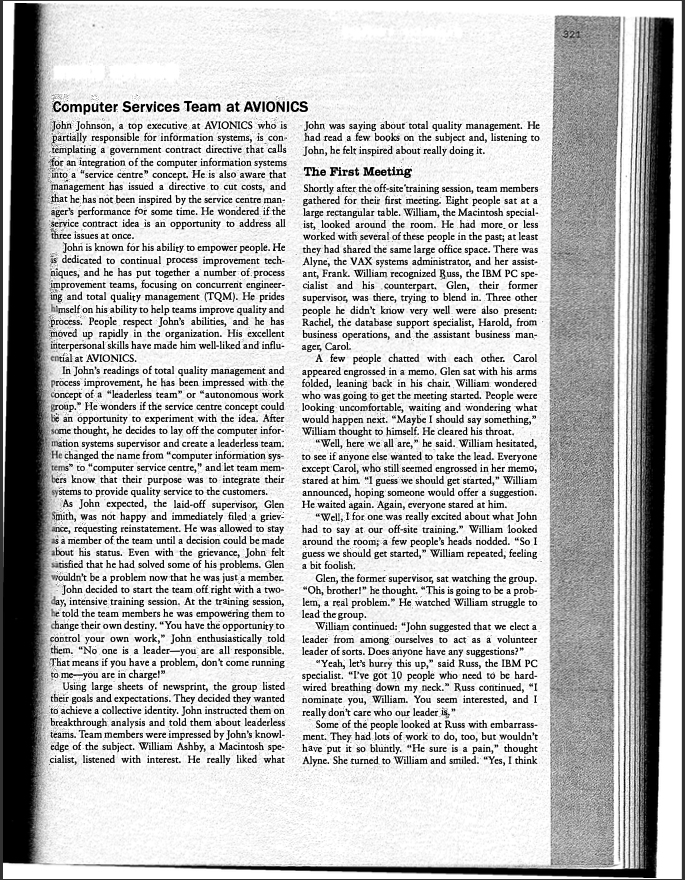
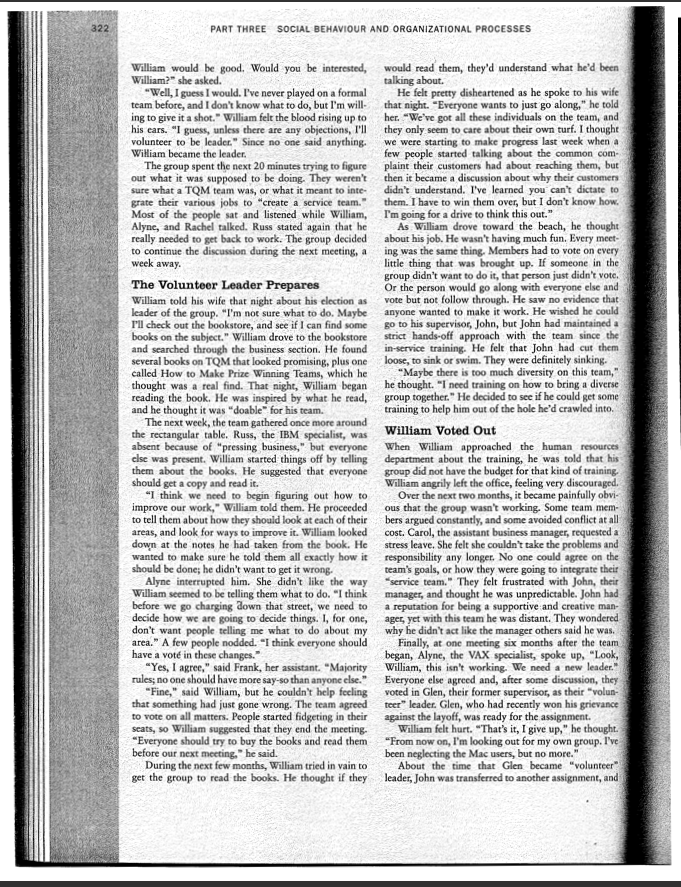
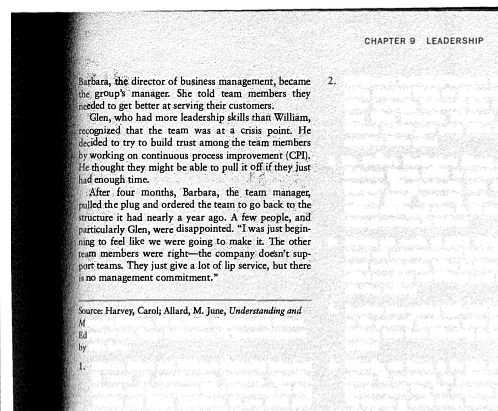
320 Computer Services Team at AVIONICS John Johnson, a top executive at AVIONICS who is John was saying about total quality management. He partially responsible for information systems, is con had read a few books on the subject and, listening to templating a government contract directive that calls John, he felt inspired about really doing it. for an integration of the computer information systems into a "service centre concept. He is also aware that The First Meeting management has issued a directive to cut costs, and Shortly after the off-site training session, team members that he has not been inspired by the service centre man gathered for their first meeting. Eight people sat at a ager's performance for some time. He wondered if the large rectangular table. William, the Macintosh special- service contract idea is an opportunity to address all ist, looked around the room. He had more or less three issues at once. worked with several of these people in the past; at least John is known for his ability to empower people. He they had shared the same large office space. There was is dedicated to continual process improvement tech Alyne, the VAX systems administrator, and her assist- niques, and he has put together a number of process ant, Frank. William recognized Russ, the IBM PC spe- improvement teams, focusing on concurrent engineer cialist and his counterpart. Glen, their former ing and total quality management (TQM). He prides supervisor, was there, trying to blend in. Three other himself on his ability to help teams improve quality and people he didn't know very well were also present: process. People respect John's abilities, and he has Rachel, the database support specialist, Harold, from moved up rapidly in the organization. His excellent business operations, and the assistant business man- interpersonal skills have made him well-liked and influ- ager, Carol ential at AVIONICS. A few people chatted with each other. Carol In John's readings of total quality management and appeared engrossed in a memo. Glen sat with his arms process improvement, he has been impressed with the folded, leaning back in his chair. William wondered concept of a "leaderless team" or "autonomous work who was going to get the meeting started. People were group. He wonders if the service centre concept could looking uncomfortable, waiting and wondering what bie an opportunity to experiment with the idea. After would happen next. "Maybe I should say something," some thought, he decides to lay off the computer infor William thought to himself. He cleared his throat, mation systems supervisor and create a leaderless team. "Well, here we all are," he said. William hesitated, He changed the name from "computer information sys to see if anyone else wanted to take the lead. Everyone tems to "computer service centre," and let team mem except Carol, who still seemed engrossed in her memo, bers know that their purpose was to integrate their stared at him "I guess we should get started," William systems to provide quality service to the customers. announced, hoping someone would offer a suggestion. As John expected, the laid-off supervisor, Glen He waited again. Again, everyone stared at him. Smith, was not happy and immediately filed a griev "Well, I for one was really excited about what John ance, requesting reinstatement. He was allowed to stay had to say at our off-site training." William looked as a member of the team until a decision could be made around the room; a few people's heads nodded. "So I about his status. Even with the grievance, John felt guess we should get started, " William repeated, feeling satisfied that he had solved some of his problems. Glen a bit foolish. wouldn't be a problem now that he was just a member. Glen, the former supervisor, sat watching the group. John decided to start the team off right with a two "Oh, brother!" he thought. This is going to be a prob- day, intensive training session. At the training session, lem, a real problem." He watched William struggle to he told the team members he was empowering them to lead the group change their own destiny. "You have the opportunity to William continued: "John suggested that we elect a control your own work," John enthusiastically told leader from among ourselves to act as a volunteer them. "No one is a leader-you are all responsible. leader of sorts. Does anyone have any suggestions?" That means if you have a problem, don't come running "Yeah, let's burry this up," said Russ, the IBM PC to me you are in charge!" specialist. "I've got 10 people who need to be hard- Using large sheets of newsprint, the group listed wired breathing down my neck." Russ continued, "I their goals and expectations. They decided they wanted nominate you, William. You seem interested, and I to achieve a collective identity. John instructed them on really don't care who our leader is." breakthrough analysis and told them about leaderless Some of the people looked at Russ with embarrass- teams. Team members were impressed by John's knowl ment. They had lots of work to do, too, but wouldn't edge of the subject. William Ashby, a Macintosh spe- have put it so bluntly. "He sure is a pain," thought cialist, listened with interest. He really liked what Alyne. She turned to William and smiled. "Yes, I think 322 PART THREE SOCIAL BEHAVIOUR AND ORGANIZATIONAL PROCESSES William would be good. Would you be interested, William?" she asked. "Well, I guess I would. I've never played on a formal team before, and I don't know what to do, but I'm will ing to give it a shot." William felt the blood rising up to his cars. "I guess, unless there are any objections, I'll volunteer to be leader. Since no one said anything. William became the leader. The group spent the next 20 minutes trying to figure out what it was supposed to be doing. They weren't sure what a TQM team was, or what it meant to inte- grate their various jobs to create a service team." Most of the people sat and listened while William, Alyne, and Rachel talked. Russ stated again that he really needed to get back to work. The group decided to continue the discussion during the next meeting, a week away. The Volunteer Leader Prepares William told his wife that night about his election as leader of the group. "I'm not sure what to do. Maybe I'll check out the bookstore, and see if I can find some books on the subject." William drove to the bookstore and searched through the business section. He found several books on TQM that looked promising, plus one called How to Make Prize Winning Teams, which he thought was a real find. That night, William began reading the book. He was inspired by what he read, and he thought it was "doable for his team. The next week, the team gathered once more around the rectangular table. Russ, the IBM specialist, was absent because of "pressing business, but everyone else was present. William started things off by telling them about the books. He suggested that everyone should get a copy and read it. "I think we need to begin figuring out how to improve our work, William told them. He proceeded to tell them about how they should look at each of their areas, and look for ways to improve it. William looked down at the notes he had taken from the book. He wanted to make sure he told them all exactly how it should be done; he didn't want to get it wrong. Alyne interrupted him. She didn't like the way William seemed to be telling them what to do. "I think before we go charging down that street, we need to decide how we are going to decide things. I, for one, don't want people telling me what to do about my area." A few people nodded. "I think everyone should have a vote in these changes." "Yes, I agree," said Frank, her assistant. "Majority rules; no one should have more say-so than anyone else." "Fine," said William, but he couldn't help feeling that something had just gone wrong. The team agreed to vote on all matters. People started fidgeting in their seats, so William suggested that they end the meeting. "Everyone should try to buy the books and read them before our next meeting," he said. During the next few months, William tried in vain to get the group to read the books. He thought if they would read them, they'd understand what he'd been talking about. He felt pretty disheartened as he spoke to his wife that night. "Everyone wants to just go along," he told her. "We've got all these individuals on the team, and they only seem to care about their own curf. I thought we were starting to make progress last week when a few people started talking about the common com- plaint their customers had about reaching them, but then it became a discussion about why their customers didn't understand. I've learned you can't dictate to them. I have to win them over, but I don't know how. I'm going for a drive to think this out." As William drove toward the beach, he thought about his job. He wasn't having much fun. Every meet- ing was the same thing. Members had to vote on every little thing that was brought up. If someone in the group didn't want to do it, that person just didn't vote. Or the person would go along with everyone else and vote but not follow through. He saw no evidence that anyone wanted to make it work. He wished he could go to his supervisor, John, but John had maintained a strict hands-off approach with the team since the in-service training. He felt that John had cut them loose, to sink or swim. They were definitely sinking. "Maybe there is too much diversity on this team," he thought. "I need training on how to bring a diverse group together." He decided to see if he could get some training to help him out of the hole he'd crawled into. William Voted Out When William approached the human resources department about the training, he was told that his group did not have the budget for that kind of training. William angrily left the office, feeling very discouraged. Over the next two months, it became painfully obvi- ous that the group wasn't working. Some team mem- bers argued constantly, and some avoided conflict at all cost. Carol, the assistant business manager, requested a stress leave. She felt she couldn't take the problems and responsibility any longer. No one could agree on the team's goals, or how they were going to integrate their service team." They felt frustrated with John, their manager, and thought he was unpredictable. John had a reputation for being a supportive and creative man- ager, yet with this team he was distant. They wondered why he didn't act like the manager others said he was. Finally, at one meeting six months after the team began, Alyne, the VAX specialist, spoke up, "Look, William, this isn't working. We need a new leader." Everyone else agreed and, after some discussion, they voted in Glen, their former supervisor, as their "volun- teer" leader. Glen, who had recently won his grievance against the layoff, was ready for the assignment. William felt hurt. "That's it, I give up," he thought. "From now on, I'm looking out for my own group. I've been neglecting the Mac users, but no more." About the time that Glen became "volunteer leader, John was transferred to another assignment, and CHAPTER 9 LEADERSHIP 2. Barbara, the director of business management, became the group's manager. She told team members they needed to get better at serving their customers. Glen, who had more leadership skills than William, recognized that the team was at a crisis point. He decided to try to build trust among the team members by working on continuous process improvement (CPI). He thought they might be able to pull it off if they just had enough time. After four months, Barbara, the team manager, pulled the plug and ordered the team to go back to the structure it had nearly a year ago. A few people, and particularly Glen, were disappointed. "I was just begin- ning to feel like we were going to make it. The other team members were right the company doesn't sup- part teams. They just give a lot of lip service, but there is no management commitment. Source: Harvey, Carol; Allard, M. June, Understanding and M byStep by Step Solution
There are 3 Steps involved in it
1 Expert Approved Answer
Step: 1 Unlock

Question Has Been Solved by an Expert!
Get step-by-step solutions from verified subject matter experts
Step: 2 Unlock
Step: 3 Unlock