







Question: Question 2 Consider the following utility maximization problem for a household: 10 c 1 1 max t) lt(t1T+Tmlg) {ct-at+1-bt+1-dt+1>0}t0 t=0 5.1:. at+1 + bt+1 +
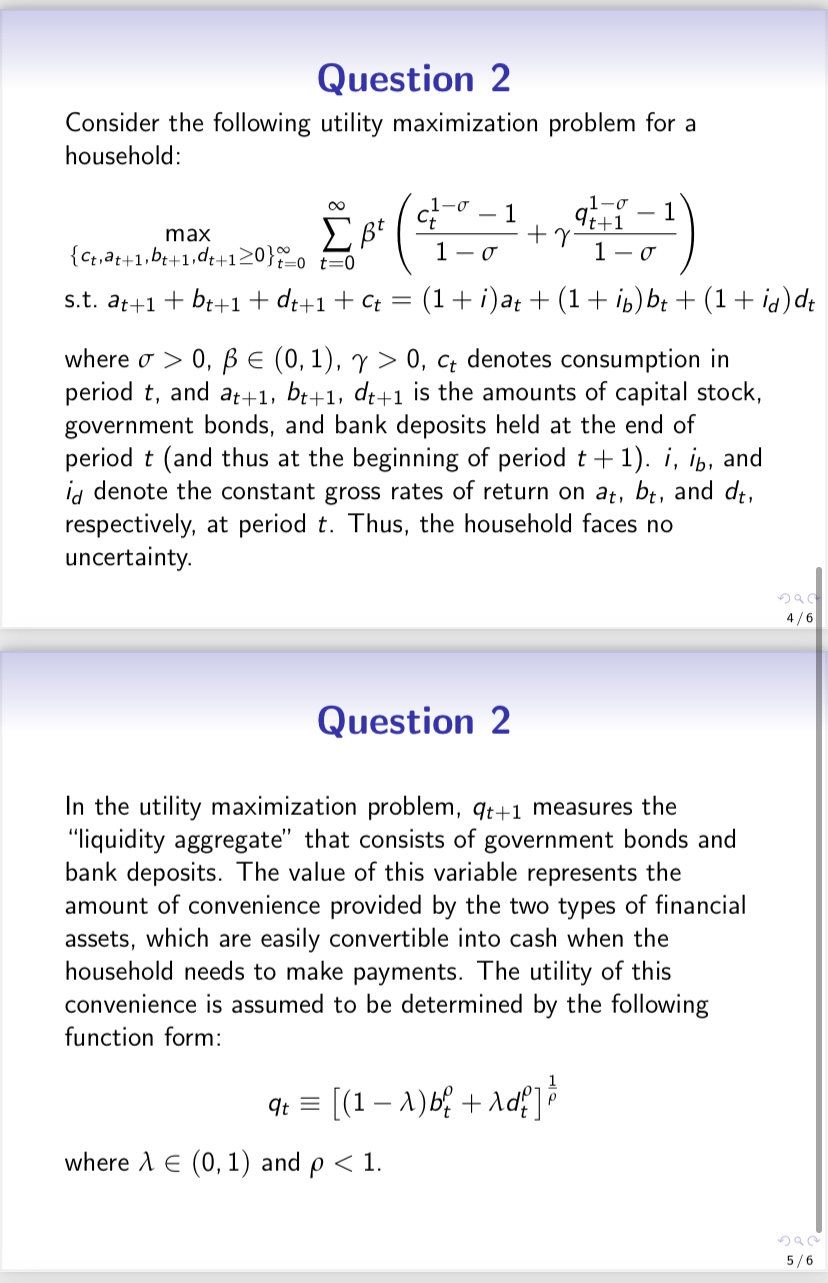
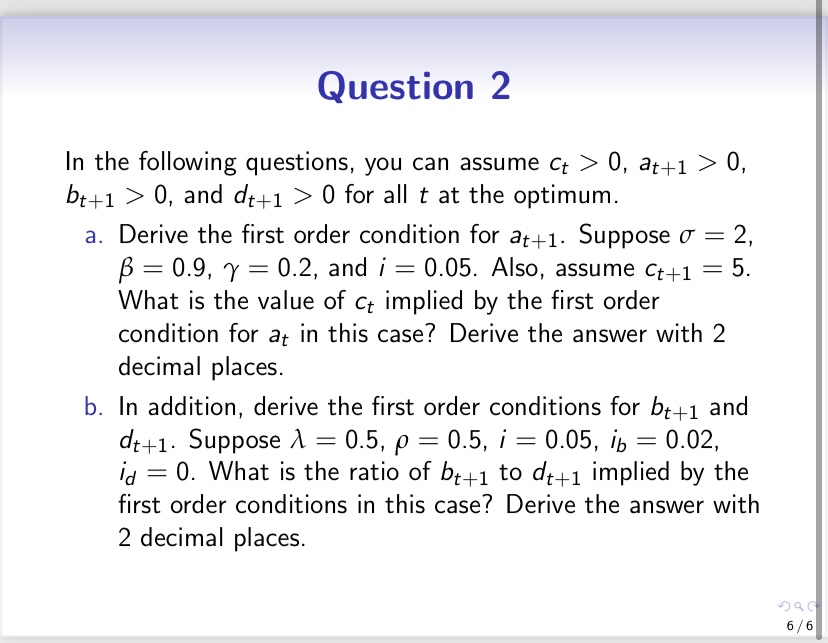
Question 2 Consider the following utility maximization problem for a household: 10 c 1 1 max t) lt(t1T+Tmlg) {ct-at+1-bt+1-dt+1>0}t0 t=0 5.1:. at+1 + bt+1 + alt5.1 + C: = (1 + 0.9: 'l' (1 'l' lb)bt 'l' (1 + id)dt where :7 > 0, :3 6 (0,1), 7 > 0, ct denotes consumption in period t, and at\Question 2 In the following questions, you can assume ct > 0, at+1 > 0, bt+1 :z- 0, and dt+1 > U for all t at the optimum. a. Derive the first order condition for 3H1. Suppose 0' = 2, = 0.9, 1/ = 0.2, and i = 0.05. Also, assume Ct+1 = 5. What is the value of ct implied by the first order condition for at in this case? Derive the answer with 2 decimal places. b. In addition, derive the first order conditions for bt+1 and dig1.1. SUPPOSE l1 = 0.5, P = 0.5, I: 0.05, if; = 0.02, id = 0. What is the ratio of bt+1 to dt+1 implied by the first order conditions in this case? Derive the answer with 2 decimal places. ere
Step by Step Solution
There are 3 Steps involved in it

Get step-by-step solutions from verified subject matter experts
 Study Help