







Question: Question 2: Consider the Priority Scheduling Algorithm with the following data Execution Time 15 Process Pi P2 Ps . Priority 3 1 5 Ps 5
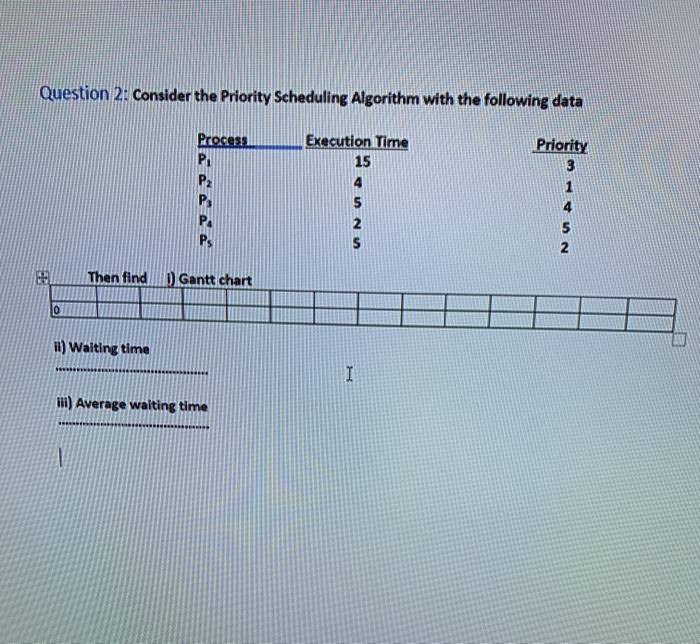
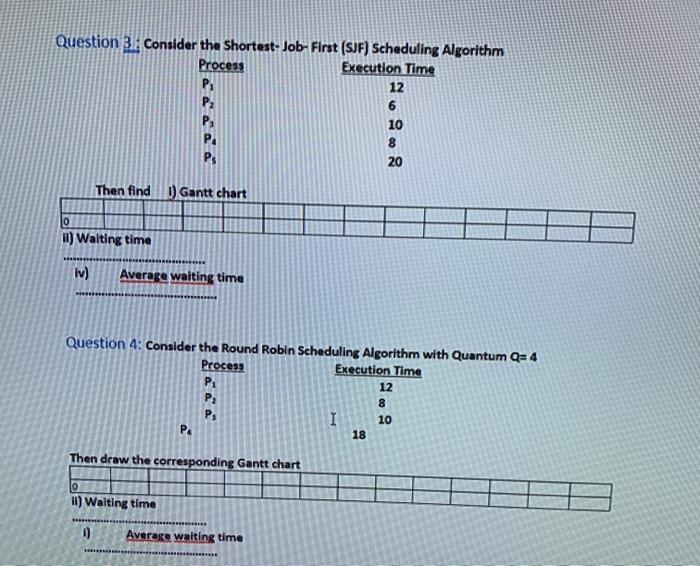
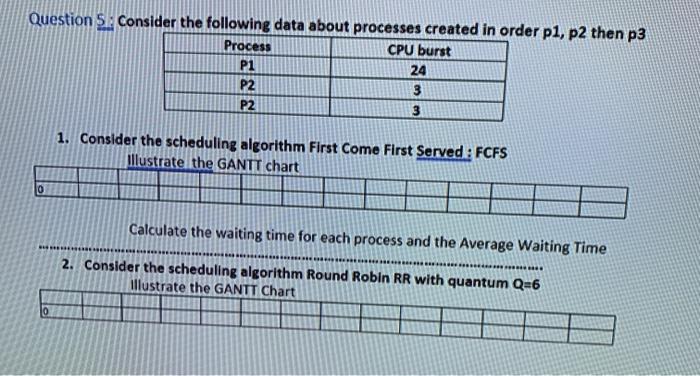
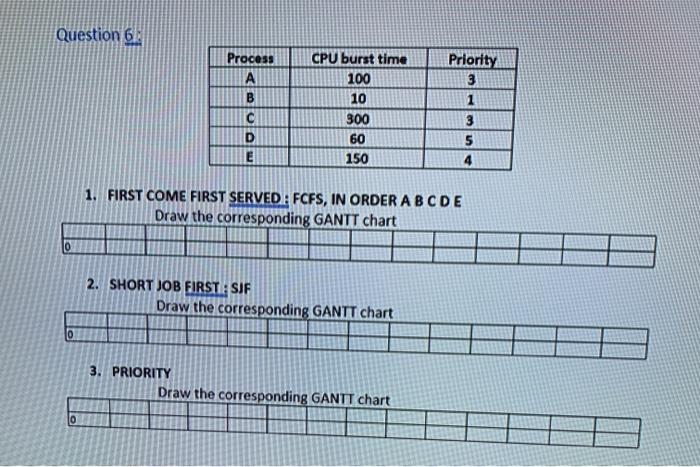
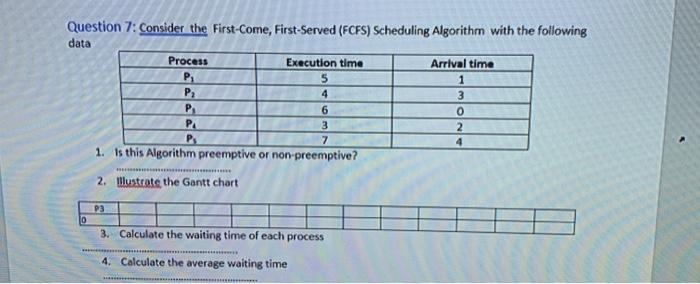
Question 2: Consider the Priority Scheduling Algorithm with the following data Execution Time 15 Process Pi P2 Ps . Priority 3 1 5 Ps 5 2 $ Then find D Gantt chart 0 i) Waiting time I i) Average waiting time Question 3: Consider the shortest-Job- First (SJF) Scheduling Algorithm Process Execution Time P. 12 P2 10 8 PS 20 6 Then find 1) Gantt chart 0 H) Waiting time iv) Average waiting time Question 4: Consider the Round Robin Scheduling Algorithm with Quantum Q= 4 Process Execution Time P P Ps 12 8 10 I PA 18 Then draw the corresponding Gantt chart 10 II) Waiting time 1) Average waiting time re Question 5: Consider the following data about processes created in order p1, p2 then p3 Process CPU burst P1 24 P2 3 P2 3 1. Consider the scheduling algorithm First Come First Served : FCFS Illustrate the GANTT chart 0 Calculate the waiting time for each process and the Average Waiting Time ene 2. Consider the scheduling algorithm Round Robin RR with quantum Q=6 Illustrate the GANTT Chart 10 Question 6 Process A B C D E CPU burst time 100 10 300 60 150 Priority 3 1 3 5 4 1. FIRST COME FIRST SERVED: FCFS, IN ORDER ABCDE Draw the corresponding GANTT chart 2. SHORT JOB FIRST SJF Draw the corresponding GANTT chart 0 3. PRIORITY Draw the corresponding GANTT chart 10 Question 7: Consider the First-Come, First-Served (FCFS) Scheduling Algorithm with the following data Process Execution time Arrival time P 5 1 P 3 P 0 PA 3 2 P 4 1. Is this Algorithm preemptive or non-preemptive? 4 6 7 2. Illustrate the Gantt chart P3 3. Calculate the waiting time of each process 4. Calculate the average waiting time
Step by Step Solution
There are 3 Steps involved in it

Get step-by-step solutions from verified subject matter experts
 Study Help