







Question: Question 2: Contributing to public goods Each player i = 1, 2 is given $100, and then asked to contribute an amount 59,-, to a
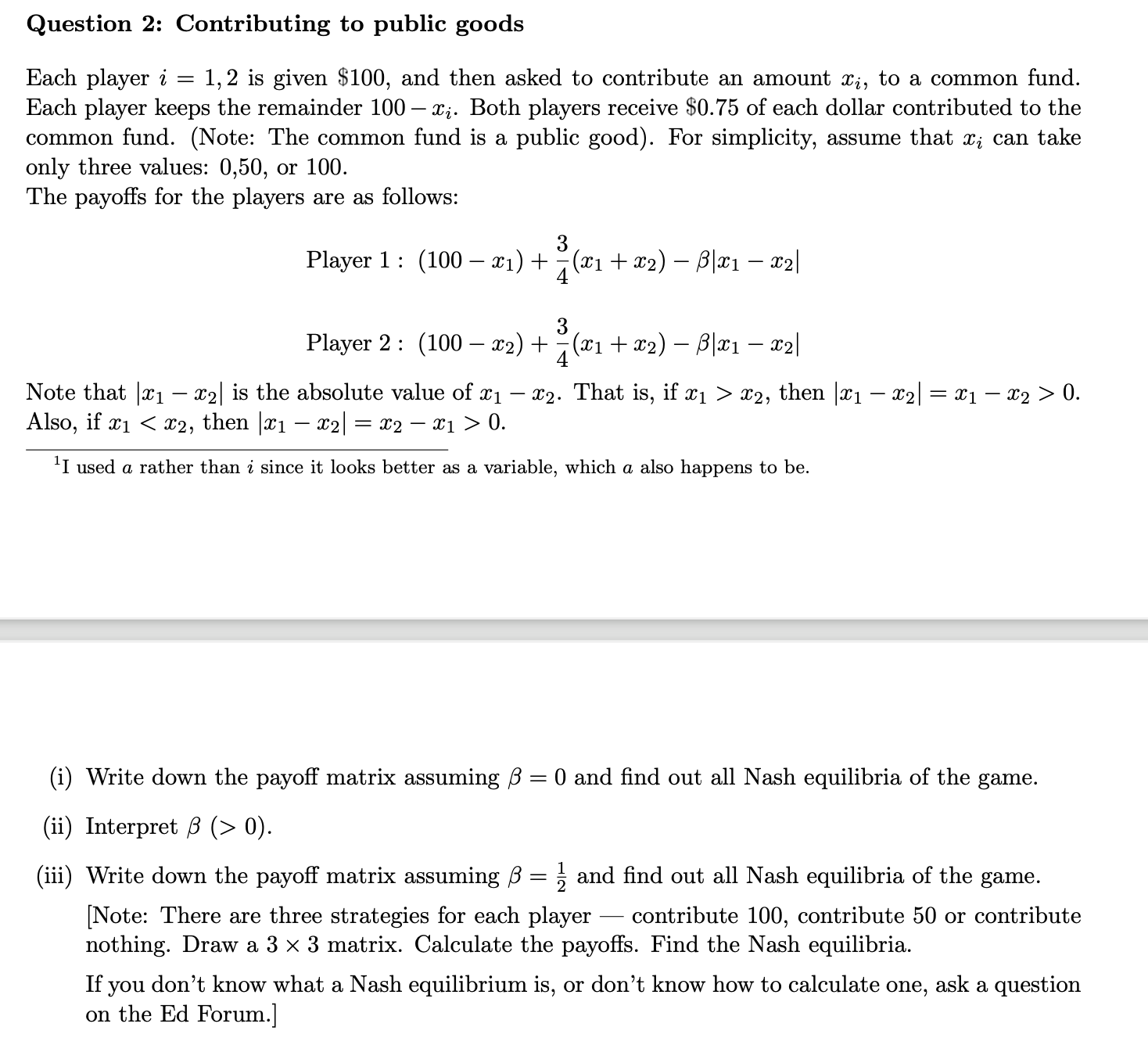
Question 2: Contributing to public goods Each player i = 1, 2 is given $100, and then asked to contribute an amount 59,-, to a common fund. Each player keeps the remainder 100 93,-. Both players receive $0.75 of each dollar contributed to the common fund. (Note: The common fund is a public good). For simplicity, assume that :5,- can take only three values: 0,50, or 100. The payoffs for the players are as follows: 3 Player 1: (100 x1) + ;(331 + :122) lwl ml 3 Player 2: (100 :02) + Z031 + m2) lml m2| Note that I331 ccgl is the absolute value of $1 332. That is, if 3:1 > :32, then |a:1 m2 = 3:1 2:2 > 0. Also, if 2:1 O. 1I used a rather than it; since it looks better as a variable, which 0. also happens to be. (i) Write down the payoff matrix assuming B = 0 and nd out all Nash equilibria of the game. (ii) Interpret ,8 (> 0). (iii) Write down the payoff matrix assuming ,6 = % and nd out all Nash equilibria of the game. [Note: There are three strategies for each player 7 contribute 100, contribute 50 or contribute nothing. Draw a 3 x 3 matrix. Calculate the payoffs. Find the Nash equilibria. If you don't know what a Nash equilibrium is, or don't know how to calculate one, ask a question on the Ed Forum.]
Step by Step Solution
There are 3 Steps involved in it

Get step-by-step solutions from verified subject matter experts
 Study Help