







Question: Question 2 Earlier in the class we discussed the need to have patents to encourage rms to make costly investments in innovation. Here we revisit
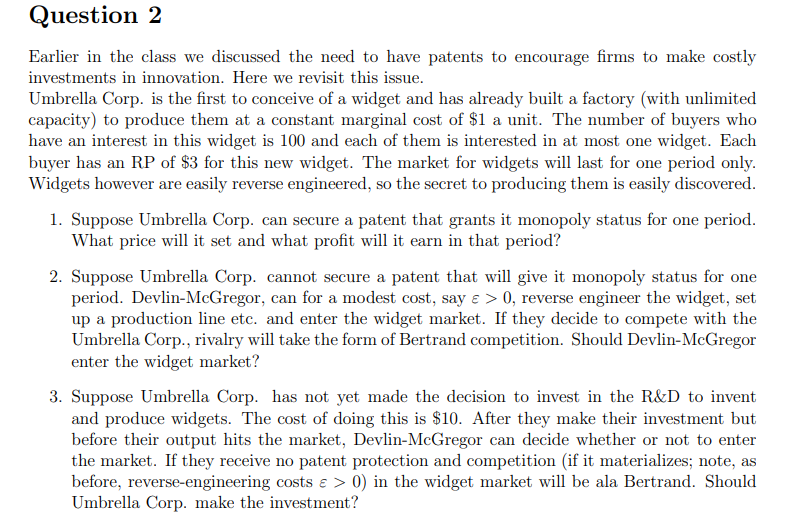
Question 2 Earlier in the class we discussed the need to have patents to encourage rms to make costly investments in innovation. Here we revisit this issue. Umbrella Corp. is the rst to conceive of a widget and has already built a factory {with unlimited capacity} to produce them at a constant marginal cost of $1 a unit. The number of buyers who have an interest in this widget is 100 and each of them is interested in at most one widget. Each buyer has an HP of $3 for this new widget. The market for widgets will last for one period only. Widgets however are easily reverse engineered, so the secret to producing them is easily discovered. 1. Suppose Umbrella Corp. can secure a patent that grants it monopoly status for one period. What price will it set and what prot will it earn in that period'iI 2. Suppose Umbrella Corp. cannot secure a patent that will give it monopoly status for one period. Devlin-McGregor, can for a modest cost, say E .3 i], reverse engineer the widget, set up a production line etc. and enter the widget market. If they decide to compete with the Umbrella Corp, rivalry will take the form of Bertrand competition. Should Devlin-McGregor enter the widget market?I 3. Suppose Umbrella Corp. has not yet made the decision to invest in the Rial] to invent and produce widgets. The cost of doing this is $10. After they make their investment but before their output hits the market, Devlin-McGregor can decide whether or not to enter the market. If they receive no patent protection and competition {if it materializes; note, as before, reverse-engineering costs a :3 [l] in the widget market will be ala Bertrand. Should Umbrella Corp. make the investment
Step by Step Solution
There are 3 Steps involved in it

Get step-by-step solutions from verified subject matter experts
 Study Help