



Question: QUESTION 2 In a given town in Zambia, the average number of people per household is 6 . The total number of households in the
QUESTION
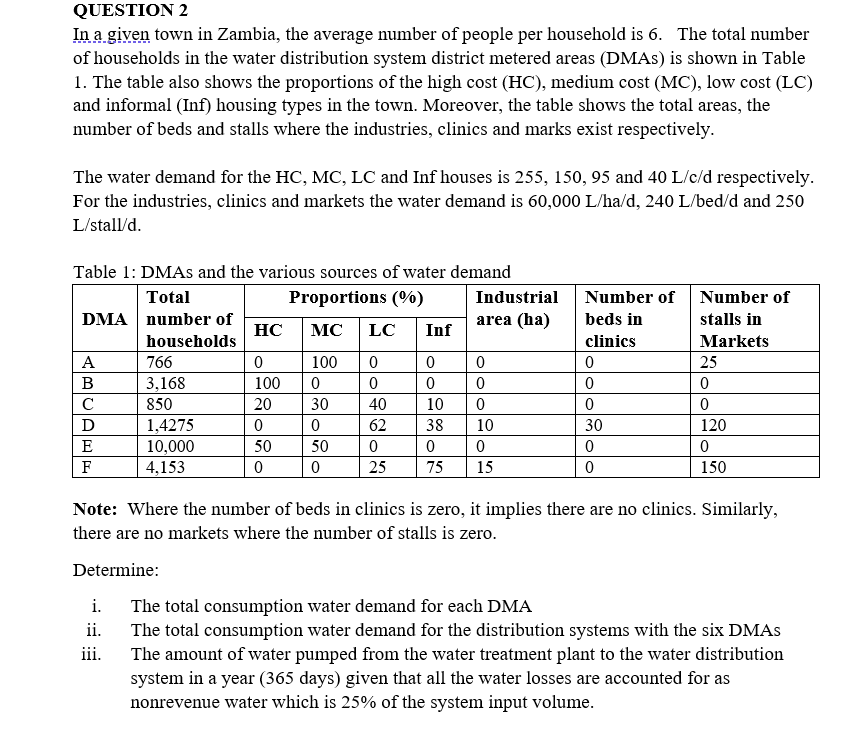
In a given town in Zambia, the average number of people per household is The total number of households in the water distribution system district metered areas DMAs is shown in Table The table also shows the proportions of the high cost HC medium cost MC low cost LC and informal Inf housing types in the town. Moreover, the table shows the total areas, the number of beds and stalls where the industries, clinics and marks exist respectively.
The water demand for the HC MC LC and Inf houses is and Lcd respectively. For the industries, clinics and markets the water demand is Lhad Lbedd and Lstalld
Table : DMAs and the various sources of water demand
DMA Total number of households Proportions Industrial area ha Number of beds in clinics Number of stalls in Markets
HC MC LC Inf
A
B
C
D
E
F
Note: Where the number of beds in clinics is zero, it implies there are no clinics. Similarly, there are no markets where the number of stalls is zero.
Determine:
i The total consumption water demand for each DMA
ii The total consumption water demand for the distribution systems with the six DMAs
iii. The amount of water pumped from the water treatment plant to the water distribution system in a year days given that all the water losses are accounted for as nonrevenue water which is of the system input volume.QUESTION
In agiven town in Zambia, the average number of people per household is The total number of households in the water distribution system district metered areas DMAs is shown in Table The table also shows the proportions of the high cost medium cost MC low cost LC and informal Inf housing types in the town. Moreover, the table shows the total areas, the number of beds and stalls where the industries, clinics and marks exist respectively.
The water demand for the HC MC LC and Inf houses is and respectively. For the industries, clinics and markets the water demand is and stalld
Table : DMAs and the various sources of water demand
tableDMAtableTotalnumber ofhouseholdsProportions tableIndustrialarea hatableNumber ofbeds inclinicstableNumber ofstalls inMarketsHCMCLCInfABCDEF
Note: Where the number of beds in clinics is zero, it implies there are no clinics. Similarly, there are no markets where the number of stalls is zero.
Determine:
i The total consumption water demand for each DMA
ii The total consumption water demand for the distribution systems with the six DMAs
iii. The amount of water pumped from the water treatment plant to the water distribution system in a year days given that all the water losses are accounted for as nonrevenue water which is of the system input volume.
Step by Step Solution
There are 3 Steps involved in it
1 Expert Approved Answer
Step: 1 Unlock

Question Has Been Solved by an Expert!
Get step-by-step solutions from verified subject matter experts
Step: 2 Unlock
Step: 3 Unlock