



Question: QUESTION 2 In order to extract acetic acid from a dilute aqueous solution with isopropyl ether, the two immiscible phases are passed counter currently through
QUESTION In order to extract acetic acid from a dilute aqueous solution with isopropyl
ether, the two immiscible phases are passed counter currently through a
packed column in length and in diameter. It is found that if
of the pure benzene is used to extract of acid by mass,
then the benzene phase leaves the column with a concentration of per
cent acid by mass. The equilibrium relationship is given by: acid
benzene acid water Calculate the concentration of acid in the
raffinate.
Use Table to calculate questions and
Table : Distillate and Bottoms mole fraction values
tableCompositiontableFeedkmolhalpha tableDistillatekmolhxdtableBottomskmolhxbALKB HKCTotal
Use the Fenske equation to determine the minimum number of trays.
If the tray efficiency is calculate the location of the feed tray.
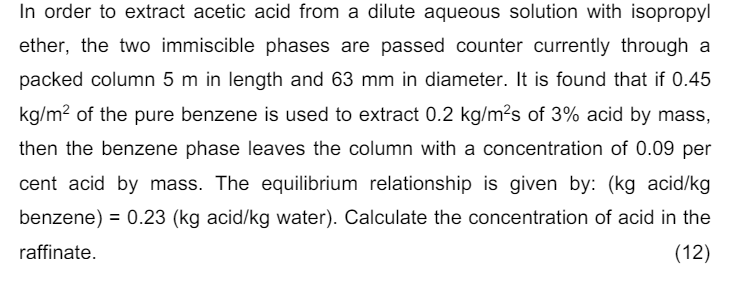
In order to extract acetic acid from a dilute aqueous solution with isopropyl
ether, the two immiscible phases are passed counter currently through a
packed column in length and in diameter. It is found that if
of the pure benzene is used to extract of acid by mass,
then the benzene phase leaves the column with a concentration of per
cent acid by mass. The equilibrium relationship is given by: acid
benzene acid water Calculate the concentration of acid in the
raffinate.
Step by Step Solution
There are 3 Steps involved in it
1 Expert Approved Answer
Step: 1 Unlock

Question Has Been Solved by an Expert!
Get step-by-step solutions from verified subject matter experts
Step: 2 Unlock
Step: 3 Unlock