







Question: Question 2 in Python please. The Discrete Fourier Transform (DFT) of a periodic array fj, for j = 0, 1, ..., N-1 (correspond- ing to
Question 2 in Python please.
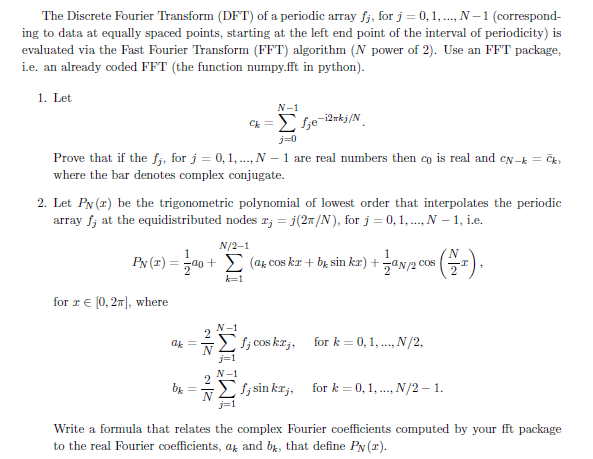
The Discrete Fourier Transform (DFT) of a periodic array fj, for j = 0, 1, ..., N-1 (correspond- ing to data at equally spaced points, starting at the left end point of the interval of periodicity) is evaluated via the Fast Fourier Transform (FFT) algorithm (N power of 2). Use an FFT package, i.e. an already coded FFT (the function numpy.fit in python). 1. Let N-1 Ck = )fje-12xkj/N j=0 Prove that if the f; for j = 0. 1. ... N - 1 are real numbers then co is real and CN-k = Ck where the bar denotes complex conjugate. 2. Let Py(r) be the trigonometric polynomial of lowest order that interpolates the periodic array f; at the equidistributed nodes x; = j(27/N), for j = 0, 1. .... N -1, i.e. N/2-1 PN(x) = zoo+ ) (a& coskr + be sinkr) + =0N/2 COS N K = 1 for r E [0, 2x], where 2 N-1 f; coskr; for k = 0, 1, ..., N/2. j=1 2 N-1 bk = f, sinkr;, for k = 0, 1. .. N/2-1. 21 Write a formula that relates the complex Fourier coefficients computed by your fit package to the real Fourier coefficients, ax and be, that define PN (r)
Step by Step Solution
There are 3 Steps involved in it

Get step-by-step solutions from verified subject matter experts
 Study Help