



Question: Question 2 In the lumber industry there are only two rms: A-tree and B-tree. They sell the same type of lumber; i.e. homogeneous products, and
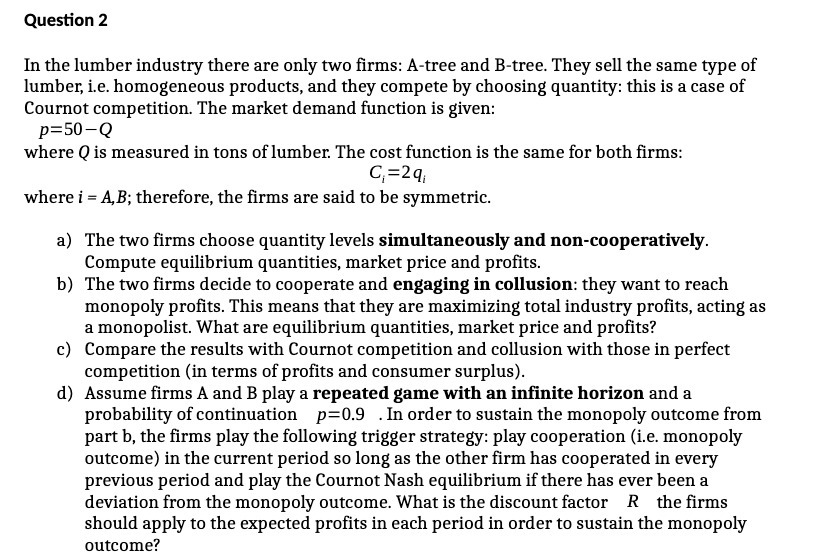
Question 2 In the lumber industry there are only two rms: A-tree and B-tree. They sell the same type of lumber; i.e. homogeneous products, and they compete by choosing quantity: this is a case of Cournot competition. The market demand function is given: P=5Q where Q is measured in tons of lumber The cost function is the same for both rms: C: :2 'li where i = AB; therefore, the rms are said to be symmetric. a) The two firms choose quantity levels simultaneously and non-cooperatively. Compute equilibrium quantities, market price and prots. b} The two rms decide to cooperate and engaging in collusion: they want to reach monopoly prots. This means that they are maximizing total industry prots, acting as a monopolist. What are equilibrium quantities, market price and prots? c} Compare the results with Cournot competition and collusion with those in perfect competition (in terms of prots and consumer surplus}. d} Assume rms A and B play a repeated game with an innite horizon and a probability of continuation 13:11.9 . In order to sustain the monopoly outcome from part bI the firms play the following trigger strategy: play cooperation (i.e. monopoly outcome) in the current period so long as the other rm has cooperated in every previous period and play the Cournot Nash equilibrium if there has ever been a deviation from the monopoly outcome. What is the discount factor R the rms should apply to the expected prots in each period in order to sustain the monopoly outcome
Step by Step Solution
There are 3 Steps involved in it

Get step-by-step solutions from verified subject matter experts