







Question: Question 2 In this problem, we will consider a multitasking problem where the principal can only incentivize the agent on one task, but where there
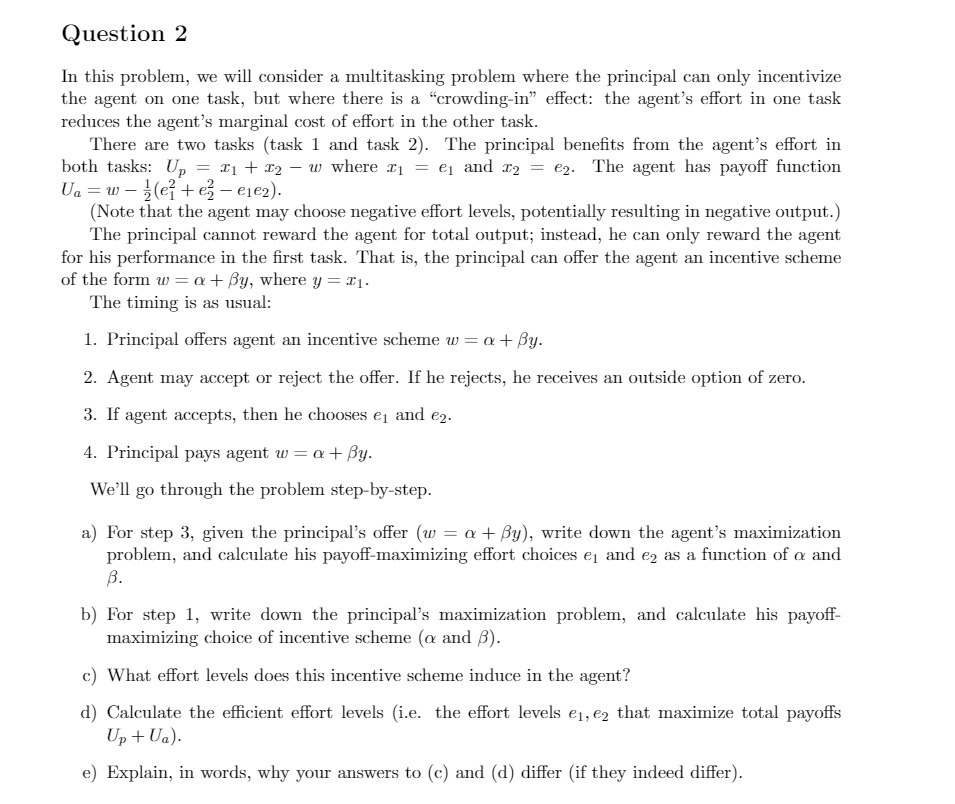
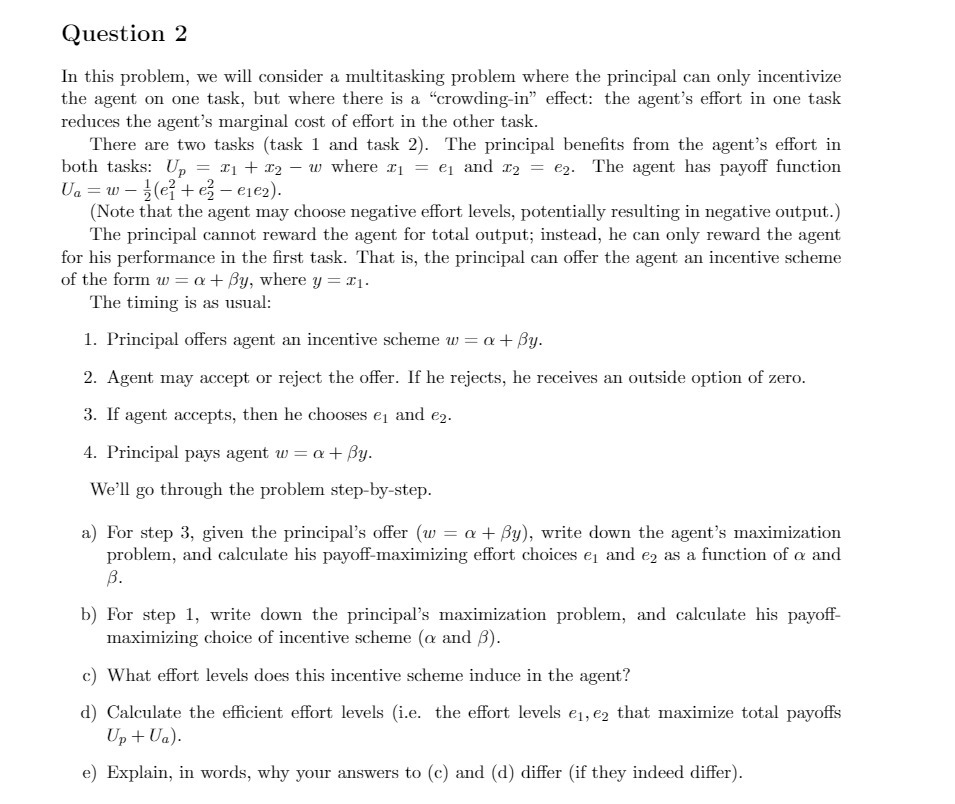
Question 2 In this problem, we will consider a multitasking problem where the principal can only incentivize the agent on one task, but where there is a "crowding-in" effect: the agent's effort in one task reduces the agent's marginal cost of effort in the other task. There are two tasks (task 1 and task 2). The principal benefits from the agent's effort in both tasks: Up = 21 + 12 - w where r1 = e and 12 = e2. The agent has payoff function Ua = w -?(eit ez -ele2). (Note that the agent may choose negative effort levels, potentially resulting in negative output.) The principal cannot reward the agent for total output; instead, he can only reward the agent for his performance in the first task. That is, the principal can offer the agent an incentive scheme of the form w = a + By, where y = =1. The timing is as usual: 1. Principal offers agent an incentive scheme w = a + By. 2. Agent may accept or reject the offer. If he rejects, he receives an outside option of zero. 3. If agent accepts, then he chooses e, and ez. 4. Principal pays agent w = a + By. We'll go through the problem step-by-step. a) For step 3, given the principal's offer (w = o + By), write down the agent's maximization problem, and calculate his payoff-maximizing effort choices e, and ez as a function of o and B. b) For step 1, write down the principal's maximization problem, and calculate his payoff- maximizing choice of incentive scheme (o and B). c) What effort levels does this incentive scheme induce in the agent? d) Calculate the efficient effort levels (i.e. the effort levels en, ez that maximize total payoffs Up + Ua). e) Explain, in words, why your answers to (c) and (d) differ (if they indeed differ)
Step by Step Solution
There are 3 Steps involved in it

Get step-by-step solutions from verified subject matter experts
 Study Help