



Question: Question 2 Ji (n) fa(n) for example, 1 fan) log(n) where g(n) h(n) means that got n n2 (b) fs(n) 210B4(4m + 17) (c) fe(n)-
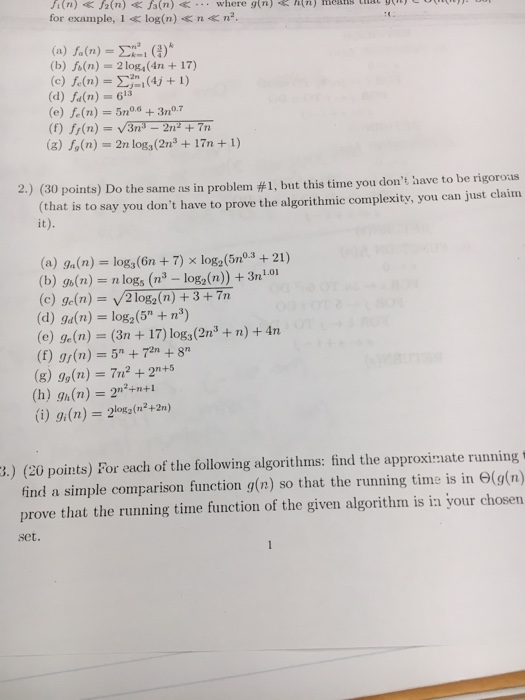
Ji (n) fa(n) for example, 1 fan) log(n) where g(n) h(n) means that got n n2 (b) fs(n) 210B4(4m + 17) (c) fe(n)- (4j+1) (d) fa(n)-613 (8) (n)-2n loga(2n3 + 17n +1) 2) (30 points) Do the same as in problem #1, but this time you don't aave to be (that is to say you don't have to prove the algorithmic complexity, you can just claim it). (a) an) log (6n +7) x log2(5n0.3+21) (b) 9(n) n logs (n3 - log2(n))+3n101 (c) ge(n) = V21082(n) + 3 + 7n (d) galn) - log2(5 n3) (e) ge(n) (3n + 17) loga (2n+ n)+4n (f) gr(n)-5 72n8 (g) gg(n)-me + 2n+5 (h))2+1 (i) gi(n) = 210Kg(m2+2n) 3.) (20 points) For each of the following algorithms: find the approximate running find a simple comparison function g(n) so that the running time is in (g(n) prove that the running time function of the given algorithm is ia your chosen set
Step by Step Solution
There are 3 Steps involved in it

Get step-by-step solutions from verified subject matter experts