







Question: Question 2 - Modeling Demand with Profit Maximization Now instead assume that in addition to the measurement error, e, there is a structural shock to
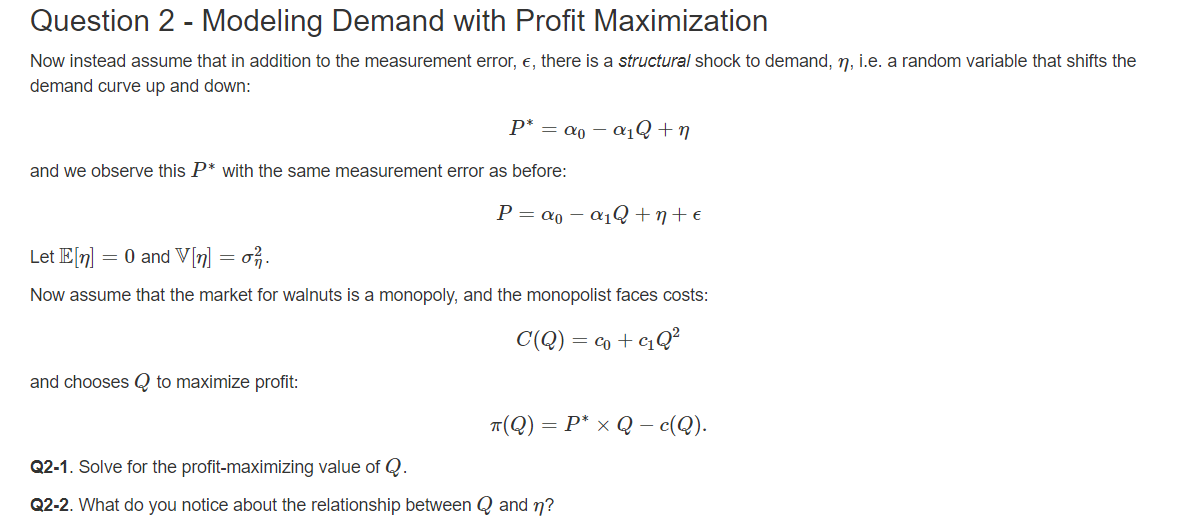
Question 2 - Modeling Demand with Profit Maximization Now instead assume that in addition to the measurement error, e, there is a structural shock to demand, n, i.e. a random variable that shifts the demand curve up and down: P* = - Q + and we observe this P* with the same measurement error as before: P = - Q++ Let E[n] = 0 and V[n] = 0 Now assume that the market for walnuts is a monopoly, and the monopolist faces costs: C(Q) = Cu + CO2 and chooses Q to maximize profit: TQ) = P* * Q - c(Q). Q2-1. Solve for the profit-maximizing value of Q. Q2-2. What do you notice about the relationship between Q and n? Question 2 - Modeling Demand with Profit Maximization Now instead assume that in addition to the measurement error, e, there is a structural shock to demand, n, i.e. a random variable that shifts the demand curve up and down: P* = - Q + and we observe this P* with the same measurement error as before: P = - Q++ Let E[n] = 0 and V[n] = 0 Now assume that the market for walnuts is a monopoly, and the monopolist faces costs: C(Q) = Cu + CO2 and chooses Q to maximize profit: TQ) = P* * Q - c(Q). Q2-1. Solve for the profit-maximizing value of Q. Q2-2. What do you notice about the relationship between Q and n
Step by Step Solution
There are 3 Steps involved in it

Get step-by-step solutions from verified subject matter experts
 Study Help