







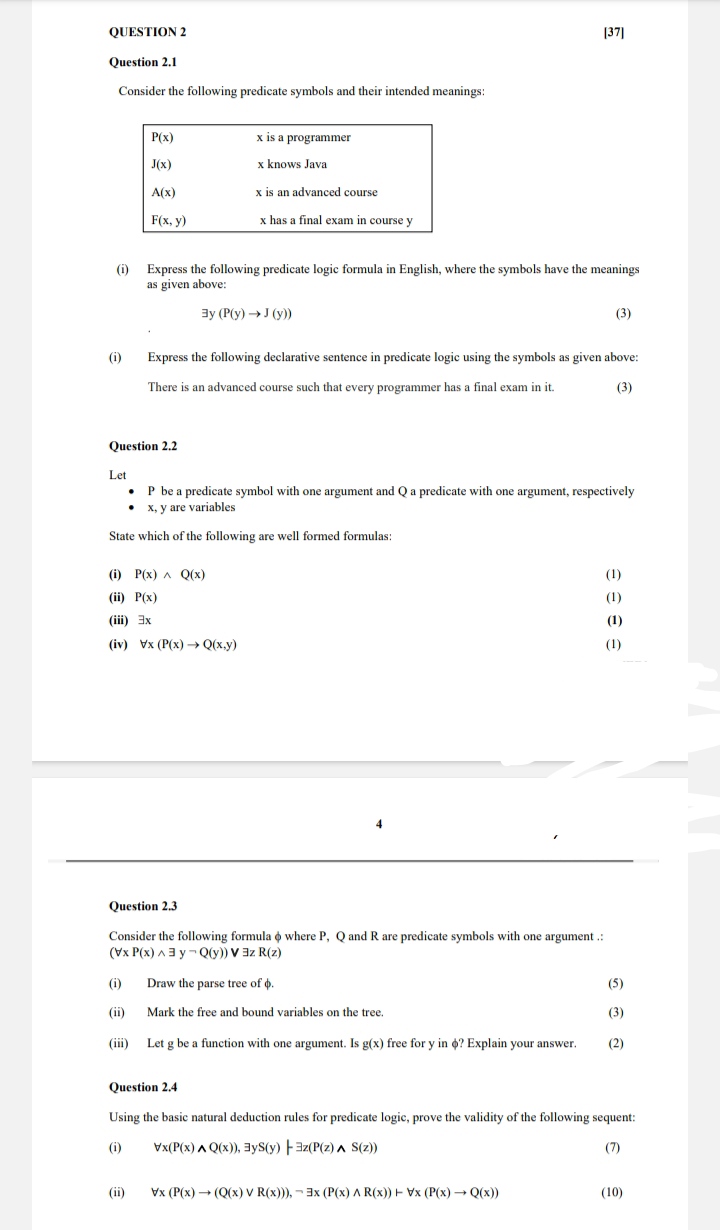
Question: QUESTION 2 Question 2 . 1 Consider the following predicate symbols and their intended meanings: ( i ) Express the following predicate logic formula in
QUESTION
Question
Consider the following predicate symbols and their intended meanings:
i Express the following predicate logic formula in English, where the symbols have the meanings
as given above:
EEy
i Express the following declarative sentence in predicate logic using the symbols as given above:
There is an advanced course such that every programmer has a final exam in it
Question
Let
be a predicate symbol with one argument and a predicate with one argument, respectively
are variables
State which of the following are well formed formulas:
i
ii
iii EEx
iv
Question
Consider the following formula where and are predicate symbols with one argument :
EEynotQ
i Draw the parse tree of
ii Mark the free and bound variables on the tree.
iii Let be a function with one argument. Is free for in Explain your answer.
Question
Using the basic natural deduction rules for predicate logic, prove the validity of the following sequent:
iAAxEEySEEz
ii AAxnotEExAAx
Step by Step Solution
There are 3 Steps involved in it
1 Expert Approved Answer
Step: 1 Unlock

Question Has Been Solved by an Expert!
Get step-by-step solutions from verified subject matter experts
Step: 2 Unlock
Step: 3 Unlock
 Study Help