







Question: Question 2: Sorting . . . . . . . . . . . . . . . . . . . . . .
Question 2: Sorting . . . . . . . . . . . . . . . . . . . . . . . . . . . . . . . . . . . . . . . . . . [10 points] We have a file P =10,000 pages, and we want to sort it using external merge sort. Assume the simplest algorithm, that is, no double buffering, no blocked I/O, and quicksort for in-memory sorting. (a) [3 points] With B=100 buffers available, what is the largest file we can sort with two passes? That is, how many pages P will this file have? (a) (b) [3 points] What is the smallest number of buffers B, that can sort the file with P =10,000 pages, in two passes? (b) (c) [4 points] How many pages P3 are in the largest file we can sort in 3 passes, with B=100 buffers? (c) Again, please give numerical answers; explanations are optional, and will only be used to your benefit, for partial credit. 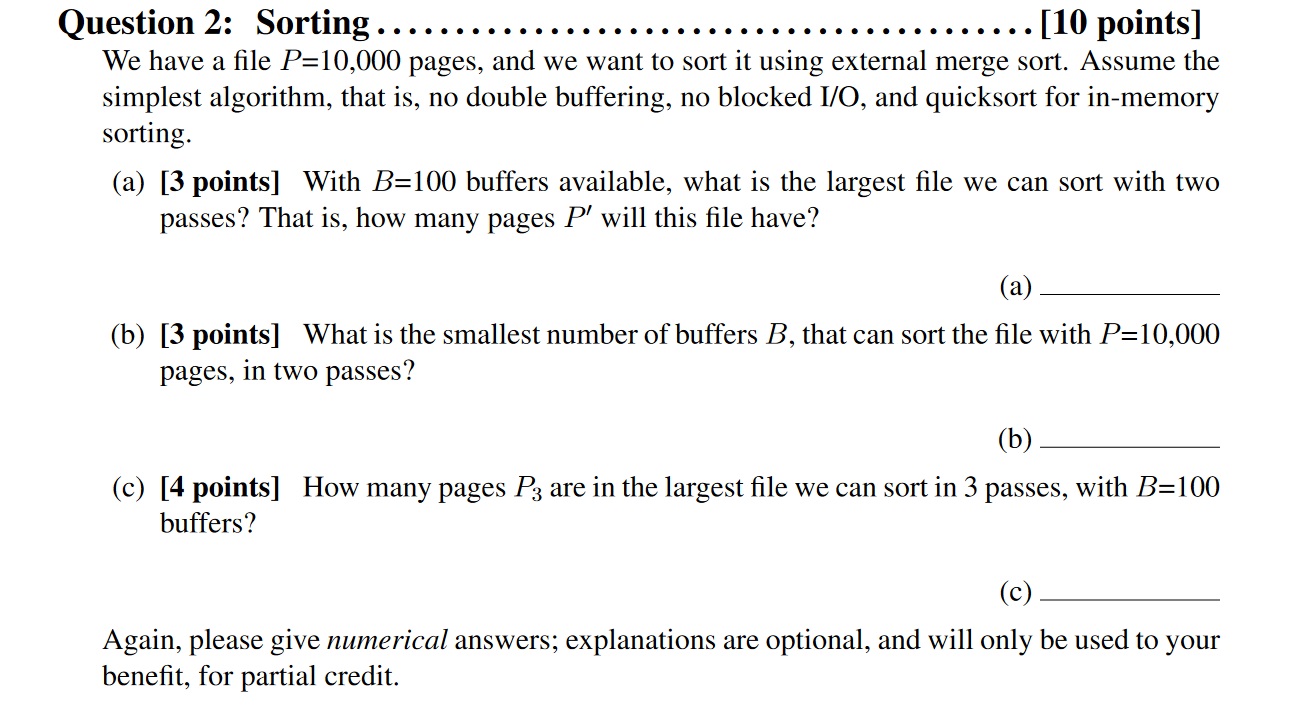
We have a file P=10,000 pages, and we want to sort it using external merge sort. Assume the simplest algorithm, that is, no double buffering, no blocked I/O, and quicksort for in-memory sorting. (a) [3 points] With B=100 buffers available, what is the largest file we can sort with two passes? That is, how many pages P will this file have? (a) (b) [3 points] What is the smallest number of buffers B, that can sort the file with P=10,000 pages, in two passes? (b) (c) [4 points] How many pages P3 are in the largest file we can sort in 3 passes, with B=100 buffers? (c) Again, please give numerical answers; explanations are optional, and will only be used to your benefit, for partial credit
Step by Step Solution
There are 3 Steps involved in it

Get step-by-step solutions from verified subject matter experts
 Study Help