







Question: question 2 thank you Let (X1, X2, . . ., Xn) denote a random sample from the density function f (z10) = -0 In(0) I(x
question 2 thank you
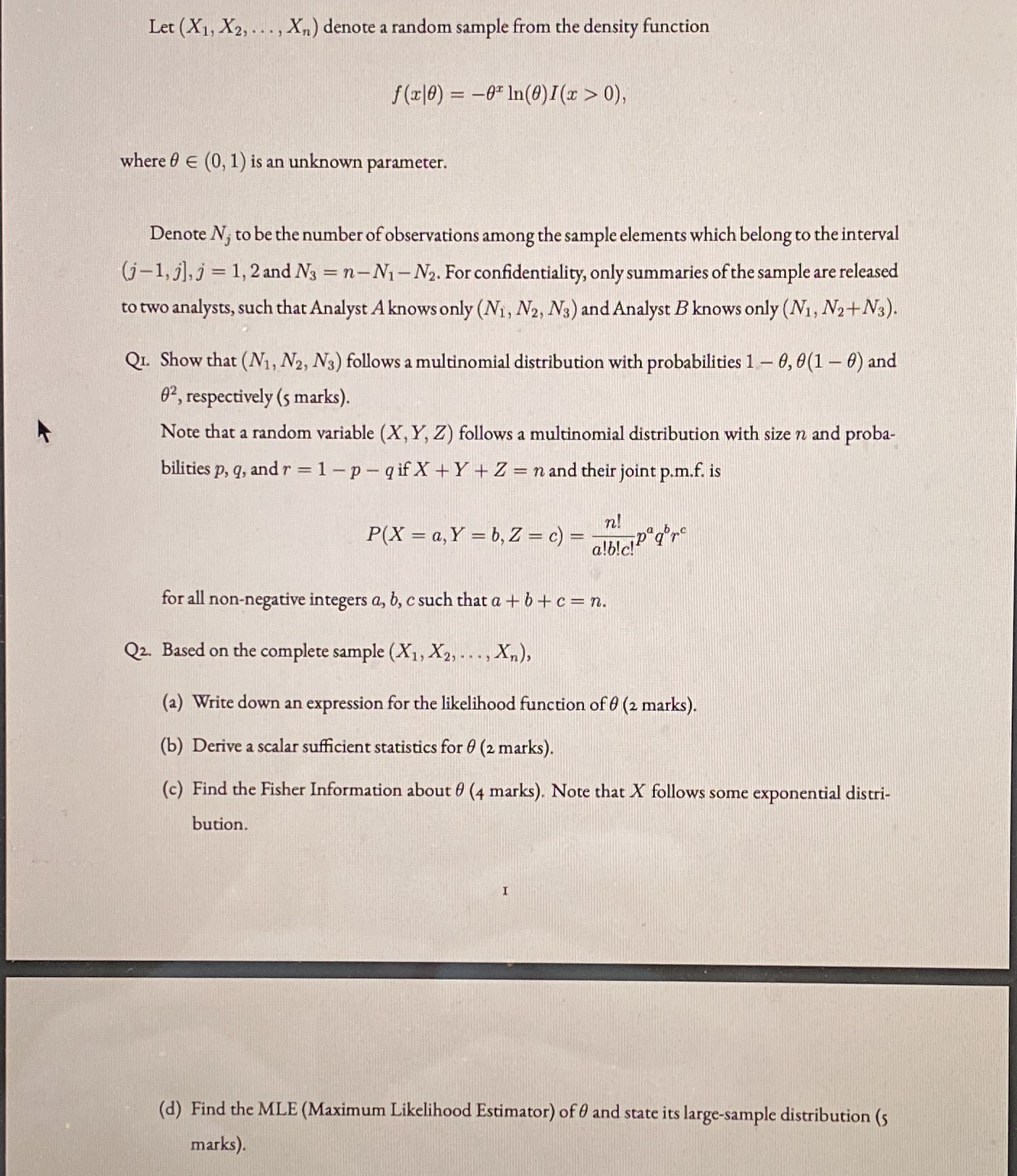
Let (X1, X2, . . ., Xn) denote a random sample from the density function f (z10) = -0" In(0) I(x > 0), where 0 E (0, 1) is an unknown parameter. Denote N, to be the number of observations among the sample elements which belong to the interval (j-1, j], j = 1, 2 and N3 = n-N1-N2. For confidentiality, only summaries of the sample are released to two analysts, such that Analyst A knows only (N1, N2, N3) and Analyst B knows only (N1, N2 + N3). Q1. Show that (N1, N2, N3) follows a multinomial distribution with probabilities 1 - 0, 0(1 - 0) and 02, respectively (s marks). Note that a random variable (X, Y, Z) follows a multinomial distribution with size n and proba- bilities p, q, and r = 1 -p - qif X + Y + Z = n and their joint p.m.f. is P(X = a, Y = b, Z = c) = _ n! a!b! ! Para for all non-negative integers a, b, c such that a + b + c = n. Q2. Based on the complete sample (X1, X2, . . ., Xn), (a) Write down an expression for the likelihood function of 0 (2 marks). (b) Derive a scalar sufficient statistics for 0 (2 marks). (c) Find the Fisher Information about 0 (4 marks). Note that X follows some exponential distri- bution. (d) Find the MLE (Maximum Likelihood Estimator) of 0 and state its large-sample distribution (s marks)
Step by Step Solution
There are 3 Steps involved in it

Get step-by-step solutions from verified subject matter experts
 Study Help