







Question: Question 2 (Thin Airfoil Theory) - 20 Marks - Solve the following questions: a. Consider the data for the NACA 2412 airfoil given in
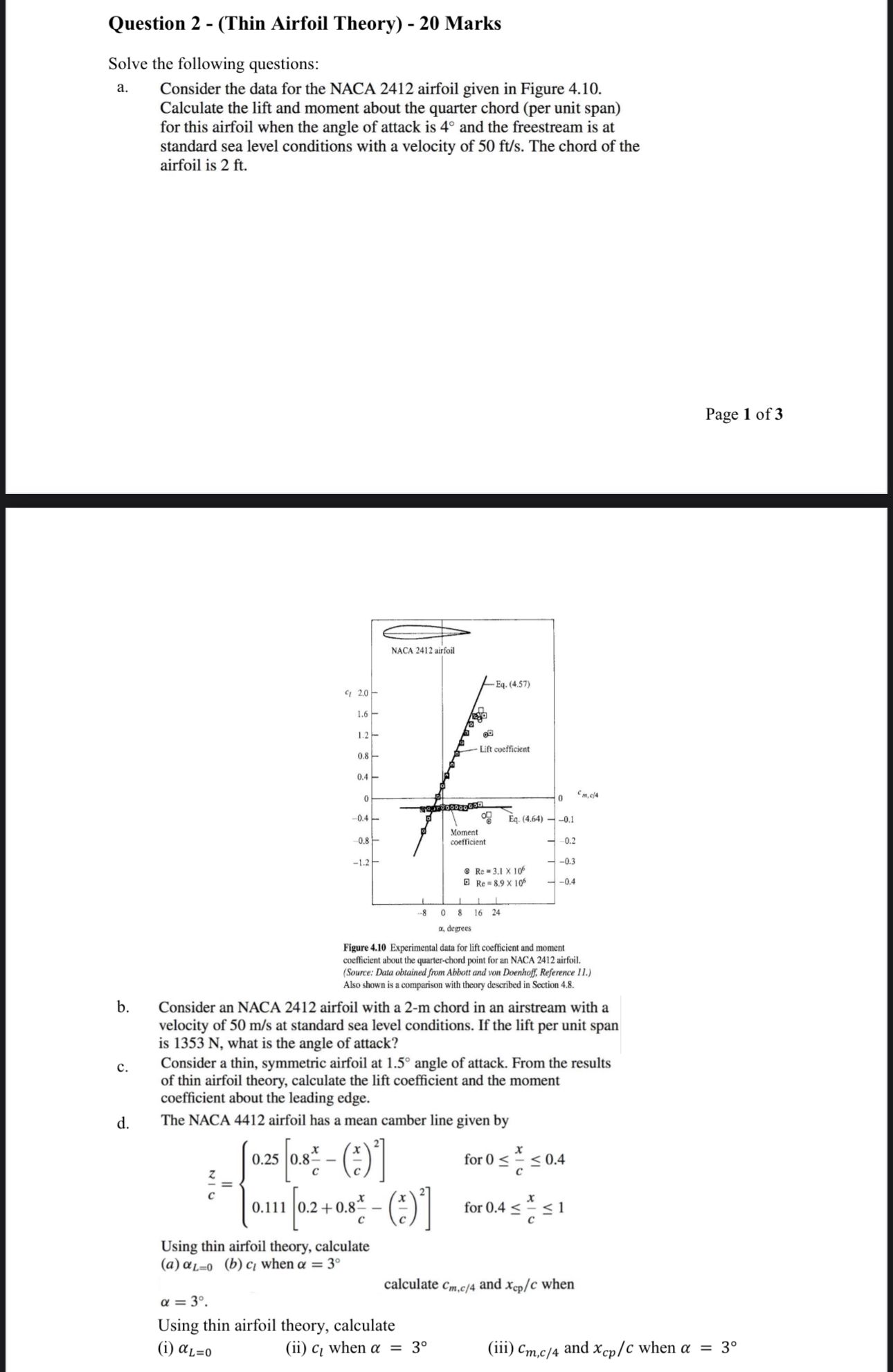
Question 2 (Thin Airfoil Theory) - 20 Marks - Solve the following questions: a. Consider the data for the NACA 2412 airfoil given in Figure 4.10. Calculate the lift and moment about the quarter chord (per unit span) for this airfoil when the angle of attack is 4 and the freestream is at standard sea level conditions with a velocity of 50 ft/s. The chord of the airfoil is 2 ft. b. C. d. 2.0- NACA 2412 airfoil -Eq. (4.57) 1.6 1.2- Lift coefficient 0.8- 0.4- Cm,c/4 0 000000050 -0.4- Eq. (4.64) -0.1 -0.8H Moment coefficient 0.2 -1.2- -0.3 Re 3.1 X 10⁶ Re = 8.9 X 10% -0.4 T -8 08 16 24 a, degrees Figure 4.10 Experimental data for lift coefficient and moment coefficient about the quarter-chord point for an NACA 2412 airfoil. (Source: Data obtained from Abbott and von Doenhoff, Reference 11.) Also shown is a comparison with theory described in Section 4.8. Consider an NACA 2412 airfoil with a 2-m chord in an airstream with a velocity of 50 m/s at standard sea level conditions. If the lift per unit span is 1353 N, what is the angle of attack? Consider a thin, symmetric airfoil at 1.5 angle of attack. From the results of thin airfoil theory, calculate the lift coefficient and the moment coefficient about the leading edge. The NACA 4412 airfoil has a mean camber line given by 0.25 [0.8-(+)*] ()] C 0.111 0.2+0.8 Using thin airfoil theory, calculate (a) -0 (b) c when = 3 = 30. x for 0 0.4 C for 0.4 = 1 x calculate Cm,c/4 and xcp/c when Using thin airfoil theory, calculate (i) L=0 Page 1 of 3 (ii) c when = 3 (iii) Cm,c/4 and xcp/c when = 3
Step by Step Solution
There are 3 Steps involved in it

Get step-by-step solutions from verified subject matter experts
 Study Help