







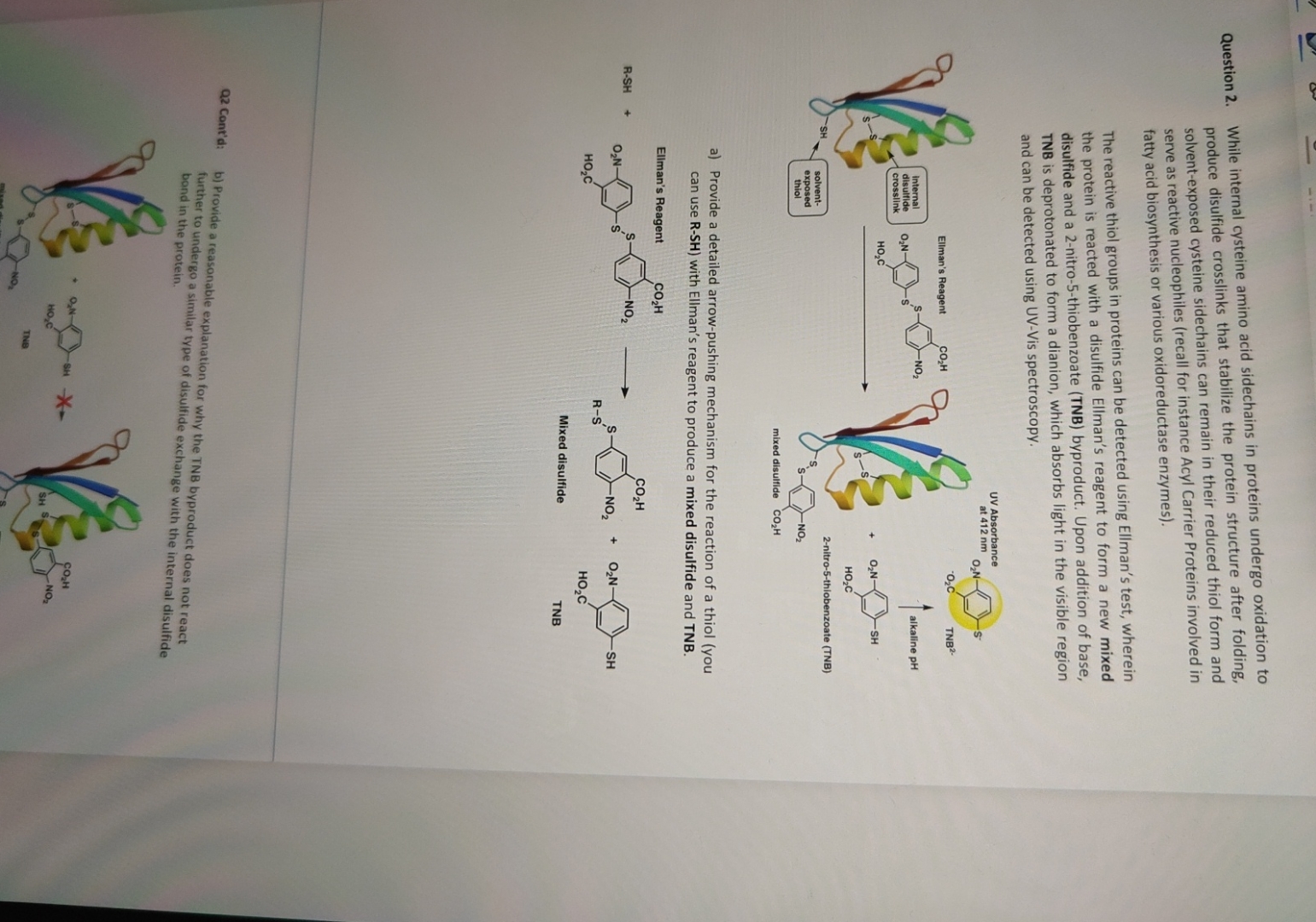
Question: Question 2 . While internal cysteine amino acid sidechains in proteins undergo oxidation to produce disulfide crosslinks that stabilize the protein structure after folding, solvent
Question While internal cysteine amino acid sidechains in proteins undergo oxidation to produce disulfide crosslinks that stabilize the protein structure after folding, solventexposed cysteine sidechains can remain in their reduced thiol form and serve as reactive nucleophiles recall for instance Acyl Carrier Proteins involved in fatty acid biosynthesis or various oxidoreductase enzymes
The reactive thiol groups in proteins can be detected using Ellman's test, wherein the protein is reacted with a disulfide Ellman's reagent to form a new mixed disulfide and a nitrothiobenzoate TNB byproduct. Upon addition of base, TNB is deprotonated to form a dianion, which absorbs light in the visible region and can be detected using UVVis spectroscopy.
a Provide a detailed arrowpushing mechanism for the reaction of a thiol you can use RSH with Ellman's reagent to produce a mixed disulfide and TNB
Q Cont'd:
b Provide a reasonable explanation for why the TNB byproduct does not react
further to undergo a similar type of disulfide exchange with the internal disulfide
band in the protein
Step by Step Solution
There are 3 Steps involved in it
1 Expert Approved Answer
Step: 1 Unlock

Question Has Been Solved by an Expert!
Get step-by-step solutions from verified subject matter experts
Step: 2 Unlock
Step: 3 Unlock
 Study Help