Question: question 2: With regards to scope management, how is the statement of work defined? In other words who determines which food are needed,the amount of
question 2: With regards to scope management, how is the statement of work defined? In other words who determines which food are needed,the amount of each food, any special preparation instructions, and so on? Olympic (C) Case study from Project management case studies (5th Edition)
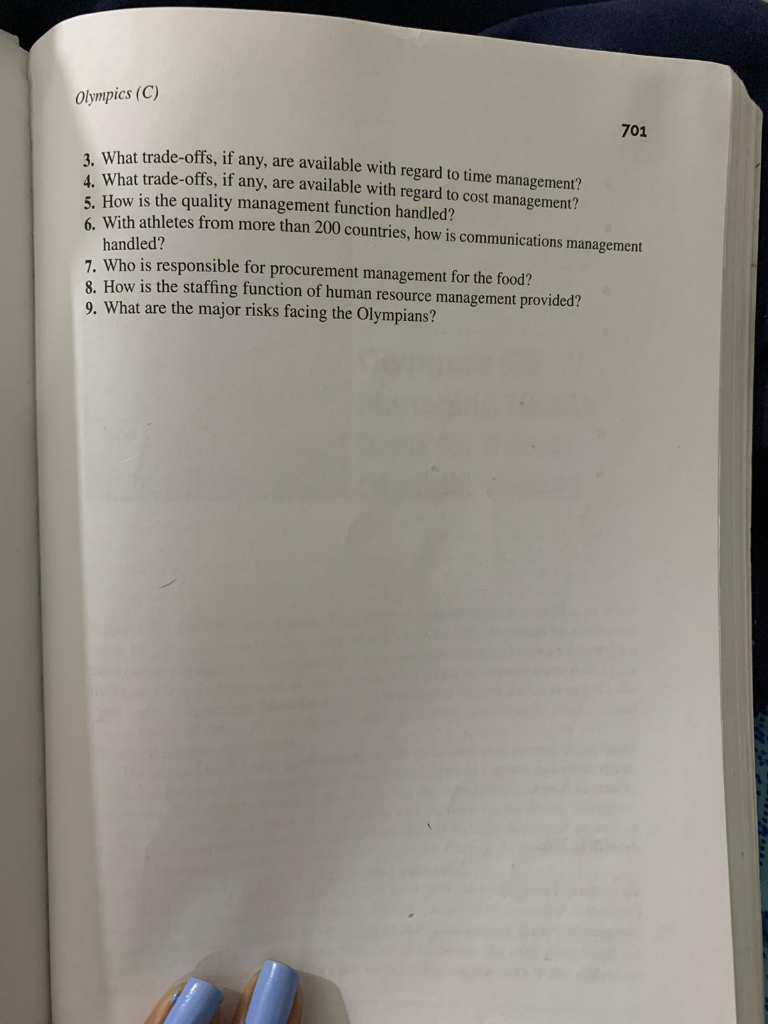
Question 3:What trade-offs, if any, are available with regard to time management?
Question 4:What trade-offs, if any, are available with regard to cost management?
Question 6: With athletes from more than 200 countries, how is communications management handled?
Question 8: How is the staffing function of human resource management provided?
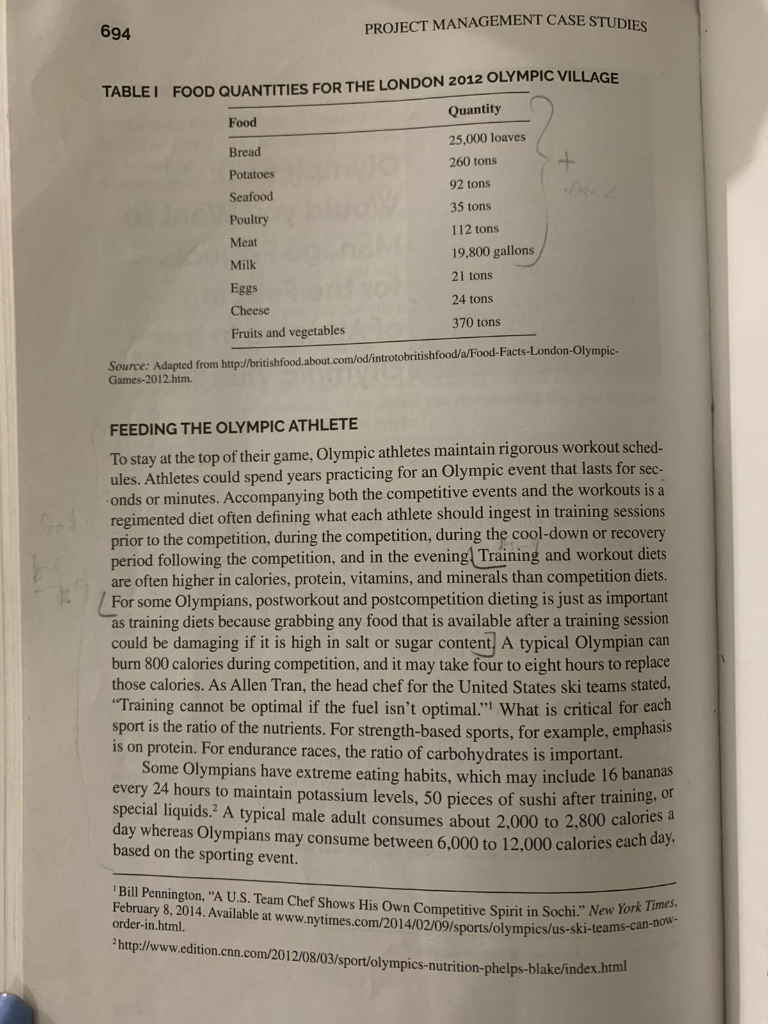
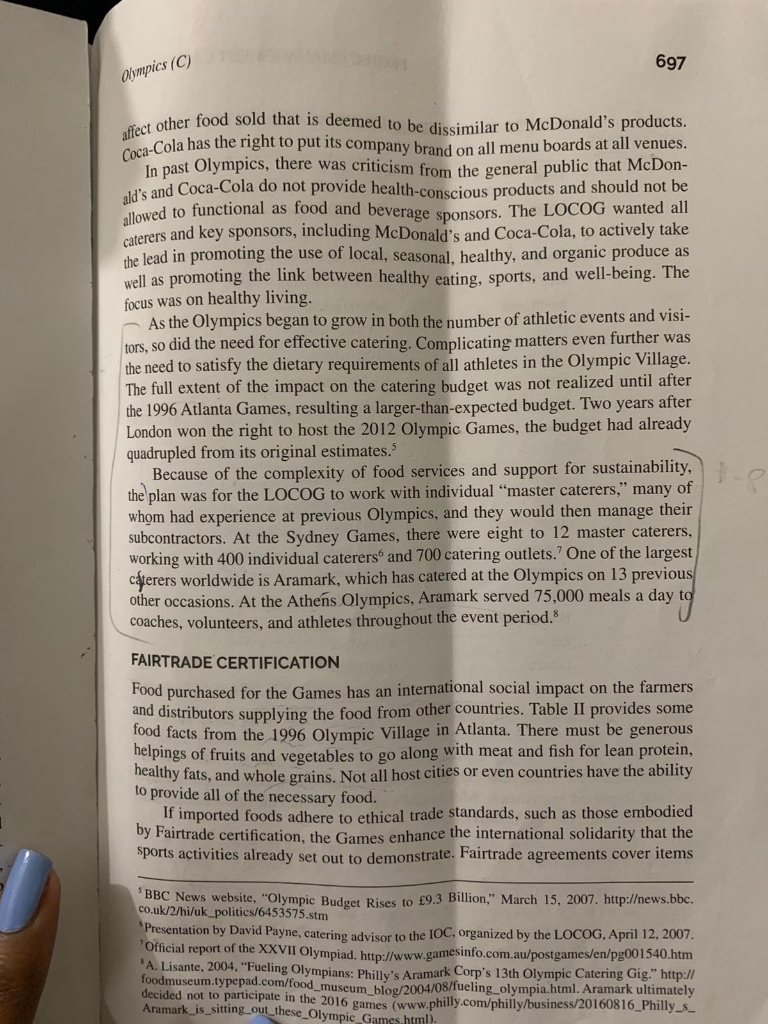
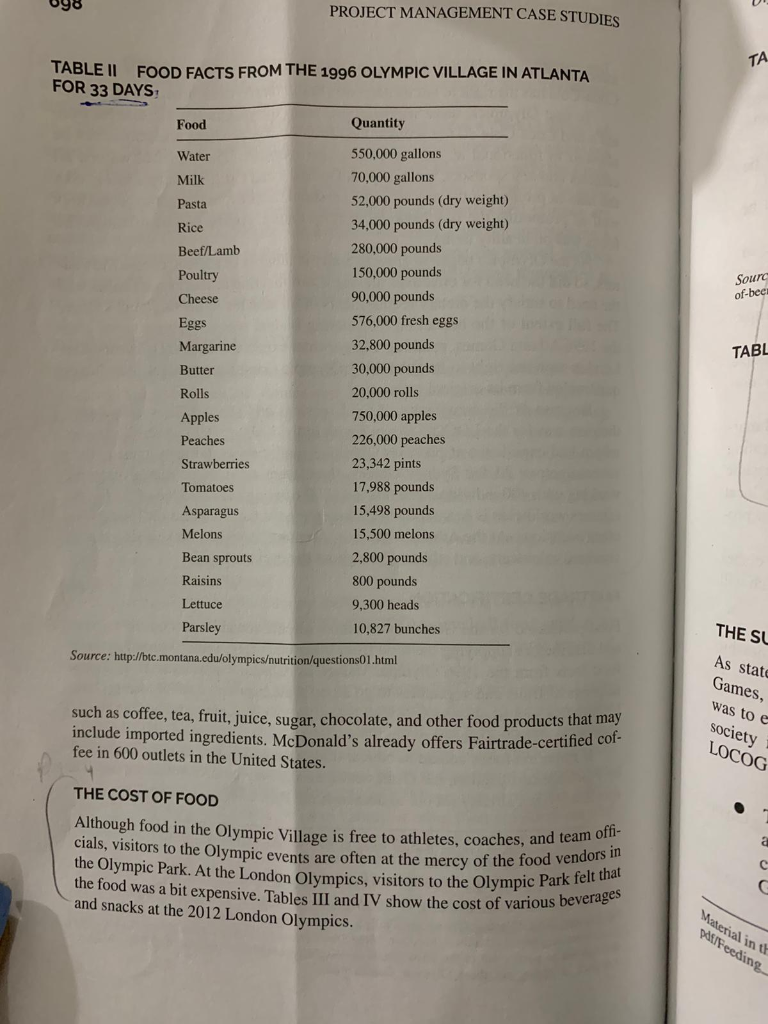
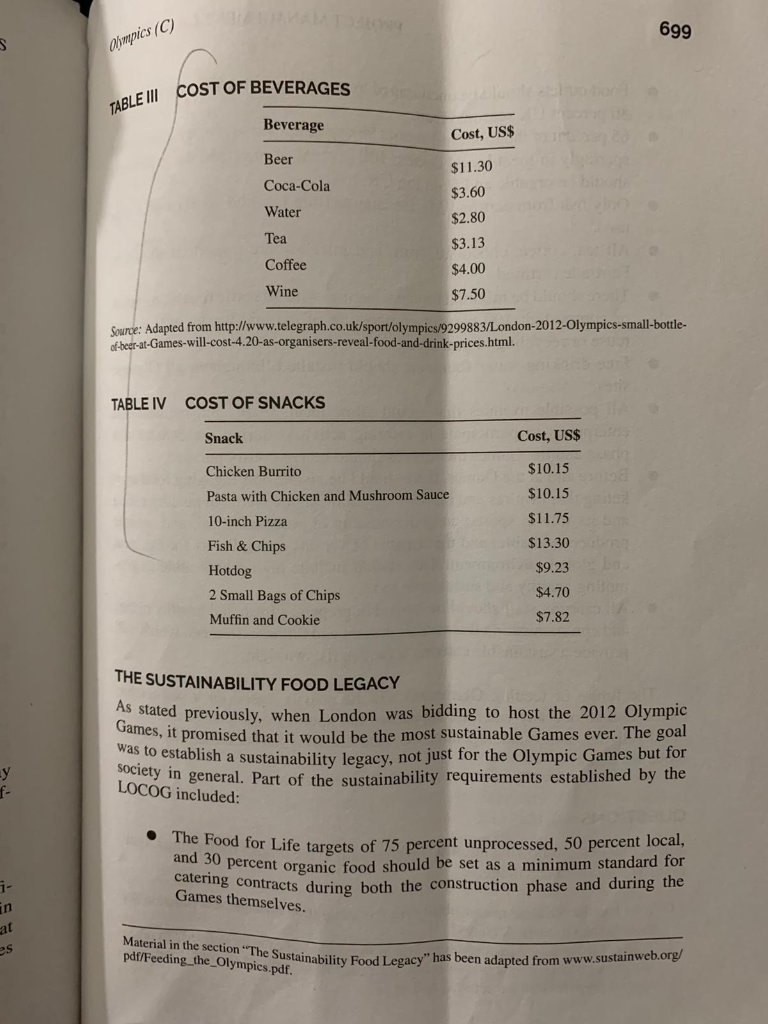
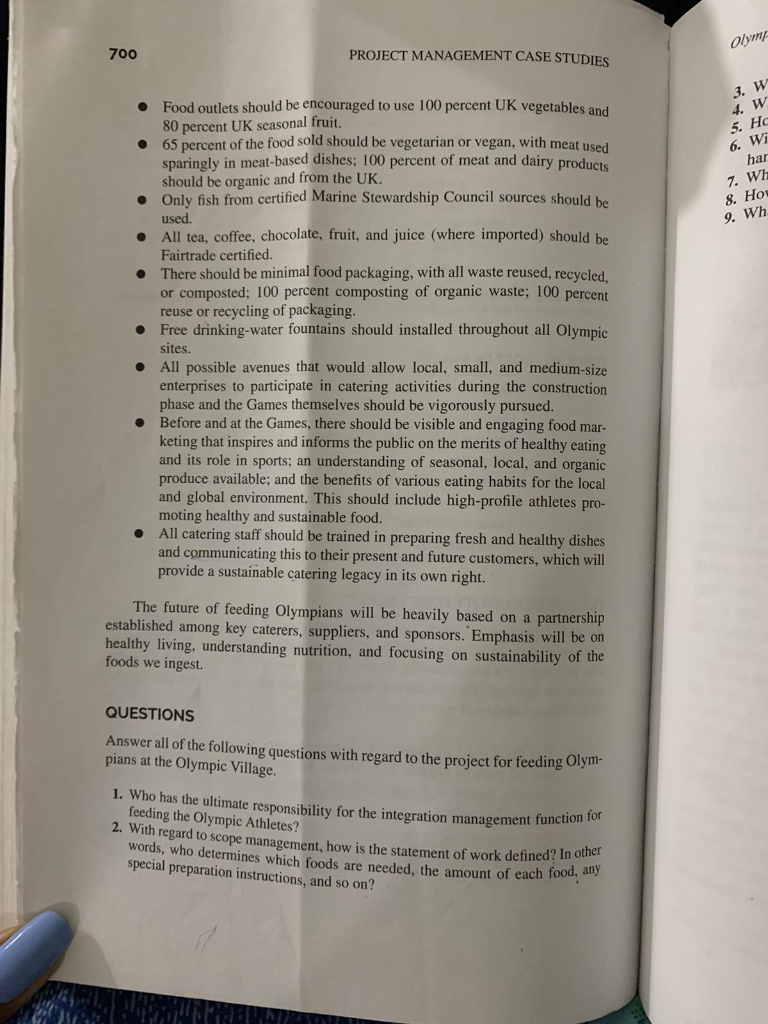
Olympics (C): Would you Want to Manage Projects for the Feeding of Athletes in the Olympic Village? Imagine that you are responsible for feeding not just one Olympic athlete, or even all of the athletes from just one country, but every person in the Olympic Village for a little more than one month. This may include up to 15,000 athletes, as well as coaches and officials from 200 countries, and possibly more than 40,000 vol- unteers. Each athlete may have different dietary requirements. How do you start such a project? What people do you need as part of your project team? Are there specific skills your team should possess? How do you determine what food you will need and the quantity of each item? PROJECT COMPLEXITY The Olympic Village opens approximately two weeks prior to the actual start of the Olympic Games and remains open for approximately 33 days. During this period, the village must be capable of serving up to 60,000 meals per day, for a total of more than 1.5 million meals There can be more than 500 different types of meals served each day. Exhibit I shows the food quantities needed at the London 2012 Olympic Games to serve 23,900 athletes and team officials. 2016 by Harold Kerzner. All rights reserved 694 PROJECT MANAGEMENT CASE STUDIES TABLET FOOD QUANTITIES FOR THE LONDON 2012 OLYMPIC VILLAGE Food Quantity Bread 25,000 loaves Potatoes 260 tons 92 tons Seafood 35 tons Poultry 112 tons Meat Milk 19.800 gallons 21 tons Eggs Cheese 24 tons Fruits and vegetables 370 tons Source: Adapted from http://britishfood.about.com/od/introtobritishfood/a/Food-Facts-London-Olympic- Games-2012.htm FEEDING THE OLYMPIC ATHLETE To stay at the top of their game, Olympic athletes maintain rigorous workout sched- ules. Athletes could spend years practicing for an Olympic event that lasts for sec- -onds or minutes. Accompanying both the competitive events and the workouts is a regimented diet often defining what each athlete should ingest in training sessions prior to the competition, during the competition, during the cool-down or recovery period following the competition, and in the evening Training and workout diets are often higher in calories, protein, vitamins, and minerals than competition diets. For some Olympians, postworkout and postcompetition dieting is just as important as training diets because grabbing any food that is available after a training session could be damaging if it is high in salt or sugar content. A typical Olympian can burn 800 calories during competition, and it may take four to eight hours to replace those calories. As Allen Tran, the head chef for the United States ski teams stated, "Training cannot be optimal if the fuel isn't optimal." What is critical for each sport is the ratio of the nutrients. For strength-based sports, for example, emphasis is on protein. For endurance races, the ratio of carbohydrates is important. Some Olympians have extreme eating habits, which may include 16 bananas every 24 hours to maintain potassium levels, 50 pieces of sushi after training, or special liquids.? A typical male adult consumes about 2,000 to 2,800 calories a day whereas Olympians may consume between 6,000 to 12,000 calories each day, based on the sporting event. Bill Pennington, "A U.S. Team Chef Shows His Own Competitive Spirit in Sochi." New York Times - February 8, 2014. Available at www.nytimes.com/2014/02/09/sports/olympics/us-ski-teams-can-now 2 http://www.edition.cnn.com/2012/08/03/sport/olympics-nutrition-phelps-blake/index.html order-in.html Food fuels the body, and each athlete demands a particular kind of sustenance. pete, while an endurance athlete like a cross-country skier needs carbs to go the 695 Olympics (C) For instance, a 250-pound bobsledder may require proteins like steak to com- distance. It seems that there is virtually no end to the power and stamina of Olym- pic athletes, which is due in part to the detailed guidance they get from experts about the right amount and type of food they need. ... The science of fueling athletes for elite sports goes way beyond caloric intake to include percentages of carbohydrates versus proteins, quantities of fluids, and the timing of meals and snacks. Some athletes intentionally gain weight during workouts to reduce the chance of injury or illness but then slim down for the actual competition. For most Olym- pians, these extreme eating habits are their normal routine. Some athletes eat only two large meals daily whereas other athletes may four meals a day, each sepa- rated by four hours, and each meal is designed to satisfy different time-of-day dietary needs. Dining at the Olympic Village can easily become a culinary trap. With more than 500 different menus covering the complete gamut of the health spectrum, athletes have an opportunity to feast on delicacies from other countries regardless of the dietary requirements they need to hone their bodies to perfection in their sport. All of the food in the Olympic Village is free to village residents. Because of the extreme workouts and eating habits, Olympic athletes often supplement their dietary intake with vitamins. The athletes themselves are respon- sible for verifying that what goes into their mouths are not substances that are banned by the IOC or other sports governing authorities. ed- ec- is a ons Jery iets iets. rtant ssion n can place stated, T each phasis THE OLYMPIC VILLAGE Olympians know the quality of the food in their own country. But there is always some concern over the quality of food provided by the city or country hosting the Olympics. (The Olympic Games have a reputation of providing high-quality food for all of the athletes at the Olympic Village. When the athletes stray from the village, the quality of the food and the ingredients is unknown, and water may be undrinkable. A Because of terrorism threats, food goes from suppliers/distributors to ware- houses to be security checked, leaving nothing to chance. Local government hygiene bureaus are used to validate quality. Executive chefs with work experience Kiri Tannenbaum. "Gold Medal Meals: What the Olympic Athletes Eat at the Vancouver Winter Games," www.delish.com, February 1, 2010. Available at www.delish.com/restaurants/a1274/winter- olympics-menu/ Barbara Bronson Gray, "The Care and Feeding of Olympic Athletes." HealthDay News, July 27, 2012. Available at health.usnews.com/health-newsews/articles/2012/07/27/the-care-and-feeding-of- olympic-athletes ?offset=100. ananas hing, or lories a ach day, York Times, S-can-now ml 696 PROJECT MANAGEMENT CASE STUDIES at previous Olympic Games supervise meal preparation. Registered dieticians and translators are in dining halls 12 hours a day to answer questions. Some registered dieticians have graduate degrees in sports nutrition. The dining halls in a typical Olympic Village may serve a "World Menu of more than 550 recipes. Special dietary and religious requirements are addressed as well. Pictograms appear at each food station to help athletes identify the foods being served. There are also kiosks that have translators and dictionaries to assist in identifying the nutritional content of the foods. Computers and printers are attached to the kiosks. For some 'Olympians, the hardest part of maintaining a regimented nutritional diet is finding the time to consume the needed calories and nutriments. The dining hall can prepare boxed lunches/meals transported in refrigerated trucks to the competition venues. SUPPORTING SUSTAINABILITY When London was bidding to host the 2012 Olympic Games, it promised that it would be the most sustainable Games ever. Specifically, it promised to support the consumption of local, seasonal, and organic produce. To understand the magnitude of this endeavor, consider that 1.3 million meals for the construction workers for the four-year period preceding the Games and then 14 million meals over 60 days for those people attending the Games, including visitors, would have to be prepared. The responsibility for food for the construction workers was with the Olym- pic Delivery Authority (ODA). The ODA would be working with as many as 12 contractors, each of which would be responsible for its own catering. The ODA was expected to promote sustainable foods even though it had no such internal procurement policy at that time. The responsibility for food during the Games rests with the OCOG in the city hosting the Games. The London OCOG (LOCOG) wanted all food vendors to serve healthy, local, and freshly produced food. Promoting an Olympic legacy of support for sustainability efforts was of high importance. The IOC controls TOP, the group of key sponsors for Olympic events. Under the IOC agreement, the TOP sponsors have extensive rights to operate outlets in the Olympic Village and the Olympic Park itself, but they do not necessar- ily utilize them. Two of the key sponsors for the Games were McDonald's and Coca-Cola. In Sydney, McDonald's operated seven restaurants at Olympic ven- ues, including two serving athletes in the Olympic Village, two serving the media, and three catering to the public. A large variety of other food providers are also used, but McDonald's has an "exclusion" on branded foods and can prevent other outlets from selling hamburgers, fries, or other foods (such as egg rolls) that are seen as too similar to McDonald's products. This arrangement does not, however, Material in the section Supporting Sustainability" has been adapted from www.sustainweb.org/pdf/ Feeding_the_Olympics.pdf. affect other food sold that is deemed to be dissimilar to McDonald's products. Coca-Cola has the right to put its company brand on all menu boards at all venues. 697 Olympics (C) In past Olympics, there was criticism from the general public that McDon- ald's and Coca-Cola do not provide health-conscious products and should not be allowed to functional as food and beverage sponsors. The LOCO wanted all caterers and key sponsors, including McDonald's and Coca-Cola, to actively take the lead in promoting the use of local, seasonal, healthy, and organic produce as well as promoting the link between healthy eating, sports, and well-being. The focus was on healthy living. As the Olympics began to grow in both the number of athletic events and visi- tors, so did the need for effective catering. Complicating matters even further was the need to satisfy the dietary requirements of all athletes in the Olympic Village. The full extent of the impact on the catering budget was not realized until after the 1996 Atlanta Games, resulting a larger-than-expected budget. Two years after London won the right to host the 2012 Olympic Games, the budget had already quadrupled from its original estimates. the plan was for the LOCOG to work with individual master caterers," many of whom had experience at previous Olympics, and they would then manage their subcontractors. At the Sydney Games, there were eight to 12 master caterers, working with 400 individual caterers and 700 catering outlets. One of the largest caterers worldwide is Aramark, which has catered at the Olympics on 13 previous other occasions. At the Athens Olympics, Aramark served 75,000 meals a day to coaches, volunteers, and athletes throughout the event period.8 FAIRTRADE CERTIFICATION Food purchased for the Games has an international social impact on the farmers and distributors supplying the food from other countries. Table II provides some food facts from the 1996 Olympic Village in Atlanta. There must be generous helpings of fruits and vegetables to go along with meat and fish for lean protein, healthy fats, and whole grains. Not all host cities or even countries have the ability to provide all of the necessary food. If imported foods adhere to ethical trade standards, such as those embodied by Fairtrade certification, the Games enhance the international solidarity that the sports activities already set out to demonstrate. Fairtrade agreements cover items BBC News website, "Olympic Budget Rises to 9.3 Billion," March 15, 2007. http:/ews.bbc. co.uk/2/hi/uk_politics/6453575.stm Presentation by David Payne, catering advisor to the IOC, organized by the LOCOG, April 12, 2007. Official report of the XXVII Olympiad. http://www.gamesinfo.com.au/postgames/en/pg001540.htm A. Lisante, 2004. "Fueling Olympians: Philly's Aramark Corp's 13th Olympic Catering Gig." http:// foodmuseum.typepad.com/food_museum_blog/2004/08/fueling_olympia.html. Aramark ultimately decided not to participate in the 2016 games (www.philly.com/philly/business/20160816_Philly_s_ Aramark_is_sitting_out_these_Olympic Games.html). cials, visitors to the Olympic events are often at the mercy of the food vendors in PROJECT MANAGEMENT CASE STUDIES TA Sourc of-beci TABLE II FOOD FACTS FROM THE 1996 OLYMPIC VILLAGE IN ATLANTA FOR 33 DAYS Food Quantity Water 550.000 gallons Milk 70.000 gallons Pasta 52,000 pounds (dry weight) Rice 34.000 pounds (dry weight) Beef/Lamb 280,000 pounds Poultry 150,000 pounds Cheese 90,000 pounds Eggs 576,000 fresh eggs Margarine 32,800 pounds Butter 30,000 pounds Rolls 20,000 rolls Apples 750,000 apples Peaches 226,000 peaches Strawberries 23,342 pints Tomatoes 17,988 pounds Asparagus 15,498 pounds Melons 15,500 melons Bean sprouts 2.800 pounds Raisins 800 pounds Lettuce 9,300 heads Parsley 10,827 bunches TABL THE SU Source: http://btc.montana.edu/olympicsutrition/questions01.html As statc Games, was to e society LOCOG such as coffee, tea, fruit, juice, sugar, chocolate, and other food products that may include imported ingredients. McDonald's already offers Fairtrade-certified cof- fee in 600 outlets in the United States. 4 THE COST OF FOOD Although food in the Olympic Village is free to athletes, coaches, and team of in the Olympic Park. At the London Olympics, visitors to the Olympic Park felt thes the food was a bit expensive. Tables III and IV show the cost of various beverages and snacks at the 2012 London Olympics. Material in Doll Feeding Olimpics (C) TABLE III COST OF BEVERAGES Material in the section "The Sustainability Food Legacy" has been adapted from www.sustainweb.org/ 699 3 Beverage Cost, US$ Beer $11.30 Coca-Cola Water $3.60 $2.80 Tea $3.13 Coffee $4.00 Wine $7.50 Source: Adapted from http://www.telegraph.co.uk/sport/olympics/9299883/London-2012-Olympics-small-bottle- of-beer-at-Games-will-cost-4.20-as-organisers-reveal-food-and-drink-prices.html. TABLE IV COST OF SNACKS Snack Cost, US$ Chicken Burrito $10.15 $10.15 Pasta with Chicken and Mushroom Sauce $11.75 10-inch Pizza Fish & Chips $13.30 Hotdog $9.23 $4.70 2 Small Bags of Chips Muffin and Cookie $7.82 THE SUSTAINABILITY FOOD LEGACY As stated previously, when London was bidding to host the 2012 Olympic Games, it promised that it would be the most sustainable Games ever. The goal Was to establish a sustainability legacy, not just for the Olympic Games but for society in general. Part of the sustainability requirements established by the LOCOG included: The Food for Life targets of 75 percent unprocessed, 50 percent local, and 30 percent organic food should be set as a minimum standard for catering contracts during both the construction phase and during the 1- Games themselves. at pdf/Feeding_the_Olympics.pdf. Olympics (C) 701 3. What trade-offs, if any, are available with regard to time management? 4. What trade-offs, if any, are available with regard to cost management? 5. How is the quality management function handled? 6. With athletes from more than 200 countries, how is communications management handled? 7. Who is responsible for procurement management for the food? 8. How is the staffing function of human resource management provided? 9. What are the major risks facing the Olympians









 Study Help