







Question: Question 2 Write code in Python or R to simulate the Lindley Recursion for an M/G/1 queue where the arrival process is Exp(A = 1
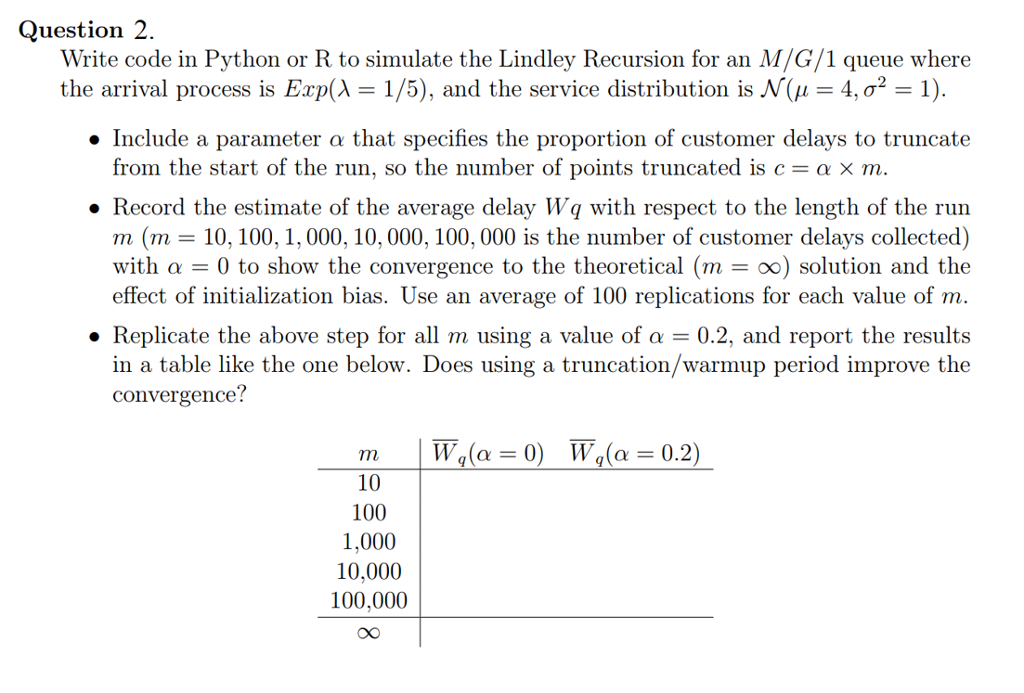
Question 2 Write code in Python or R to simulate the Lindley Recursion for an M/G/1 queue where the arrival process is Exp(A = 1 /5), and the service distribution is N( = 4, -1) . Include a parameter that specifies the proportion of customer delays to truncate from the start of the run, so the number of points truncated is c m Record the estimate of the average delay Wq with respect to the length of the run m (m = 10. 100, 1,000, 10.000. 100.000 is the number of customer delays collected) with = 0 to show the convergence to the theoretical (m = oo) solution and the effect of initialization bias. Use an average of 100 replications for each value of m Replicate the above step for all m using a value of -0.2, and report the results in a table like the one below. Does using a truncation/warmup period improve the convergence! 10 100 1,000 10,000 100,000 C0 Question 2 Write code in Python or R to simulate the Lindley Recursion for an M/G/1 queue where the arrival process is Exp(A = 1 /5), and the service distribution is N( = 4, -1) . Include a parameter that specifies the proportion of customer delays to truncate from the start of the run, so the number of points truncated is c m Record the estimate of the average delay Wq with respect to the length of the run m (m = 10. 100, 1,000, 10.000. 100.000 is the number of customer delays collected) with = 0 to show the convergence to the theoretical (m = oo) solution and the effect of initialization bias. Use an average of 100 replications for each value of m Replicate the above step for all m using a value of -0.2, and report the results in a table like the one below. Does using a truncation/warmup period improve the convergence! 10 100 1,000 10,000 100,000 C0
Step by Step Solution
There are 3 Steps involved in it

Get step-by-step solutions from verified subject matter experts
 Study Help