



Question: QUESTION: (2&3) PLEASE FOLLOW INSTRUCTIONS. AND IF YOU CAN'T DO IT PLEASE DON'T WASTE THE QUESTION. Founded by enigmatic designer Tommy Haverford, Get-A-Dress (GAD) rents
QUESTION: (2&3) PLEASE FOLLOW INSTRUCTIONS. AND IF YOU CAN'T DO IT PLEASE DON'T WASTE THE QUESTION.
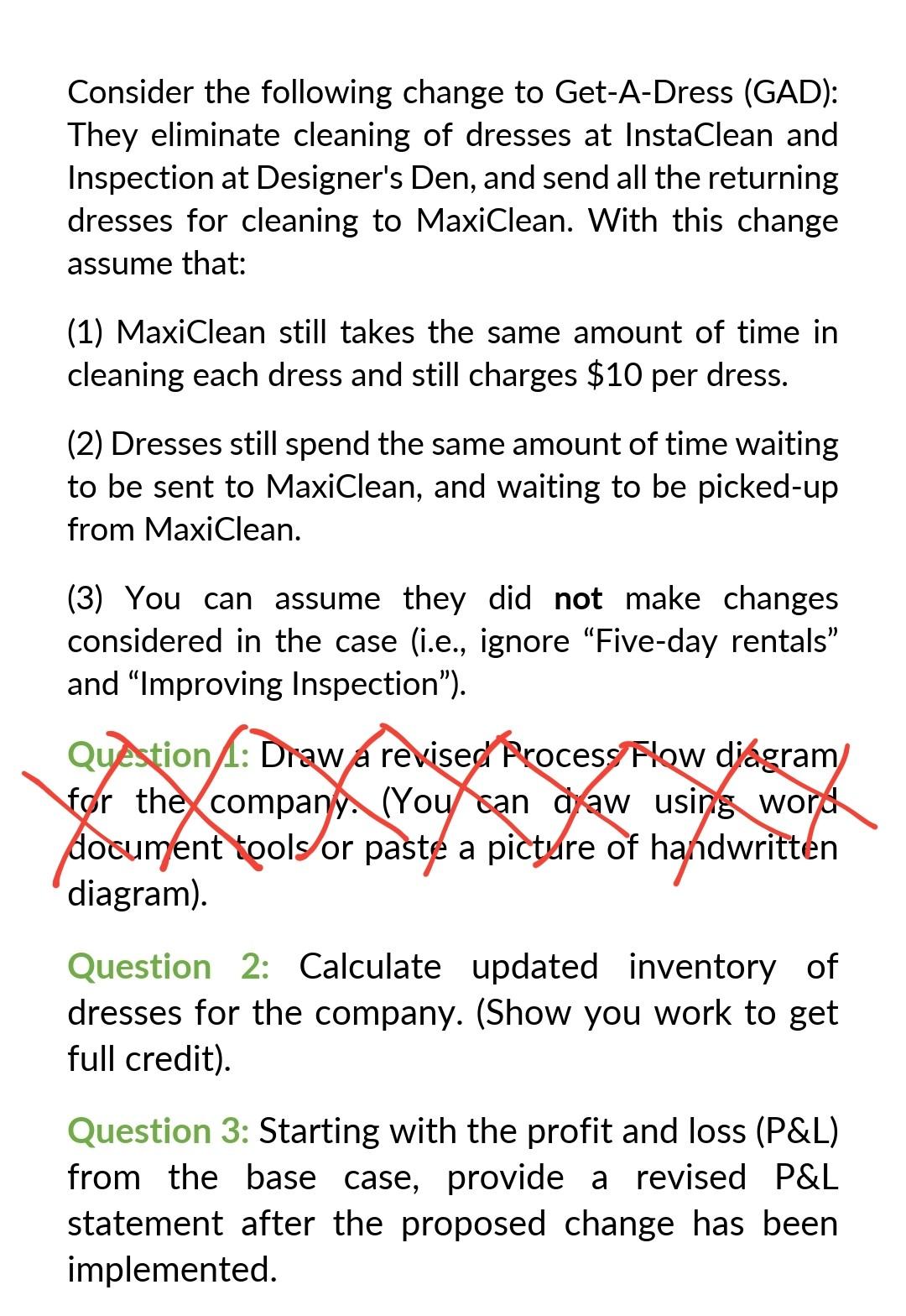
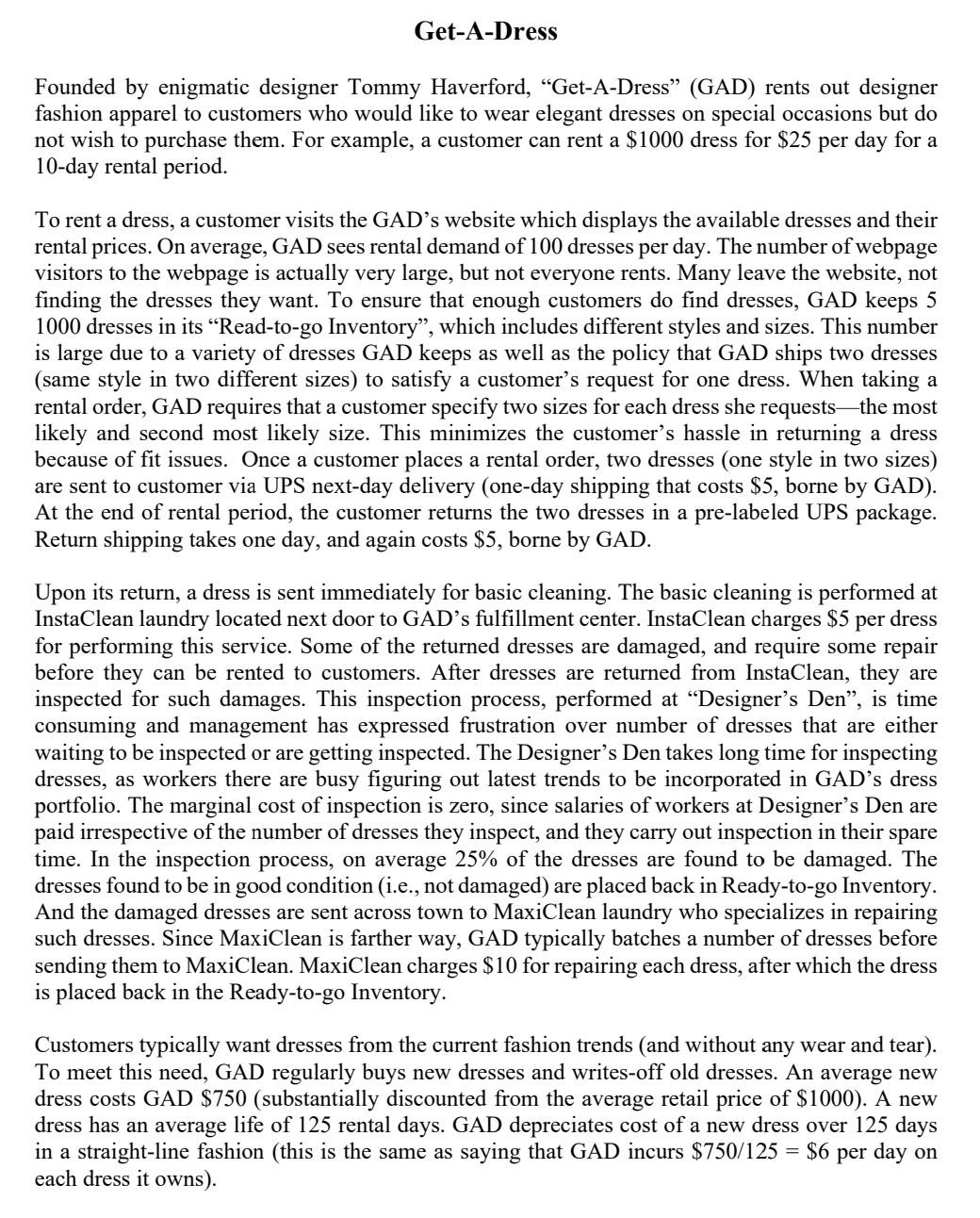
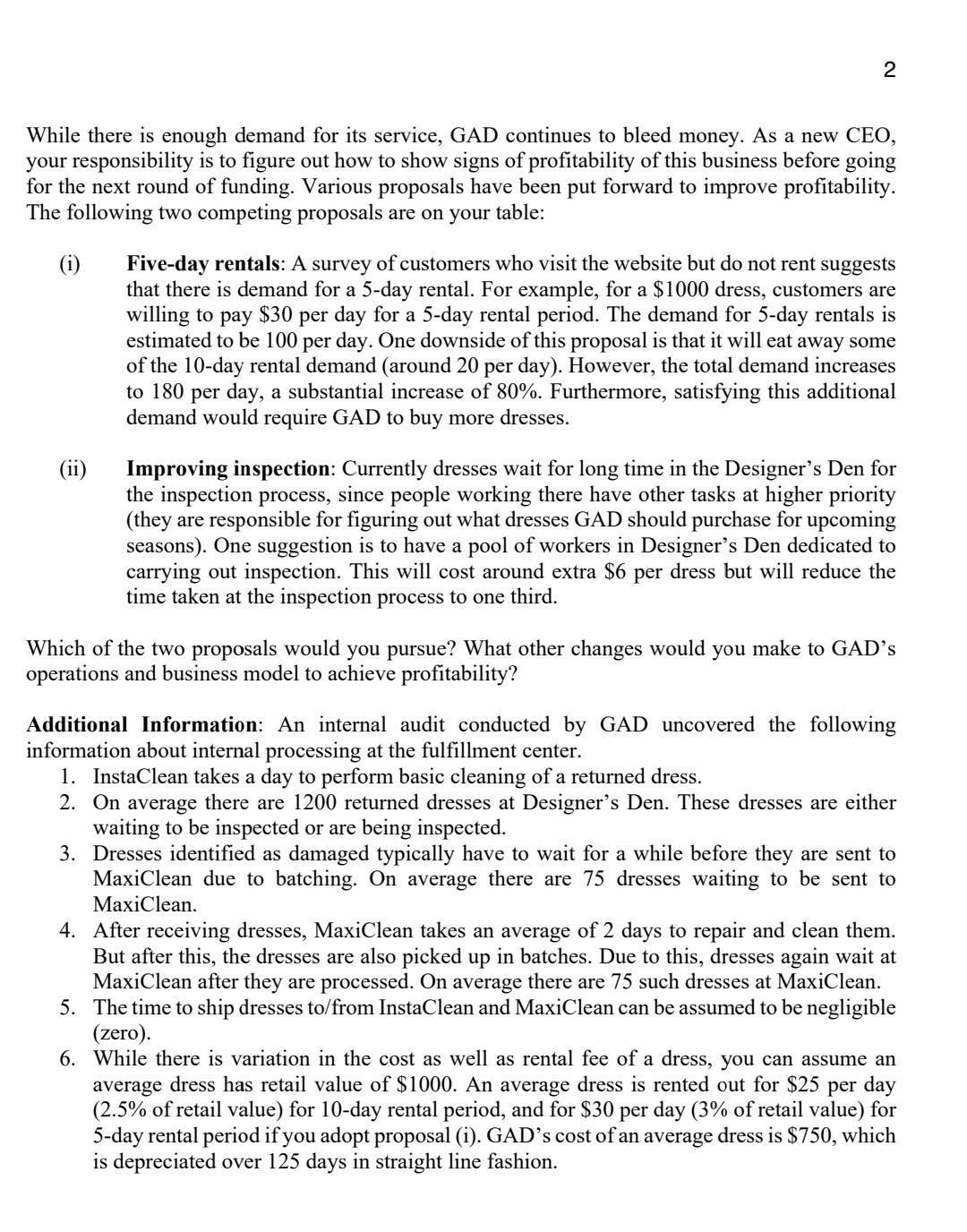
Founded by enigmatic designer Tommy Haverford, "Get-A-Dress" (GAD) rents out designer fashion apparel to customers who would like to wear elegant dresses on special occasions but do not wish to purchase them. For example, a customer can rent a $1000 dress for $25 per day for a 10-day rental period. To rent a dress, a customer visits the GAD's website which displays the available dresses and their rental prices. On average, GAD sees rental demand of 100 dresses per day. The number of webpage visitors to the webpage is actually very large, but not everyone rents. Many leave the website, not finding the dresses they want. To ensure that enough customers do find dresses, GAD keeps 5 1000 dresses in its "Read-to-go Inventory", which includes different styles and sizes. This number is large due to a variety of dresses GAD keeps as well as the policy that GAD ships two dresses (same style in two different sizes) to satisfy a customer's request for one dress. When taking a rental order, GAD requires that a customer specify two sizes for each dress she requests-the most likely and second most likely size. This minimizes the customer's hassle in returning a dress because of fit issues. Once a customer places a rental order, two dresses (one style in two sizes) are sent to customer via UPS next-day delivery (one-day shipping that costs $5, borne by GAD). At the end of rental period, the customer returns the two dresses in a pre-labeled UPS package. Return shipping takes one day, and again costs $5, borne by GAD. Upon its return, a dress is sent immediately for basic cleaning. The basic cleaning is performed at InstaClean laundry located next door to GAD's fulfillment center. InstaClean charges $5 per dress for performing this service. Some of the returned dresses are damaged, and require some repair before they can be rented to customers. After dresses are returned from InstaClean, they are inspected for such damages. This inspection process, performed at "Designer's Den", is time consuming and management has expressed frustration over number of dresses that are either waiting to be inspected or are getting inspected. The Designer's Den takes long time for inspecting dresses, as workers there are busy figuring out latest trends to be incorporated in GAD's dress portfolio. The marginal cost of inspection is zero, since salaries of workers at Designer's Den are paid irrespective of the number of dresses they inspect, and they carry out inspection in their spare time. In the inspection process, on average 25% of the dresses are found to be damaged. The dresses found to be in good condition (i.e., not damaged) are placed back in Ready-to-go Inventory. And the damaged dresses are sent across town to MaxiClean laundry who specializes in repairing such dresses. Since MaxiClean is farther way, GAD typically batches a number of dresses before sending them to MaxiClean. MaxiClean charges $10 for repairing each dress, after which the dress is placed back in the Ready-to-go Inventory. Customers typically want dresses from the current fashion trends (and without any wear and tear). To meet this need, GAD regularly buys new dresses and writes-off old dresses. An average new dress costs GAD $750 (substantially discounted from the average retail price of $1000 ). A new dress has an average life of 125 rental days. GAD depreciates cost of a new dress over 125 days in a straight-line fashion (this is the same as saying that GAD incurs $750/125=$6 per day on each dress it owns). 2 While there is enough demand for its service, GAD continues to bleed money. As a new CEO, your responsibility is to figure out how to show signs of profitability of this business before going for the next round of funding. Various proposals have been put forward to improve profitability. The following two competing proposals are on your table: (i) Five-day rentals: A survey of customers who visit the website but do not rent suggests that there is demand for a 5-day rental. For example, for a $1000 dress, customers are willing to pay $30 per day for a 5-day rental period. The demand for 5-day rentals is estimated to be 100 per day. One downside of this proposal is that it will eat away some of the 10-day rental demand (around 20 per day). However, the total demand increases to 180 per day, a substantial increase of 80%. Furthermore, satisfying this additional demand would require GAD to buy more dresses. (ii) Improving inspection: Currently dresses wait for long time in the Designer's Den for the inspection process, since people working there have other tasks at higher priority (they are responsible for figuring out what dresses GAD should purchase for upcoming seasons). One suggestion is to have a pool of workers in Designer's Den dedicated to carrying out inspection. This will cost around extra $6 per dress but will reduce the time taken at the inspection process to one third. Which of the two proposals would you pursue? What other changes would you make to GAD's operations and business model to achieve profitability? Additional Information: An internal audit conducted by GAD uncovered the following information about internal processing at the fulfillment center. 1. InstaClean takes a day to perform basic cleaning of a returned dress. 2. On average there are 1200 returned dresses at Designer's Den. These dresses are either waiting to be inspected or are being inspected. 3. Dresses identified as damaged typically have to wait for a while before they are sent to MaxiClean due to batching. On average there are 75 dresses waiting to be sent to MaxiClean. 4. After receiving dresses, MaxiClean takes an average of 2 days to repair and clean them. But after this, the dresses are also picked up in batches. Due to this, dresses again wait at MaxiClean after they are processed. On average there are 75 such dresses at MaxiClean. 5. The time to ship dresses to/from InstaClean and MaxiClean can be assumed to be negligible (zero). 6. While there is variation in the cost as well as rental fee of a dress, you can assume an average dress has retail value of $1000. An average dress is rented out for $25 per day ( 2.5% of retail value) for 10 -day rental period, and for $30 per day ( 3% of retail value) for 5-day rental period if you adopt proposal (i). GAD's cost of an average dress is $750, which is depreciated over 125 days in straight line fashion. Consider the following change to Get-A-Dress (GAD): They eliminate cleaning of dresses at InstaClean and Inspection at Designer's Den, and send all the returning dresses for cleaning to MaxiClean. With this change assume that: (1) MaxiClean still takes the same amount of time in cleaning each dress and still charges $10 per dress. (2) Dresses still spend the same amount of time waiting to be sent to MaxiClean, and waiting to be picked-up from MaxiClean. (3) You can assume they did not make changes considered in the case (i.e., ignore "Five-day rentals" and "Improving Inspection"). Qyestion/L: Draw a revised Process Flow diagram/ for the company (You san d aw using word document tools or paste a picture of handwritten diagram). Question 2: Calculate updated inventory of dresses for the company. (Show you work to get full credit). Question 3: Starting with the profit and loss (P\&L) from the base case, provide a revised P&L statement after the proposed change has been implemented
Step by Step Solution
There are 3 Steps involved in it
1 Expert Approved Answer
Step: 1 Unlock

Question Has Been Solved by an Expert!
Get step-by-step solutions from verified subject matter experts
Step: 2 Unlock
Step: 3 Unlock