





Question: QUESTION 24 Read each question carefully, and then write (true) or (false) on the line next to the question. (8 points) 1. A cross-sectional study
QUESTION 24 Read each question carefully, and
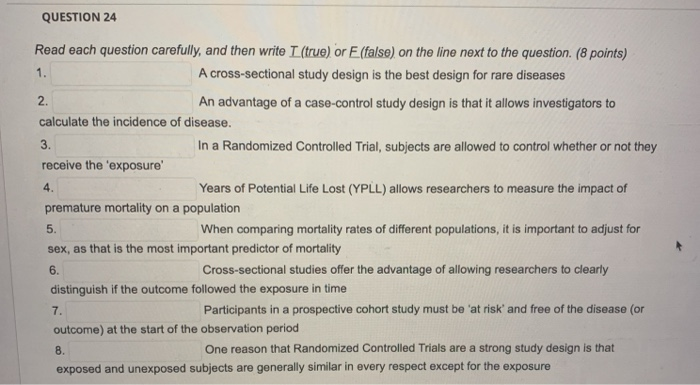
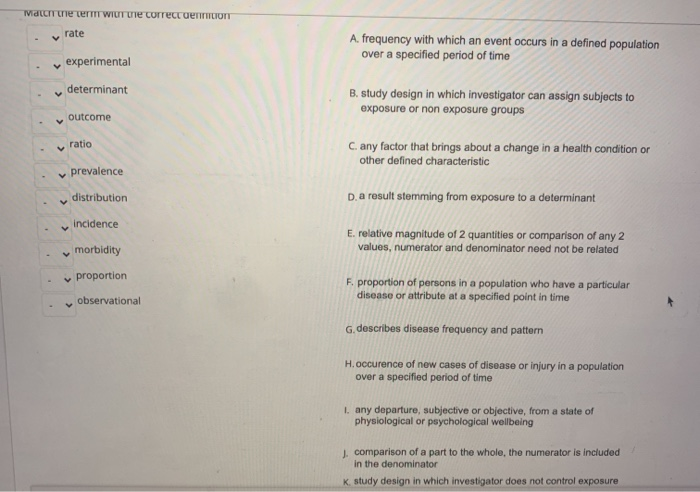
QUESTION 24 Read each question carefully, and then write (true) or (false) on the line next to the question. (8 points) 1. A cross-sectional study design is the best design for rare diseases 2. An advantage of a case-control study design is that it allows investigators to calculate the incidence of disease. 3. In a Randomized Controlled Trial, subjects are allowed to control whether or not they receive the 'exposure 4. Years of Potential Life Lost (YPLL) allows researchers to measure the impact of premature mortality on a population 5. When comparing mortality rates of different populations, it is important to adjust for sex, as that is the most important predictor of mortality 6. Cross-sectional studies offer the advantage of allowing researchers to clearly distinguish if the outcome followed the exposure in time 7. Participants in a prospective cohort study must be 'at risk' and free of the disease (or outcome) at the start of the observation period 8. One reason that Randomized Controlled Trials are a strong study design is that exposed and unexposed subjects are generally similar in every respect except for the exposure Marine term WILT Ue correctuer TOTT rate A. frequency with which an event occurs in a defined population over a specified period of time experimental determinant B. study design in which investigator can assign subjects to exposure or non exposure groups v outcome ratio C. any factor that brings about a change in a health condition or other defined characteristic prevalence distribution D. a result stemming from exposure to a determinant v incidence E. relative magnitude of 2 quantities or comparison of any 2 values, numerator and denominator need not be related morbidity proportion F. proportion of persons in a population who have a particular disease or attribute at a specified point in time observational G.describes disease frequency and pattern H. occurence of new cases of disease or injury in a population over a specified period of time 1. any departure, subjective or objective, from a state of physiological or psychological wellbeing J. comparison of a part to the whole, the numerator is included in the denominator K study design in which investigator does not control exposure

Step by Step Solution

There are 3 Steps involved in it

1 Expert Approved Answer
Step: 1 Unlock blur-text-image

Question Has Been Solved by an Expert!

Get step-by-step solutions from verified subject matter experts

Step: 2 Unlock
Step: 3 Unlock

Students Have Also Explored These Related General Management Questions!