





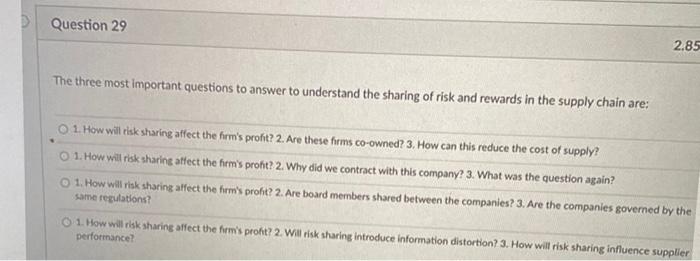
Question: Question 29 2.85 The three most important questions to answer to understand the sharing of risk and rewards in the supply chain are: 1. How
Question 29 2.85 The three most important
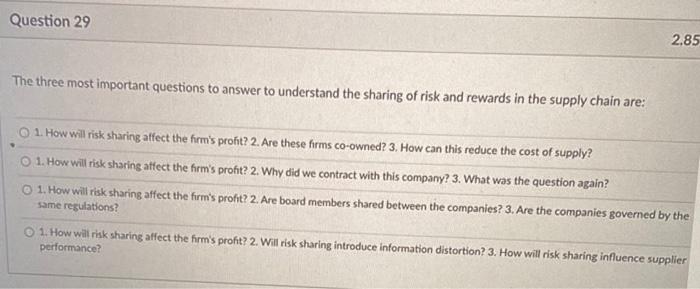
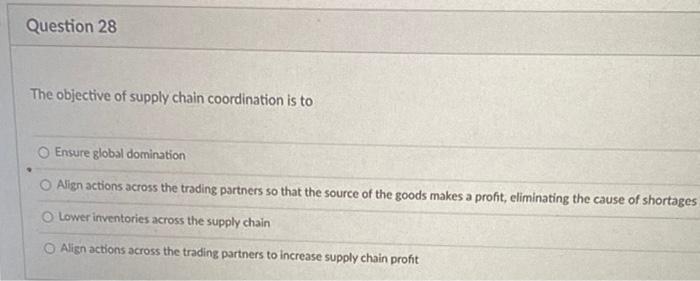
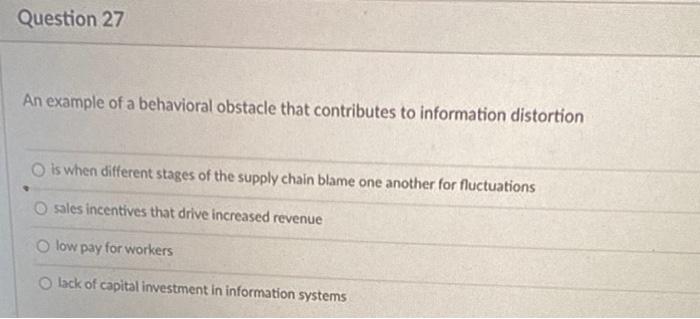
Question 29 2.85 The three most important questions to answer to understand the sharing of risk and rewards in the supply chain are: 1. How will risk sharing affect the form's proft? 2. Are these firms co-owned? 3. How can this reduce the cost of supply? 1. How will risk sharing affect the firm's profit? 2. Why did we contract with this company? 3. What was the question again? 1. How will risk sharing affect the firm's profit? 2. Are board members shared between the companies? 3. Are the companies governed by the same regulations? 1. How will risk sharing affect the firm's profit? 2. Will risk sharing introduce information distortion? 3. How will risk sharing influence supplier performance Question 29 2.85 The three most important questions to answer to understand the sharing of risk and rewards in the supply chain are: 1. How will risk sharing affect the firm's prot? 2. Are these firms co-owned? 3. How can this reduce the cost of supply? 1. How will risk sharing affect the firm's profit? 2. Why did we contract with this company? 3. What was the question again? 1. How will risk sharing affect the firm's profit? 2. Are board members shared between the companies? 3. Are the companies governed by the same regulations? 1. How will risk sharing affect the firm's proht? 2. Will risk sharing introduce information distortion? 3. How will risk sharing influence supplier performance? Question 28 The objective of supply chain coordination is to Ensure global domination Align actions across the trading partners so that the source of the goods makes a profit, eliminating the cause of shortages Lower inventories across the supply chain Align actions across the trading partners to increase supply chain profit Question 27 An example of a behavioral obstacle that contributes to information distortion is when different stages of the supply chain blame one another for fluctuations O sales incentives that drive increased revenue low pay for workers lack of capital investment in information systems
Step by Step Solution

There are 3 Steps involved in it

1 Expert Approved Answer
Step: 1 Unlock blur-text-image

Question Has Been Solved by an Expert!

Get step-by-step solutions from verified subject matter experts

Step: 2 Unlock
Step: 3 Unlock

Students Have Also Explored These Related General Management Questions!