







Question: Question 3. [13 marks] Suppose the random variables X1, X2 have the covariance matrix 1 = (-25) with the eigenvalues-eigenvectors pairs given as follows
![Question 3. [13 marks] Suppose the random variables X1, X2 have the](https://s3.amazonaws.com/si.experts.images/answers/2024/05/6647d543ae033_6836647d54394799.jpg)
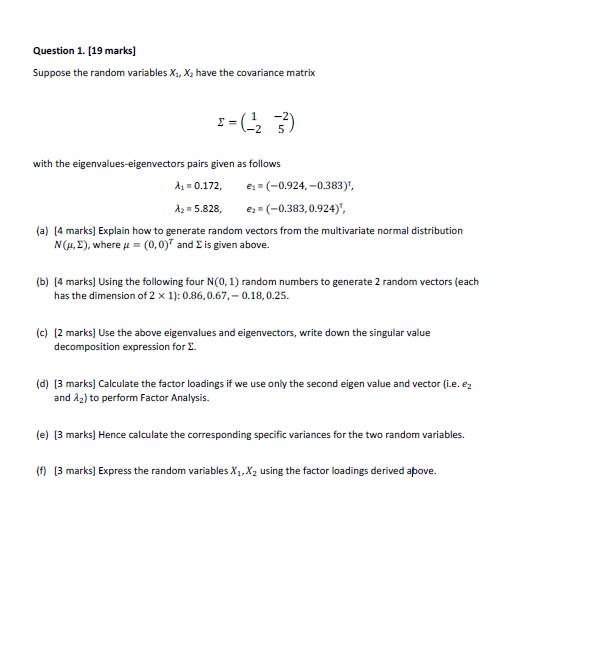
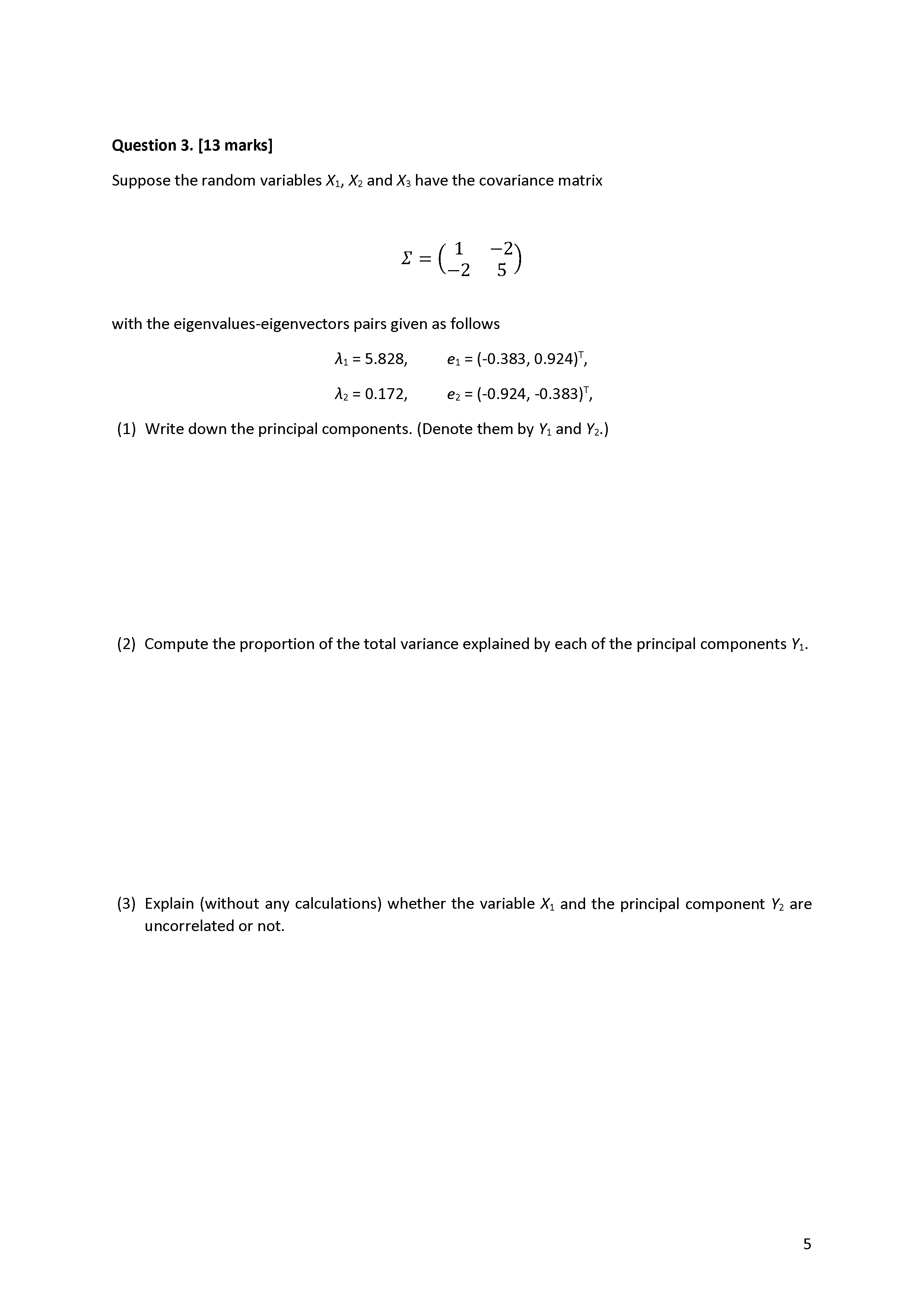
Question 3. [13 marks] Suppose the random variables X1, X2 have the covariance matrix 1 = (-25) with the eigenvalues-eigenvectors pairs given as follows A = 5.828, e =(-0.383, 0.924)", 12 = 0.172, ez = (-0.924, -0.383)", (1) [4 marks] Use these eigenvalues and eigenvectors, write down the singular value decomposition expression for . (2) [5 marks] Calculate the factor loadings if we use only the first eigenvalue and its eigenvector to perform Factor Analysis. Question 1. [19 marks] Suppose the random variables X1, X2 have the covariance matrix 1=(-23) with the eigenvalues-eigenvectors pairs given as follows A = 0.172, e: (-0.924,-0.383), A = 5.828, e2 = (-0.383, 0.924), (a) [4 marks] Explain how to generate random vectors from the multivariate normal distribution N(,), where =(0,0) and is given above. (b) [4 marks] Using the following four N(0, 1) random numbers to generate 2 random vectors (each has the dimension of 2 x 1): 0.86,0.67,-0.18, 0.25. (c) [2 marks] Use the above eigenvalues and eigenvectors, write down the singular value decomposition expression for . (d) [3 marks] Calculate the factor loadings if we use only the second eigen value and vector (i.e. ez and A) to perform Factor Analysis. (e) [3 marks] Hence calculate the corresponding specific variances for the two random variables. (f) [3 marks] Express the random variables X1, X2 using the factor loadings derived above. Question 3. [13 marks] Suppose the random variables X1, X2 and X3 have the covariance matrix = (1/2 3) -2 5 with the eigenvalues-eigenvectors pairs given as follows = 5.828, e = (-0.383, 0.924)T, = 0.172, e2 = (-0.924, -0.383)T, (1) Write down the principal components. (Denote them by Y and Y.) (2) Compute the proportion of the total variance explained by each of the principal components Y. (3) Explain (without any calculations) whether the variable X and the principal component Y are uncorrelated or not. 5
Step by Step Solution
There are 3 Steps involved in it

Get step-by-step solutions from verified subject matter experts
 Study Help