







Question: Question 3 (14 points) [14 marks] For the following question, . You get 2 marks for choosing the correct answer. . You get up to
![Question 3 (14 points) [14 marks] For the following question, .](https://s3.amazonaws.com/si.experts.images/answers/2024/06/6675b4b001c08_9996675b4afbfc6f.jpg)
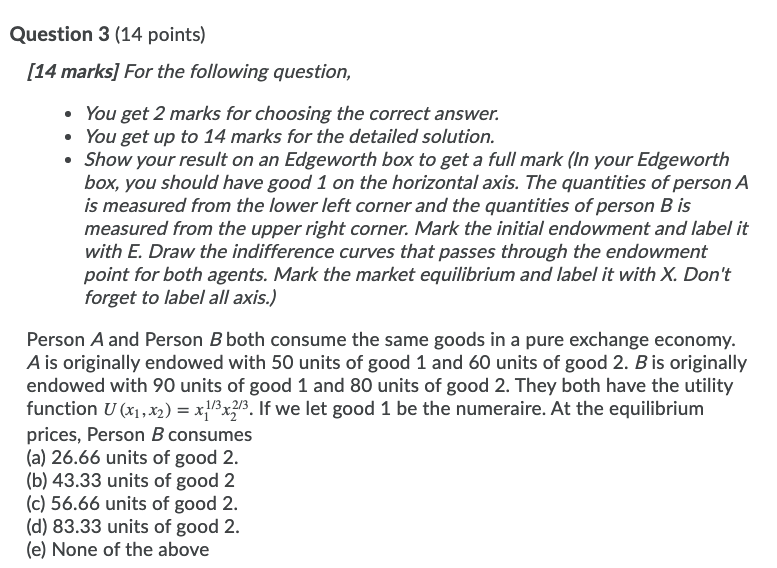
Question 3 (14 points) [14 marks] For the following question, . You get 2 marks for choosing the correct answer. . You get up to 14 marks for the detailed solution. . Show your result on an Edgeworth box to get a full mark (In your Edgeworth box, you should have good 1 on the horizontal axis. The quantities of person A is measured from the lower left corner and the quantities of person B is measured from the upper right corner. Mark the initial endowment and label it with E. Draw the indifference curves that passes through the endowment point for both agents. Mark the market equilibrium and label it with X. Don't forget to label all axis.) Person A and Person B both consume the same goods in a pure exchange economy. A is originally endowed with 50 units of good 1 and 60 units of good 2. B is originally endowed with 90 units of good 1 and 80 units of good 2. They both have the utility function U (x1,12) = x1/3x2/3. If we let good 1 be the numeraire. At the equilibrium prices, Person B consumes (a) 26.66 units of good 2. (b) 43.33 units of good 2 (c) 56.66 units of good 2. (d) 83.33 units of good 2. (e) None of the above
Step by Step Solution
There are 3 Steps involved in it

Get step-by-step solutions from verified subject matter experts
 Study Help