







Question: Question 3 [15 points): (Modified from Schroeder 1.25) Part A [5 points]: Draw a diagram similar the one given in the Week 1 Lecture 3
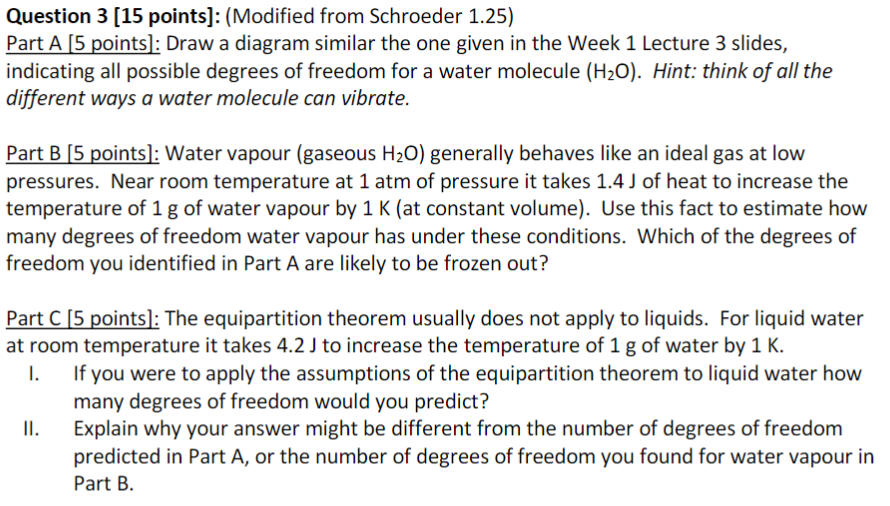
Question 3 [15 points): (Modified from Schroeder 1.25) Part A [5 points]: Draw a diagram similar the one given in the Week 1 Lecture 3 slides, indicating all possible degrees of freedom for a water molecule (H2O). Hint: think of all the different ways a water molecule can vibrate. Part B (5 points]: Water vapour (gaseous H20) generally behaves like an ideal gas at low pressures. Near room temperature at 1 atm of pressure it takes 1.4 J of heat to increase the temperature of 1 g of water vapour by 1 K (at constant volume). Use this fact to estimate how many degrees of freedom water vapour has under these conditions. Which of the degrees of freedom you identified in Part A are likely to be frozen out? Part C [5 points]: The equipartition theorem usually does not apply to liquids. For liquid water at room temperature it takes 4.2 J to increase the temperature of 1 g of water by 1 K. I. If you were to apply the assumptions of the equipartition theorem to liquid water how many degrees of freedom would you predict? II. Explain why your answer might be different from the number of degrees of freedom predicted in Part A, or the number of degrees of freedom you found for water vapour in Part B
Step by Step Solution
There are 3 Steps involved in it

Get step-by-step solutions from verified subject matter experts
 Study Help