







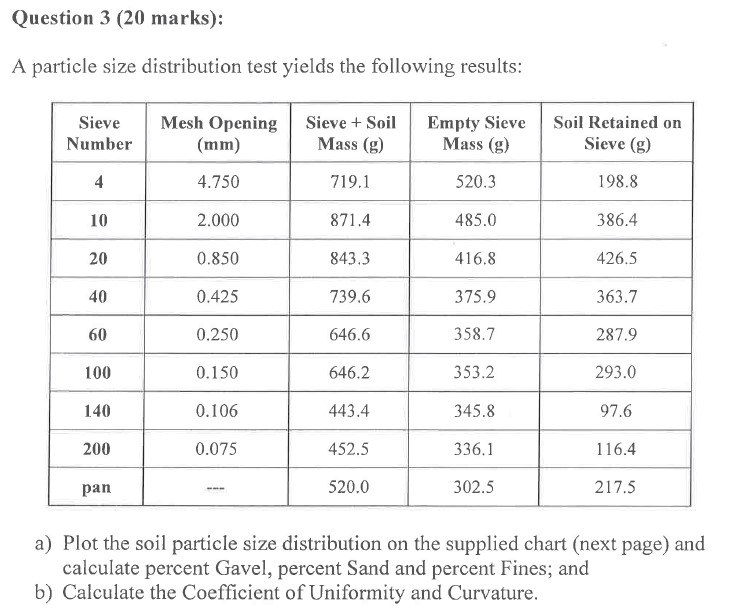
Question: Question 3 ( 2 0 marks ) : A particle size distribution test yields the following results: table [ [ table [ [
Question marks:
A particle size distribution test yields the following results:
tabletableSieveNumbertableMesh OpeningmmtableSieve SoilMass gtableEmpty SieveMass gtableSoil Retained onSieve gpan
a Plot the soil particle size distribution on the supplied chart next page and calculate percent Gavel, percent Sand and percent Fines; and
b Calculate the Coefficient of Uniformity and Curvature.
Step by Step Solution
There are 3 Steps involved in it
1 Expert Approved Answer
Step: 1 Unlock

Question Has Been Solved by an Expert!
Get step-by-step solutions from verified subject matter experts
Step: 2 Unlock
Step: 3 Unlock
 Study Help