







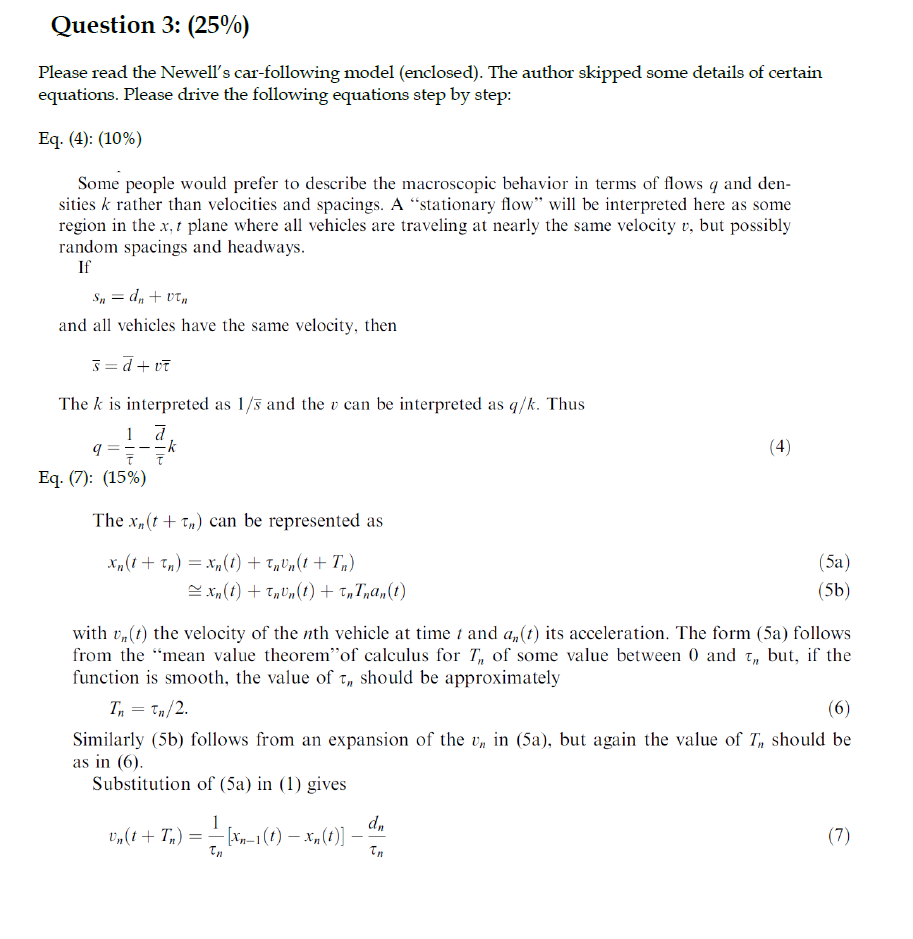
Question: Question 3 : ( 2 5 % ) Please read the Newell's car - following model ( enclosed ) . The author skipped some details
Question :
Please read the Newell's carfollowing model enclosed The author skipped some details of certain
equations. Please drive the following equations step by step:
Eq:
Some people would prefer to describe the macroscopic behavior in terms of flows and den
sities rather than velocities and spacings. A "stationary flow" will be interpreted here as some
region in the plane where all vehicles are traveling at nearly the same velocity but possibly
random spacings and headways.
If
and all vehicles have the same velocity, then
The is interpreted as bar and the can be interpreted as Thus
Eq:
The can be represented as
~
with the velocity of the th vehicle at time and its acceleration. The form a follows
from the "mean value theorem" of calculus for of some value between and but, if the
function is smooth, the value of should be approximately
Similarly b follows from an expansion of the in a but again the value of should be
as in
Substitution of a in gives
Step by Step Solution
There are 3 Steps involved in it
1 Expert Approved Answer
Step: 1 Unlock

Question Has Been Solved by an Expert!
Get step-by-step solutions from verified subject matter experts
Step: 2 Unlock
Step: 3 Unlock
 Study Help